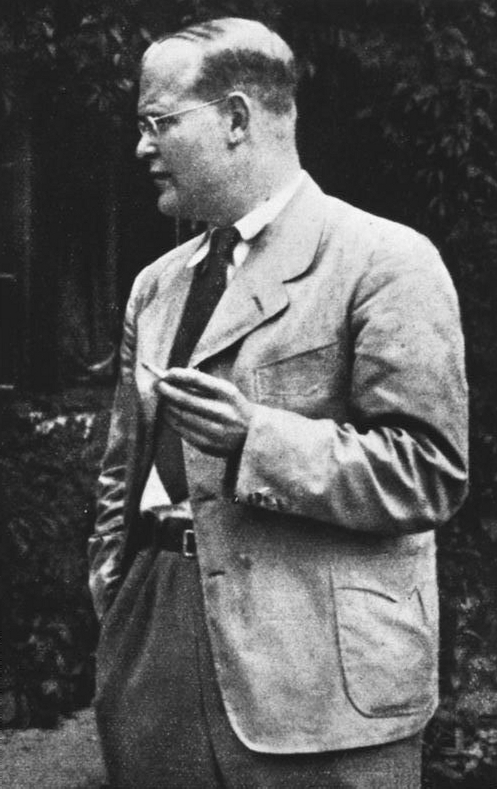
Dietrich Bonhoeffer
Dietrich Bonhoeffer was a German Lutheran pastor, neo-orthodox theologian and anti-Nazi dissident who was a key founding member of the Confessing Church. His writings on Christianity's role in the secular world have become widely influential; his 1937 book The Cost of Discipleship is described as a modern classic.
Dietrich Bonhoeffer (4 February 1906 – 9 April 1945) was a German Lutheran pastor, neo-orthodox theologian and anti-Nazi dissident who was a key founding member of the Confessing Church. His writings on Christianity's role in the secular world have become widely influential; his 1937 book The Cost of Discipleship is described as a modern classic. Apart from his theological writings, Bonhoeffer was known for his staunch resistance to the Nazi dictatorship, including vocal opposition to Nazi euthanasia program and genocidal persecution of Jews. He was arrested in April 1943 by the Gestapo and imprisoned at Tegel Prison for a year and a half. Later, he was transferred to Flossenbürg concentration camp.
Though many believe Bonhoeffer was accused of being associated with a plot to assassinate Hitler, the actual arrest and court documents show that he was arrested for his involvement in "Operation 7" – which succeeded in saving the lives of first 7 then 14 Jews. He was hanged on 9 April 1945 during the collapse of the Nazi regime.
Childhood and family
Bonhoeffer was born on 4 February 1906 in Breslau, Germany (now Wrocław, Poland), into a large family. Dietrich and his twin sister, Sabine Bonhoeffer Leibholz, were the sixth and seventh children out of eight. His father, Karl Bonhoeffer, was a psychiatrist and neurologist, noted for his criticism of Sigmund Freud; his mother, Paula Bonhoeffer, was a teacher and the granddaughter of Protestant theologian Karl von Hase and painter Stanislaus von Kalckreuth. Bonhoeffer's family dynamic and his parents' values enabled him to receive a high level of education and encouraged his curiosity, which impacted his ability to lead others around him, specifically in the church setting. He learned how to play the piano at age eight and composed songs performed at the Philharmonic at age eleven. Walter Bonhoeffer, second born of the Bonhoeffer family, was killed in action during World War I, when Bonhoeffer was twelve years old.
At age fourteen, Bonhoeffer decided to pursue his education in theology despite the criticism of his older brothers Klaus, a lawyer, and Karl-Friedrich, a scientist. He took Hebrew as an elective in school and attended many evangelical meetings, moved by the manifold suffering inflicted by war. Bonhoeffer began his studies at Tübingen and eventually moved to the University of Berlin, where he defended his dissertation, Sanctorum Communio. At age twenty-one, on 17 December 1927, he went on to complete his Doctor of Theology degree from Humboldt University of Berlin, graduating summa cum laude.
Studies in the United States
In 1930, Bonhoeffer moved to the United States with the intent of attaining a Sloane Fellowship at New York City's Union Theological Seminary. Bonhoeffer was greatly unimpressed with the theology of the United States. He described the students as lacking interest in theology and would "laugh out loud" when learning a passage from Martin Luther's Sin and Forgiveness. During his time there, he met Frank Fisher, a black seminarian who introduced him to the Abyssinian Baptist Church in Harlem, where Bonhoeffer taught Sunday school and formed a lifelong love for the African-American church. He heard Adam Clayton Powell Sr. preach the "Gospel of Social Justice" and became sensitive to the social injustices experienced by racial and ethnic minorities in the U.S., as well as the ineptitude of churches when it came to bringing about integration. He was captivated by the sermons he witnessed in black churches. The originally nationalist Bonhoeffer later changed his views after seeing All Quiet on the Western Front, which showed the horrors of war. Later in life he favored the views of pacifism, which promoted love for all people and placed a high value on each individual life. Bonhoeffer became involved with the ecumenical Christian movement, which eventually led him to resist Adolf Hitler and the Nazis.
Return to Germany
After returning to Germany in 1931, Bonhoeffer became a lecturer in systematic theology at the University of Berlin. Deeply interested in ecumenism, he was appointed by the World Alliance for Promoting International Friendship through the Churches (a forerunner of the World Council of Churches) as one of its three European youth secretaries. At this time he seems to have undergone a personal conversion, as he changed from being a theologian primarily attracted to the intellectual side of Christianity, to being a dedicated man of personal faith, resolved to literally carry out the teachings of Christ, revealed in the Gospels. On 15 November 1931, at age 25, he was ordained at Old-Prussian United St. Matthew in Berlin-Tiergarten.
Anti-Nazism
Bonhoeffer's promising academic and ecclesiastical career was derailed by the Nazi ascent to power on 30 January 1933. He was a determined opponent of the regime from its first days. Two days after Hitler was installed as chancellor, Bonhoeffer delivered a radio address in which he attacked Hitler and warned Germany against slipping into an idolatrous cult of the Führer (leader), who he argued might well turn out to be verführer ("misleader", "seducer"). His broadcast was abruptly cut off, though it is unclear whether the newly elected Nazi regime was responsible.
In November 1932, two months before the Nazi takeover, there had been an election for presbyters and synodals (church officials) of the German Landeskirche (Protestant mainstream churches). This election was marked by a struggle within the Old-Prussian Union Protestant Church between the pro-Nazi Deutsche Christen (German Christian) movement and Young Reformers, who were interested in following the Gospel teachings of Jesus—a struggle that threatened to explode into schism. In July 1933, Hitler unconstitutionally imposed new church elections. Bonhoeffer put all his efforts into the election, campaigning for the selection of independent, non-Nazi officials who were dedicated to following Christ.
Despite Bonhoeffer's efforts, in the July election an overwhelming number of key church positions went to the Deutsche Christen. The Deutsche Christen won a majority in the Old-Prussian general synod and all its provincial synods except Westphalia, and in synods of all other Protestant church bodies, except for the Lutheran churches of Bavaria, Hanover, and Württemberg. The anti-Nazi Christian opposition regarded these bodies as uncorrupted "intact churches", as opposed to the other so-called "destroyed churches".
In opposition to Nazification, Bonhoeffer urged an interdict to stop offering all pastoral ceremonial services (baptisms, confirmations, weddings, funerals, etc.), but Karl Barth and others advised against such a radical proposal. In August 1933, Bonhoeffer and Hermann Sasse were deputized by opposition church leaders to draft the "Bethel Confession," as a statement of faith in opposition to the Deutsche Christen movement. Notable for affirming God's fidelity to Jews as His chosen people, the "Bethel Confession" was eventually so watered down to make it more palatable that ultimately Bonhoeffer refused to sign it.
In September 1933, the nationalist church synod at Wittenberg voluntarily passed a resolution to apply the Aryan paragraph within the church, meaning that pastors and church officials of Jewish descent were to be removed from their posts. Regarding this as an affront to the principle of baptism, Martin Niemöller founded the Pfarrernotbund (Pastors' Emergency League). In November, a rally of twenty thousand Deutsche Christens demanded the removal of the Jewish Old Testament from the Bible, which was seen by many as heresy, further swelling the ranks of the Pastors Emergency League.
Within weeks of its founding, more than a third of German pastors had joined the Emergency League, forerunner of the Bekennende Kirche (Confessing Church), which aimed to preserve historical, biblically based Christian beliefs and practices. The Barmen Declaration, drafted by Barth in May 1934 and adopted by the Confessing Church, insisted that Christ, not the Führer, was the head of the Church. The adoption of the declaration has often been viewed as a triumph, although only about twenty percent of German pastors supported the Confessing Church.
Ministries in London
When Bonhoeffer was offered a parish post in eastern Berlin in the autumn of 1933, he refused it in protest of the Nationalist policy, and he accepted a two-year appointment as a pastor of two German-speaking Protestant churches in London: the German Lutheran Church in Dacres Road, Sydenham, and the German Reformed Church of St Paul's, Goulston Street, Whitechapel. He explained to Barth that he had found little support for his views on devotion to literally following the words of Jesus—even among friends—and that "it was about time to go for a while into the desert". Barth regarded this as running away from a real battle. He sharply rebuked Bonhoeffer: "I can only reply to all the reasons and excuses which you put forward: 'And what will now happen to the people of the German Church?'" Barth accused Bonhoeffer of abandoning his post and wasting his "splendid theological armory" while "the house of your church is on fire", and chided him to return to Berlin "by the next ship".
Bonhoeffer, however, did not go to England simply to avoid trouble at home; he hoped to put the ecumenical movement to work in the interest of the Confessing Church. He continued his involvement with the Confessing Church, running up a high telephone bill to maintain his contact with Martin Niemöller. In international gatherings, Bonhoeffer rallied people to oppose the Deutsche Christen movement and its attempt to amalgamate Nazi nationalism with Christianity. When Bishop Theodor Heckel—the official in charge of German Lutheran Church foreign affairs—traveled to London to warn Bonhoeffer to abstain from any ecumenical activity not directly authorized by Berlin, Bonhoeffer refused to abstain.
Underground seminaries
In 1935, Bonhoeffer was offered a coveted opportunity to study non-violent resistance under Mahatma Gandhi in his ashram. However, remembering Barth's rebuke, Bonhoeffer decided to return to Germany instead, where he was the head at an underground seminary in Finkenwalde for training Confessing Church pastors. As the Nazi suppression of the Confessing Church intensified, Barth was driven back to Switzerland in 1935; Niemöller was arrested in July 1937; and in August 1936, Bonhoeffer's authorization to teach at the University of Berlin was revoked after he was denounced as a "pacifist and enemy of the state" by Theodor Heckel. Bonhoeffer's efforts on behalf of the underground seminaries included securing necessary funds. He found a great benefactor in Ruth von Kleist-Retzow. In times of trouble, Bonhoeffer's former students and their wives would take refuge in von Kleist-Retzow's Pomeranian estate, and Bonhoeffer was a frequent guest. Later he fell in love with Kleist-Retzow's granddaughter, Maria von Wedemeyer, to whom he became engaged three months before his arrest in 1943. By August 1937, SS leader Heinrich Himmler had decreed the education and examination of Confessing Church ministry candidates illegal. In September 1937, the Gestapo closed the seminary at Finkenwalde, and by November twenty-seven pastors and former students were arrested. It was around this time that Bonhoeffer published his best-known book, The Cost of Discipleship, a study on the Sermon on the Mount in which he attacked "cheap grace" as a cover for ethical laxity against the virtues of "costly grace".
Bonhoeffer spent the next two years secretly traveling from one eastern German village to another to conduct a "seminary on the run," supervising the continuing education and work of his students, most of whom were working illegally in small parishes within the old-Prussian Ecclesiastical Province of Pomerania. The von Blumenthal family hosted the underground seminary on its estate of Groß Schlönwitz. The pastors of Groß Schlönwitz and neighbouring villages supported the education of young men who voluntarily housed these seminarians (among whom was Eberhard Bethge, who later became his best friend and edited Bonhoeffer's Letters and Papers from Prison) and employing them as vicars in their congregations.
In 1938, the Gestapo banned Bonhoeffer from Berlin. In the summer of 1939, the seminary was able to move to Sigurdshof, an outlying estate (Vorwerk) of the von Kleist family in Wendisch Tychow. In March 1940, the Gestapo shut down the underground seminary there following the outbreak of World War II. Bonhoeffer's semi-monastic communal life and teaching at the underground Finkenwalde seminary formed the basis of his books, The Cost of Discipleship and Life Together.
Bonhoeffer's sister Sabine, along with her Jewish-classified husband Gerhard Leibholz and their two daughters, escaped to England by way of Switzerland in 1938.
Return to the United States
In February 1938, Bonhoeffer made an initial contact with members of the German resistance when his brother-in-law Hans von Dohnányi introduced him to a group seeking Hitler's overthrow at the Abwehr, the German military intelligence service.
Bonhoeffer learned from Dohnányi that war was imminent. He was particularly troubled by the prospect of being conscripted. As a committed Christian pacifist opposed to the Nazi regime, he refused to swear an oath to Hitler, commit violence, or fight in Hitler's army, though such refusal was potentially a capital offense. He worried about consequences refusing military service could have for the Confessing Church, as it was a move that would be frowned upon by most nationalist Christians and their churches at the time.
It was at this juncture that Bonhoeffer left for the United States in June 1939 at the invitation of Union Theological Seminary in New York. After much inner turmoil, he soon regretted his decision and returned after only two weeks, despite strong pressure from his friends to remain in the United States. He wrote to Reinhold Niebuhr:
I have come to the conclusion that I made a mistake in coming to America this time. I must live through this difficult period in our national history along with the people of Germany. I will have no right to participate in the reconstruction of Christian life in Germany after the war if I do not share the trials of this time with my people ... Christians in Germany will have to face the terrible alternative of either willing the defeat of their nation in order that a future Christian civilization may survive, or else willing the victory of their nation and thereby destroying our civilization and any true Christianity. I know which of these alternatives I must choose but I cannot make that choice from a place of security.
Abwehr agent
Back in Germany, Bonhoeffer was further harassed by the Nazi authorities, as he was forbidden to speak in public and was required regularly to report his activities to the police. In 1941, he was forbidden to print or to publish anything. In the meantime, Bonhoeffer had joined the Abwehr. Dohnányi, already part of the Abwehr, brought him into the organization on the claim that his wide ecumenical contacts would be of use to Germany, thus protecting him from conscription to active service. Bonhoeffer presumably knew about various 1943 plots against Hitler through Dohnányi, who was actively involved in the planning. Bonhoeffer had advocated for nonviolent resistance and conscientious objection, and been clear in his radio addresses and in his writing.
In the face of Nazi atrocities against the Jews and other minorities, the full scale of which Bonhoeffer learned through the Abwehr, some read back into his work that he concluded that "the ultimate question for a responsible man to ask is not how he is to extricate himself from this whole affair, but how the coming generation shall continue to survive and live for Truth." He did not justify his action but wrote, "When a man takes guilt upon himself in responsibility, he imputes his guilt to himself and no one else. He answers for it... Before other men he is justified by dire necessity; before himself he is acquitted by his conscience, but before God he hopes only for grace." (In a 1932 sermon, Bonhoeffer said, "The blood of martyrs might once again be demanded, but this blood, if we really have the courage and loyalty to shed it, will not be innocent, shining like that of the first witnesses for the faith. On our blood lies heavy with guilt, the guilt of the unprofitable servant who is cast into outer darkness." Despite ways that this is quoted as supporting assassination, Bonhoeffer also advocated for conscientious objection against conscription in 1935.) The quotes in support of his participation in plots are retrospective, assuming his own involvement as his friend, Eberhard Bethge, asserted rather than the reality about which he wrote often: The seminarians he had taught were actively involved in fighting for Hitler; they had written to him about participating in atrocities such as the killing of surrendered soldiers. Historian Victoria J. Barnett supported the conclusion that Bonhoeffer endorsed the overthrow of the Nazi regime and that he understood that this would involve Hitler's assassination.
Under cover of the Abwehr, Bonhoeffer served as a courier for the German resistance movement to reveal its existence and intentions to the Western Allies in hope of garnering their support. Through his ecumenical contacts abroad, he hoped to secure possible peace terms with the Allies for a post-Hitler government. In May 1942, he met Anglican Bishop George Bell of Chichester, a member of the House of Lords and an ally of the Confessing Church, contacted by Bonhoeffer's exiled brother-in-law Leibholz; through him feelers were sent to British Foreign Secretary Anthony Eden. However, the British government ignored these, as it had all other approaches from the German resistance, considering all Germans to be the enemy. In addition, British war policy was to conduct area bombing of civilian cities, which Bell opposed, a view that had become unpopular in Britain. Dohnányi and Bonhoeffer were also involved in Abwehr operations to help German Jews escape to Switzerland – again, the actual stated reason for his arrest. During this time, Bonhoeffer worked on his book Ethics and wrote letters to keep up the spirits of his former students. He intended Ethics as his magnum opus, but it remained unfinished when he was arrested. On 5 April 1943, Bonhoeffer and Dohnányi were arrested and imprisoned. The judge in the trial was especially angry that Bonhoeffer had successfully avoided serving in the military by working for the Abwehr, something cited in the court documents.
Imprisonment
Adapted from the Wikipedia article Dietrich Bonhoeffer, available under CC BY-SA 4.0.
Connections
Influenced by
1
You might also explore
 Martin Luther King Jr.★Americas1929 – 1968Minister and civil-rights leader whose philosophy of non-violent resistance drew on Gandhi and Christian ethics.
 Karl BarththeologianModern European1886 – 1968Karl Barth was a Swiss Reformed theologian. Barth is best known for his commentary The Epistle to the Romans, his…
 Paul TillichAmericas1886 – 1965Paul Johannes Tillich was a German and American Christian existentialist philosopher, religious socialist, and Lutheran…
 A. J. AyerModern European1910 – 1989Sir Alfred Jules "Freddie" Ayer was an English philosopher who became professionally established through his exposition…
 Adam FergusonModern European1723 – 1816Adam Ferguson (Scottish Gaelic: Adhamh MacFhearghais), also known as Ferguson of Raith, was a Scottish philosopher and…
 Adam Smith★Modern European1723 – 1790Moral philosopher of sympathy and the impartial spectator, and father of economics.