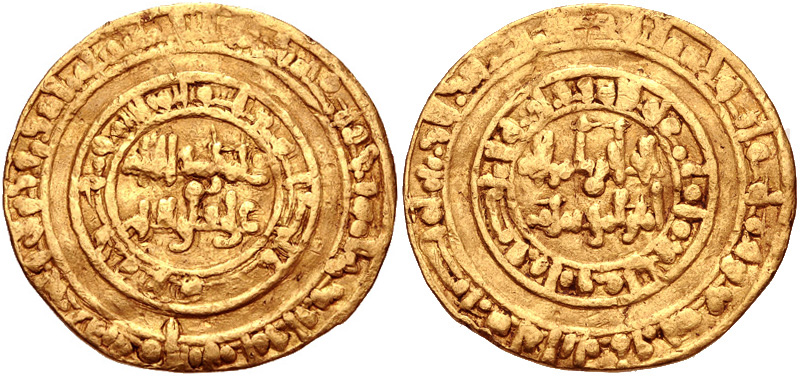
Al-Hakim bi-Amr Allah
Abu Ali al-Mansur, better known by his regnal name al-Hakim bi-Amr Allah (Arabic: الحاكم بأمر الله, romanized: al-Ḥākim bi-Amr Allāh, lit. 'The Ruler by the Order of God'), was the sixth Fatimid caliph and 16th Ismaili imam. Al-Hakim is an important figure in a number of Shia Ismaili sects, such as the world's 15 milli
Abu Ali al-Mansur (Arabic: أبو علي المنصور, romanized: Abū ʿAlī al-Manṣūr; 13 August 985 – 13 February 1021), better known by his regnal name al-Hakim bi-Amr Allah (Arabic: الحاكم بأمر الله, romanized: al-Ḥākim bi-Amr Allāh, lit. 'The Ruler by the Order of God'), was the sixth Fatimid caliph and 16th Ismaili imam (996–1021). Al-Hakim is an important figure in a number of Shia Ismaili sects, such as the world's 15 million Nizaris and 1–2 million Musta'lis, in addition to 2 million Druze.
Histories of al-Hakim can prove controversial, as conflicting views of his life and legacy exist. Historian Paul Walker writes "Ultimately, both views of him, the mad and despotic tyrant (like Germanic and Roman despots) irrationally given to killing those around him on a whim, and the ideal supreme ruler, divinely ordained and chosen, whose every action was just and righteous, were to persist, the one among his enemies and those who rebelled against him, and the other in the hearts of true believers, who, while perhaps perplexed by events, nonetheless remained avidly loyal to him to the end." Appraisals of the more controversial accounts of al-Hakim's life and rule have earned him such monikers as "the Nero of Egypt", and "the Mad Caliph".
Background and family
Born in 985 CE in Cairo, Abu 'Ali al-Mansur was the first Fatimid ruler to have been born in Egypt. Abu 'Ali al-Mansur had been proclaimed as heir-apparent (wali al-'ahd) in 993 CE and succeeded his father al-Aziz Billah (975–996) at the age of eleven, on 14 October 996, with the caliphal title of al-Hakim Bi-Amr Allah. Al-Ḥākim is reported to have had blue eyes flecked with reddish gold.
Lineage
Al-Ḥākim was born on Thursday, 3 Rabi' al-awwal in AD 985 (AH 375). His father, caliph al-'Azīz bil-Lāh, had two consorts. One was an umm al-walad who is only known by the title as-Sayyidah al-'Azīziyyah or al-'Azīzah (d. 385/995). She was a Melkite Christian whose two brothers were appointed patriarchs of the Melkite Church by Caliph al-'Azīz. Different sources say either one of her brothers or her father was sent by al-'Azīz as an ambassador to Sicily.
As-Sayyidah al-'Azīzah is considered to be the mother of Sitt al-Mulk, one of the most famous women in Islamic history, who had a stormy relationship with her half-brother al-Ḥākim and may have had him assassinated. Some, such as the Crusader chronicler William of Tyre, claimed that al-'Azīzah was also the mother of Caliph al-Ḥākim, though most historians dismiss this. William of Tyre went so far as to claim that al-Ḥākim's destruction of the Church of the Holy Sepulchre in 1009 was due to his eagerness to disprove taunts that he was a Christian born of a Christian woman. By contrast, the chronicler al-Musabbihi recounts that in 981, al-Ḥākim's Muslim mother sought the aid of an imprisoned Islamic sage named ibn al-Washa and asked him to pray for her son who had fallen ill. The sage wrote the entire Qur'an in the inner surface of a bowl and bade her wash her son out of it. When al-Ḥākim recovered, she demanded the release of the sage in gratitude. Her request was granted and the sage and his associates were freed from prison.
Druze sources claim that al-Ḥākim's mother was the daughter of 'Abdu l-Lāh, one of al-Mu'izz li-Din Allah's sons and therefore al-'Azīz's niece. Historians such as Delia Cortese are critical of this claim:[I]t is more likely that this woman was in fact a wife of al-Hakim, rather than his mother. It could be argued that the Druzes' emphasis on al-Hakim's descent from an endogamic union served the doctrinal purpose of reinforcing the charisma genealogically transmitted with the "holy family", thereby enhancing the political and doctrinal status they bestow upon al-Hakim.The only direct textual testimony towards the identity of al-Ḥākim's mother comes from the Coptic source the History of the Patriarchs of Alexandria. It states that she was a Melkite Christian concubine, and that she intervened with al-Aziz Billah to appoint her brother Arsenius as Melkite cosmopolitan of Cairo and Fustat. However, this Melkite concubine is unlikely to be the same woman as as-Sayyidah al-'Azīzah. Despite the latter's notability, there is no mention of al-Ḥākim in the chronicles' detailed report on her death in December 995, and a Melkite report from 1009 mentions the Caliph's still living mother. The text's suggestion that al-Ḥākim had a Melkite mother may have been influenced by the conflict between Egyptian Christians in that period, as the Copts could have intended to use her alleged involvement in politics to explain their own problems.
Consort and issue
The mother of al-Hakim's heir Ali al-Zahir li-I'zaz Din Allah was the umm al-walad Amīna Ruqayya, daughter to the late prince Abd Allah, son of al-Mu'izz. Some see her as the same as the woman in the prediction reported by al-Hamidi which held "that in 390/1000 al-Hakim would choose an orphan girl of good stock brought up [by?] his father al-Aziz and that she would become the mother of his successor." While the chronicler al-Maqrizi claims that al-Hakim's stepsister Sitt al-Mulk was hostile to Amīna, other sources say she gave her and her child refuge when they were fleeing al-Hakim's persecution. Some sources say al-Hakim married the jariya (young female servant) known by the title as-Sayyidah but historians are unsure if this is just another name for Amīna.
Besides al-Zahir, al-Hakim had a daughter named Sitt Misr (d. 455/1063) who was said to be a princess of generous patronage and a noble character.
Reign
In 996, al-Ḥākim's father Caliph al-'Azīz began a trip to visit Syria (which was held by the Fatimids only by force of arms and was under pressure from the Byzantines). The Caliph fell ill at the beginning of the trip at Bilbeis and lay in sickbed for several days. He suffered from "stone with pains in the bowels." When he felt that his end was nearing he charged Qadi Muhammad ibn an-Nu'man and General Abū Muhammad al-Hasan ibn 'Ammar to take care of al-Ḥākim, who was then only eleven. He then spoke to his son. Al-Ḥākim later recalled the event:
"I found him with nothing on his body but rags and bandages. I kissed him, and he pressed me to his bosom, exclaiming: "How I grieve for thee, beloved of my heart," and tears flowed from his eyes. He then said: "Go, my master, and play, for I am well." I obeyed and began to amuse myself with sports such as are usual with boys, and soon after God took him to himself. Barjawan [the treasurer] then hastened to me, and seeing me on the top of a sycamore tree, exclaimed: "Come down, my boy; may God protect you and us all." When I descended he placed on my head the turban adorned with jewels, kissed the ground before me, and said: "Hail to the Commander of the faithful, with the mercy of God and his blessing." He then led me out in that attire and showed me to all the people, who kissed the ground before me and saluted me with the title of Khalif." On the following day, he and his new court proceeded from Bilbays to Cairo, behind the camel bearing his father's body, and with the dead Caliph's feet protruding from the litter. They arrived shortly before evening prayer and his father was buried the next evening next to the tomb of his predecessor al-Mu'īzz. Al-Ḥākim was sworn in by Barjawan, a "white eunuch whom al-'Azīz had appointed as Ustad 'tutor'."
Because it had been unclear whether he would inherit his father's position, this successful transfer of power was a demonstration of the stability of the Fatimid dynasty. Al-Hakim's father had intended the eunuch Barjawan to act as regent until al-Hakim was old enough to rule by himself. Ibn 'Ammar and Qadi Muhammad ibn Nu'man were to assist in the guardianship of the new caliph.
Nevertheless, the Kutama Berbers seized the chance to recover their dominant position in the state, which had eroded under al-Aziz due to the influx of Turkish and Daylamite mercenaries from the Islamic East (the Mashāriqa, "Easterners"). They compelled the underage al-Hakim to dismiss the Christian vizier 'Īsa ibn Nestorius (who was executed shortly after) and appoint their leader Ibn Ammar to head the government, with the title of wāsiṭa ("intermediary") rather than full vizier. At the time the office of sifāra "secretary of state" was also combined within that office. Ibn 'Ammar then took the title of Amīn ad-Dawla "the one trusted in the empire". This was the first time that the term "empire" was associated with the Fatimid state. Ibn Ammar's rule quickly descended into a Berber tyranny: he immediately began staffing the government with Berbers, who engaged in a virtual pillaging of the state coffers. The Berbers' attempts to exclude the other interest groups from power—not only the Turks and the other ethnic contingents of the army, but also the civilian bureaucracy, whose salary was cut—alienated not only the Mashāriqa, but alarmed Barjawan as well. Barjawan contacted the Fatimid governor of Damascus, the Turk Manjutakin, and invited him to march onto Egypt and depose Ibn Ammar. Manjutakin accepted, but was defeated by Ibn Ammar's troops under Sulayman ibn Ja'far ibn Falah at Ascalon and taken prisoner. Barjawan however soon found a new ally, in the person of the Kutama leader Jaysh ibn Samsam, governor of Tripoli, whom Ibn Falah dismissed and replaced with his own brother. Jaysh and Barjawan gathered a following of other dissatisfied Berber leaders, and launched an uprising in Cairo in October 997. Ibn Ammar was forced to flee, and Barjawan replaced him as wāsiṭa.
Adapted from the Wikipedia article Al-Hakim bi-Amr Allah, available under CC BY-SA 4.0.
You might also explore
 Abay KunanbaiulyIslamic1845 – 1904Abai Qūnanbaiūly was a Kazakh poet, composer and Hanafi Maturidi theologian philosopher. Abai was a cultural reformer…Abd al-Latif al-BaghdadiIslamic1162 – 1231ʿAbd al-Laṭīf al-Baghdādī, short for Muwaffaq al-Dīn Abu Muḥammad ʿAbd al-Laṭīf ibn Yūsuf al-Baghdādī (Arabic: موفق…
 Abd al-Rahman al-Awza'iIslamic707 – 774Abū ʿAmr ʿAbd al-Raḥmān ibn ʿAmr al-Awzāʿī was a Sunni Muslim scholar, jurist, theologian, and the chief representative…
 Abdolkarim SoroushIslamicborn 1945Abdolkarim Soroush (عبدالكريم سروش () Persian pronunciation: [æbdolkæriːm soruːʃ]), born Hossein Haj Faraj Dabbagh, is…Abu al-Hassan al-AmirilogicianIslamic913 – 992Abu al-Hassan Muhammad ibn Yusuf al-Amiri (Persian: ابوالحسن محمد بن ابی ذر یوسف عامری نیشابوری, romanized: Abu’l-Ḥasan…
 Abu Bakr al-RaziIslamic866 – 925Abū Bakr al-Rāzī, also known as Rhazes, was a Persian Muslim physician, philosopher, alchemist, and pre-eminent medical…