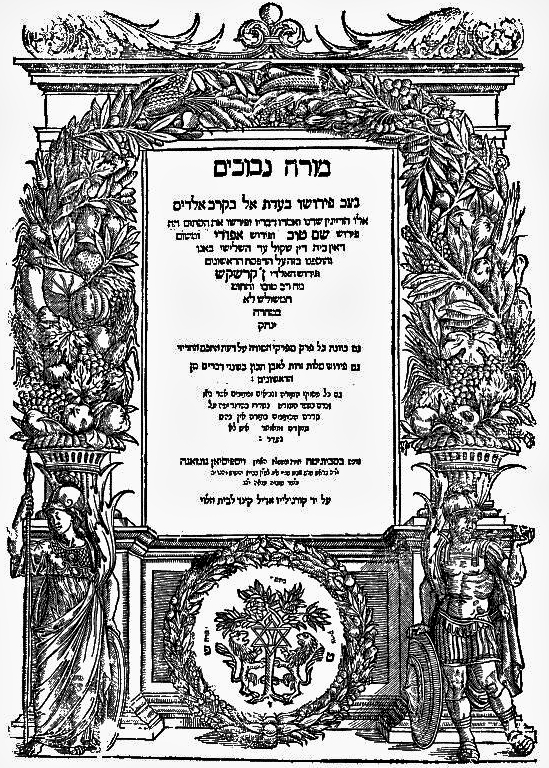
Abraham ibn Daud
Abraham ibn Daud (Judeo-Arabic: אַבְרָהָם בֶּן־דָּוִד הַלֵּוִי אִבְּן דָּאוּד, romanized: ʾAvrāhām ben-Dāvid hal-Lēvi ibn Dāʾūd; Arabic: ابراهيم بن داود, romanized: ʾIbrāhīm ibn Daʾūd) was a Spanish-Jewish astronomer, historian and philosopher born in Córdoba, Spain, in about 1110 who was said to have been killed for h
Abraham ibn Daud (Judeo-Arabic: אַבְרָהָם בֶּן־דָּוִד הַלֵּוִי אִבְּן דָּאוּד, romanized: ʾAvrāhām ben-Dāvid hal-Lēvi ibn Dāʾūd; Arabic: ابراهيم بن داود, romanized: ʾIbrāhīm ibn Daʾūd) was a Spanish-Jewish astronomer, historian and philosopher born in Córdoba, Spain, in about 1110 who was said to have been killed for his religious beliefs in Toledo, Spain, in about 1180. He is sometimes known by the abbreviation Rabad I. His maternal grandfather was Isaac Albalia. Some scholars believe he was the Arabic-into-Latin translator known as Avendauth.
Aristotelian approach
Ibn Daud was the first to introduce the phase of Jewish philosophy which is generally attributed to Maimonides and which differs from former systems of philosophy mainly in its more thorough systematic form derived from Aristotle. He is considered the first Aristotelian in medieval Jewish philosophy; his work has been given less attention than Maimonides' subsequent and widely popular work The Guide for the Perplexed. Hasdai Crescas said Ibn Daud was the only Jewish philosopher among the predecessors of Maimonides.
The only Jewish philosophical works that Ibn Daud had before him, according to his own statement, were Saadia Gaon's Emunoth ve-Deoth (אמונות ודעות, ʾĔmûnôt wĕ-Dēʿôt, Beliefs and Opinions) and The Fountain of Life (מקור חיים, Mĕqôr Ḥayyîm by Solomon ibn Gabirol. On the one hand, he fully recognized the merits of Saadia Gaon, although he did not adopt his views on the freedom of the will, notwithstanding that the solution of this problem was to be the chief aim and purpose of his whole system. On the other hand, his attitude toward ibn Gabirol was entirely antagonistic, and even in the preface to his Emunah Ramah, he pitilessly condemned ibn Gabirol's Fountain of Life. He considered Aristotle and his Arabic commentators Alfarabi and Ibn Sina to be the only true philosophers.
True philosophy, according to Ibn Daud, does not entice one from religion; it tends rather to strengthen and solidify it. Moreover, it is the duty of every Jew to become acquainted with the harmony existing between the fundamental doctrines of Judaism and those of philosophy, and, wherever they seem to contradict one another, to seek a mode of reconciling them. Ibn Daud insists that, however highly philosophy may be valued, Judaism is preferable. Knowledge, which had been acquired by philosophers through the evolution of several thousand years, and after overcoming the most serious errors, had been bestowed upon Judaism from the beginning through revelation. As to moral truths, it may be even assumed as probable that the philosophers did not attain to them through independent study, but rather under the influence of the doctrines of Holy Scripture.
Theology
As to the incorporeality of God, it follows logically from the notion of infinity which belongs to the First Cause of motion that no material thing can be infinite itself; nor can infinite force be attributed to it. But the Prime Mover is infinite; for, since it itself is without motion, its force also remains unaffected by the motion of change and transformation. Therefore, the Prime Mover—that is, God—cannot be corporeal.
But as a being of necessary existence, God must also be absolutely simple and single; inasmuch as the conception of a plurality in its essence would, at the same time, nullify the notion of the necessity of Its existence. For the consolidation of this plurality into a unity must have been effected by another being different from itself; hence the existence of this plural being would be no more necessary, that is, determined by its own essence, but would be dependent upon that other being which brought about the unification.
From the notion of absolute unity results the conception of the uniqueness of God; for if two beings of this kind could exist, the unity of God would be nullified, since to one, at least, of the units a special character must be attributed so as to distinguish it from the other. With the doctrine of the unity of God is connected the doctrine of the divine attributes, which is preceded in Abraham ibn Daud's system by the doctrine of the negative attributes, already accepted by Bahya ibn Paquda. and by Judah ha-Levi from the older Arabic theology. According to Ibn Daud, only negative attributes, in the strict and proper sense, can be imputed to God; so that, whatever multiplicity of these negative attributes may be ascribed to It, no multiplicity in the essence of God can result. Certainly this is equivalent to a renunciation of a positive conception of the Divine Being; for negative statements may suffice to prevent erroneous ideas, but a positive knowledge can never be obtained through them alone. Indeed, our whole knowledge of God is limited to two certainties, (1) that It exists and (2) that Its essence is incomprehensible. In addition to the negative attributes, only relative attributes can be predicated of God; for even these latter, however many may be assumed, since they do not apply to the essence of God but only to Its relation to the world, produce no modification in the notion of the unity of the Divine Being.
From the speculative doctrines of faith, the truth of which can be proved only by reasoning, are to be distinguished the historical dogmas whose authenticity is based principally upon divine revelation, or (more precisely) upon the historical tradition of such a revelation. The tradition concerning an event that is reported to have taken place publicly before a great body of men, which originated, so to say, under the control of public opinion, without having been disputed by contemporaries, and has descended with an uninterrupted continuity, is persuasive which cannot be controverted even by the professional logician. The trustworthiness of historical tradition forms a presumption in favour of the truth of prophecy. This trust only applies when the divine revelations apply to important public matters, but not when they relate to less important matters, or to the personal affairs of a single individual. Thus, as ibn Daud remarks (perhaps referring to the miracles attributed to Jesus), the authenticity of the Torah would be in a difficult situation if, instead of being based on historically certain miracles such as those of Moses, it were supported only by private miracles such as the resurrections by Elijah and Elisha.
Theory of prophecy
Relying upon the doctrines of Alfarabi and Avicenna, Ibn Daud (whom Maimonides follows in many ways in his conception of prophecy) further argues that the gift of prophecy must not be considered as a phenomenon, interrupting the continuity of the development of the human mind, but in a certain sense as the final stage of a natural evolution whose lower phases, though they must be distinguished from prophecy proper, are nevertheless connected with the same faculty through a certain identity of nature. And even if the true stage of prophecy is reached, this gift is, nevertheless, still capable of progressive development, although it may exceptionally at once reach the highest perfection in particularly gifted individuals.
The connection between the mind of the prophet and the higher intellects, principally with the Active Intelligence, furnishes a sufficient explanation of the higher cognitive faculty of the prophet, as well as of his power of transcending natural law. Appointed to become an intermediary between God and man, the prophet is elevated almost to the plane of the separated intelligences, or angels.
On predestination
Based upon the philosophical system developed above, and after the exposition of the doctrine of faith, the problem of human free will and its relation to faith in a divine providence, or predestination, may be regarded as much nearer its solution. The objection that faith in a divine providence is inconsistent with the existence of evil in the world, because God can not be the author of evil and good at the same time, is refuted by the fact that evil has no existence in itself, but is only the natural result of the absence of actual good, and that, consequently, evil needs no creator. The defects and imperfections which appear in this world in no way contradict the wisdom and goodness of God. The defects appear only to a finite conception which considers things separately and in themselves, and not in their connection with the whole. Viewed from a higher standpoint, the imperfections adhering to things or individuals would perhaps, in their relation to the whole, even prove to be perfections and advantages.
Human free will, as a subjective principle, has as its objective correlate the notion of possibility, by which one of two alternatives may occur. This does not limit divine omniscience in any way; unless, misled by common usage, one should designate as "possible" those things whose undetermined state results not from their own essence, but only from our deficient knowledge of the essence. But this kind of possibility, which, indeed, is no possibility at all, must be eliminated from God as quite irreconcilable with His omniscience. In its strict and precise form, the notion of possibility is not at all antagonistic to the omniscience of God; for it is easily conceivable that God from the beginning regulated creation, so that for certain cases both alternatives should be "possible" events; that the Creator, in order to grant to human liberty the opportunity to display its own energy, left the final issue of certain actions undecided even for His own knowledge.
Adapted from the Wikipedia article Abraham ibn Daud, available under CC BY-SA 4.0.
You might also explore
 Abbo of FleuryMedieval Latin945 – 1004Abbo or Abbon of Fleury, also known as Saint Abbo or Abbon, was a monk and abbot of Fleury Abbey in present-day…Abd al-Karīm ibn Hawāzin QushayrimysticMedieval Latin986 – 1072'Abd al-Karīm ibn Hawazin Abū al-Qāsim al-Qushayrī al-Naysābūrī was an Arab Muslim scholar, theologian, jurist, legal…Abner of BurgosMedieval Latin1270 – 1347Abner of Burgos was a Jewish philosopher, a convert to Christianity, and a polemical writer against his former…
 Abū ḤanīfatheologianMedieval Latin699 – 767Abu Hanifa was a Muslim scholar, jurist, theologian, and ascetic, and the founder and eponym of the Hanafi school of…Adam de WodehamMedieval Latin1298 – 1358Adam of Wodeham, OFM was a philosopher and theologian. Currently, Wodeham is best known for having been a secretary of…
 Adelard of BathMedieval Latin1075 – 1160Adelard of Bath was a 12th-century English natural philosopher. He is known both for his original works and for…