Renaissance and the new science
Humanists revived classical learning and human dignity; Machiavelli separated politics from morality; Montaigne invented the essay; Bacon championed experiment.
- 1
 Era1400 – 1600
Renaissance
Humanism revived classical learning and placed human dignity at the centre.
Read the full pageThe Renaissance (UK: rin-AY-sənss, US: REN-ə-sahnss, "rebirth") was a European period of history and cultural movement taking place at the end of the Middle Ages and the beginning of the Early modern era. It is variously defined as covering the 15th and 16th centuries or, more broadly, as lasting from the 16th century to the 17th century. It was characterized by the European rediscovery and revival of the literary, philosophical, and artistic achievements of classical antiquity. Associated with great change in art, architecture, politics, literature, exploration and technology, the Renaissance was first centered in the Republic of Florence, then spread to the rest of Italy and later throughout Europe.
The Renaissance's intellectual basis was founded in its version of humanism, derived from the concept of Roman humanitas and the rediscovery of classical Greek philosophy, such as that of Protagoras, who said that "man is the measure of all things". Although the invention of metal movable type sped the dissemination of ideas from the later 15th century, the changes of the Renaissance were not uniform across Europe: the first traces appear in Italy as early as the late 13th century, in particular with the writings of Dante and the paintings of Giotto.
As a cultural movement, the Renaissance encompassed an innovative flowering of literary Latin and an explosion of vernacular literatures, beginning with the 14th-century resurgence of learning based on classical sources, which contemporaries credited to Petrarch; the development of linear perspective and other techniques of rendering a more natural reality in painting; and gradual but widespread educational reform. It saw myriad artistic developments and contributions from such polymaths as Leonardo da Vinci and Michelangelo, who inspired the term "Renaissance man". In politics, the Renaissance contributed to the development of the customs and conventions of diplomacy. The period also saw revolutions in printing and navigation, as well as the introduction of modern banking and the field of accounting.
- 2SchoolModern European1350 – 1600
Renaissance humanism
Recovery of classical learning and celebration of human dignity and potential.
Read the full pageRenaissance humanism is a worldview centered on the nature and importance of humanity that emerged from the study of classical antiquity.
Renaissance humanists sought to create a citizenry able to speak and write with eloquence and clarity, and thus capable of engaging in the civic life of their communities and persuading others to virtuous and prudent actions. Humanism, while set up by a small elite who had access to books and education, was intended as a cultural movement to influence all of society. It was a program to revive the cultural heritage, literary legacy, and moral philosophy of the Greco-Roman civilization.
It first began in Italy and then spread across Western Europe in the 14th, 15th, and 16th centuries. During the period, the term humanist (Italian: umanista) referred to teachers and students of the humanities, known as the studia humanitatis, which included the study of Latin and Greek literatures, grammar, rhetoric, history, poetry, and moral philosophy. It was not until the 19th century that this began to be called humanism instead of the original humanities, and later by the retronym Renaissance humanism to distinguish it from later humanist developments.
- 3
 PhilosopherModern European1466 – 1536
Erasmus
Prince of the humanists, satirist of folly and advocate of tolerance.
- ◆ad fontes
- ◆Erasmian pronunciation
- ◆just war theory
- ◆accommodation
- ◆Lectio difficilior potior
Read the full pageDesiderius Erasmus Roterodamus ( DEZ-i-DEER-ee-əs irr-AZ-məs; Dutch: [ˌdeːziˈdeːrijʏs eːˈrɑsmʏs]; 28 October c. 1466 – 12 July 1536), commonly known in English as Erasmus of Rotterdam or simply Erasmus, was a Dutch humanist, theologian, and philosopher. He was, through his writings and translations, one of the most influential scholars of the Northern Renaissance and a major figure of Western culture.
Erasmus was an important figure in Renaissance classical scholarship who wrote in a spontaneous, copious and correct but natural Latin style. As a Catholic priest developing humanist techniques for working on texts, he prepared pioneering new Latin and Greek scholarly editions of the New Testament and of the Church Fathers, with annotations and commentary that were immediately and vitally influential in both the Protestant Reformation and the Catholic Reformation. He also wrote On Free Will, The Praise of Folly, The Complaint of Peace, Handbook of a Christian Knight, On Civility in Children, Copia: Foundations of the Abundant Style and many other academic, popular and pedagogical works.
Erasmus lived against the backdrop of the growing European religious reformations and relocated regularly. He influenced a large circle of friends, scholars and correspondents including kings and popes. He developed a biblical humanistic theology in which he advocated the religious and civil necessity both of peaceable concord and of pastoral tolerance on matters of indifference. He remained a member of the Catholic Church all his life, remaining committed to reforming the church from within, but faced dangerous pushback from some university theologians. He promoted what he understood as the traditional doctrine of synergism, which some prominent reformers such as Martin Luther and John Calvin rejected in favour of the doctrine of monergism. His influential middle-road approach disappointed, and even angered, partisans in both camps.
- 4
 PhilosopherModern European1469 – 1527
Niccolò Machiavelli
Florentine diplomat whose The Prince separated politics from conventional morality.
- ◆virtù
- ◆modern republicanism
Read the full pageNiccolò di Bernardo dei Machiavelli (3 May 1469 – 21 June 1527) was a Florentine diplomat, author, philosopher, and historian who lived during the Italian Renaissance. He is best known for his political treatise The Prince (Il Principe), written around 1513 but not published until 1532, five years after his death. He has often been called the father of modern political philosophy and political science.
For many years he served as a senior official in the Florentine Republic with responsibilities in diplomatic and military affairs. He worked as secretary to the second chancery of the Republic of Florence from 1498 to 1512, when the Medici were out of power. He was expelled from his duties as a diplomat when the Medici retook power in Florence in 1512, and soon thereafter would be mistakenly suspected of treason, and sent into exile. A year later, he took up the life of a political writer.
After his death Machiavelli's name came to evoke unscrupulous acts of the sort he recommended in his most famous work, The Prince. In the treatise, Machiavelli stated that rulers will have to take on unsavory policies in the furtherance of their political society, in contradiction to classical political thought. He advised rulers to engage in evil when political necessity requires it, for example, stating that successful founders and reformers of governments should be excused for killing their political enemies. Machiavelli's Prince has been surrounded by controversy since it was published, with many commentators viewing The Prince as a manual that aims to teach would-be tyrants how they should seize authority and establish an absolute regime. Even into recent times, scholars such as Leo Strauss have restated the traditional opinion that Machiavelli was a "teacher of evil".
- 5
 WorkModern European1513
The Prince
Machiavelli's handbook of power: it is safer to be feared than loved.
Read the full pageThe Prince (Italian: Il Principe [il ˈprintʃipe]; Latin: De Principatibus) is a 16th-century political treatise written by the Italian diplomat and political philosopher Niccolò Machiavelli in the form of an instruction guide for new princes. Many commentators have viewed that one of the main themes of The Prince is that immoral acts are sometimes necessary to achieve political glory.
From Machiavelli's correspondence, a version was being written in 1513, using a Latin title, De Principatibus (Of Principalities). However, the printed version was not published until 1532, five years after Machiavelli's death. This was carried out with the permission of the Medici pope Clement VII, but "long before then, in fact since the first appearance of The Prince in manuscript, controversy had swirled about his writings".
Although The Prince was written as if it were a traditional work in the mirrors for princes style, it was generally agreed as being especially innovative. This is because Machiavelli appears to distance his book from all of the classical works of political philosophy, as he viewed that they were too concerned with the ideal regime. Machiavelli illustrates his reasoning using remarkable comparisons of classical, biblical, and medieval events, including many positive references to the murderous career of Cesare Borgia, which occurred during Machiavelli's own diplomatic career.
- 6
 PhilosopherModern European1533 – 1592
Michel de Montaigne
Inventor of the essay, whose skeptical motto was "What do I know?"
- ◆Common herd
- ◆Essay
- ◆Charles Cotton
Read the full pageMichel Eyquem, Seigneur de Montaigne (28 February 1533 – 13 September 1592), commonly known as just Michel de Montaigne, was one of the most significant writers of the French Renaissance. He is known for popularising the essay as a literary genre. His work is noted for its merging of casual anecdotes and autobiography with intellectual insight. Montaigne had a direct influence on numerous writers of Western literature; his Essais contain some of the most influential essays ever written.
During his lifetime, Montaigne was admired as a statesman more than as an author. The tendency in his essays to digress into anecdotes and personal ruminations was seen as detrimental to proper style, rather than as an innovation; moreover, his declaration that "I am myself the matter of my book" was viewed by his contemporaries as self-indulgent. In time, however, Montaigne came to be recognised as embodying the spirit of critical thought and open inquiry that began to emerge around that time. He is best known for his sceptical remark, "What do I know?" ("Que sçay-je?" in Middle French; "Que sais-je?" in modern French).
Montaigne was born in the Guyenne (Aquitaine) region of France, on the family estate Château de Montaigne in a town now called Saint-Michel-de-Montaigne, near Bordeaux. The family was very wealthy. His great-grandfather Ramon Felipe Eyquem had made a fortune as a herring merchant and had bought the estate in 1477, thereby becoming the Lord of Montaigne. His father, Pierre Eyquem, Seigneur of Montaigne, was the mayor of Bordeaux and later a French Catholic soldier in Italy for a time.
- 7
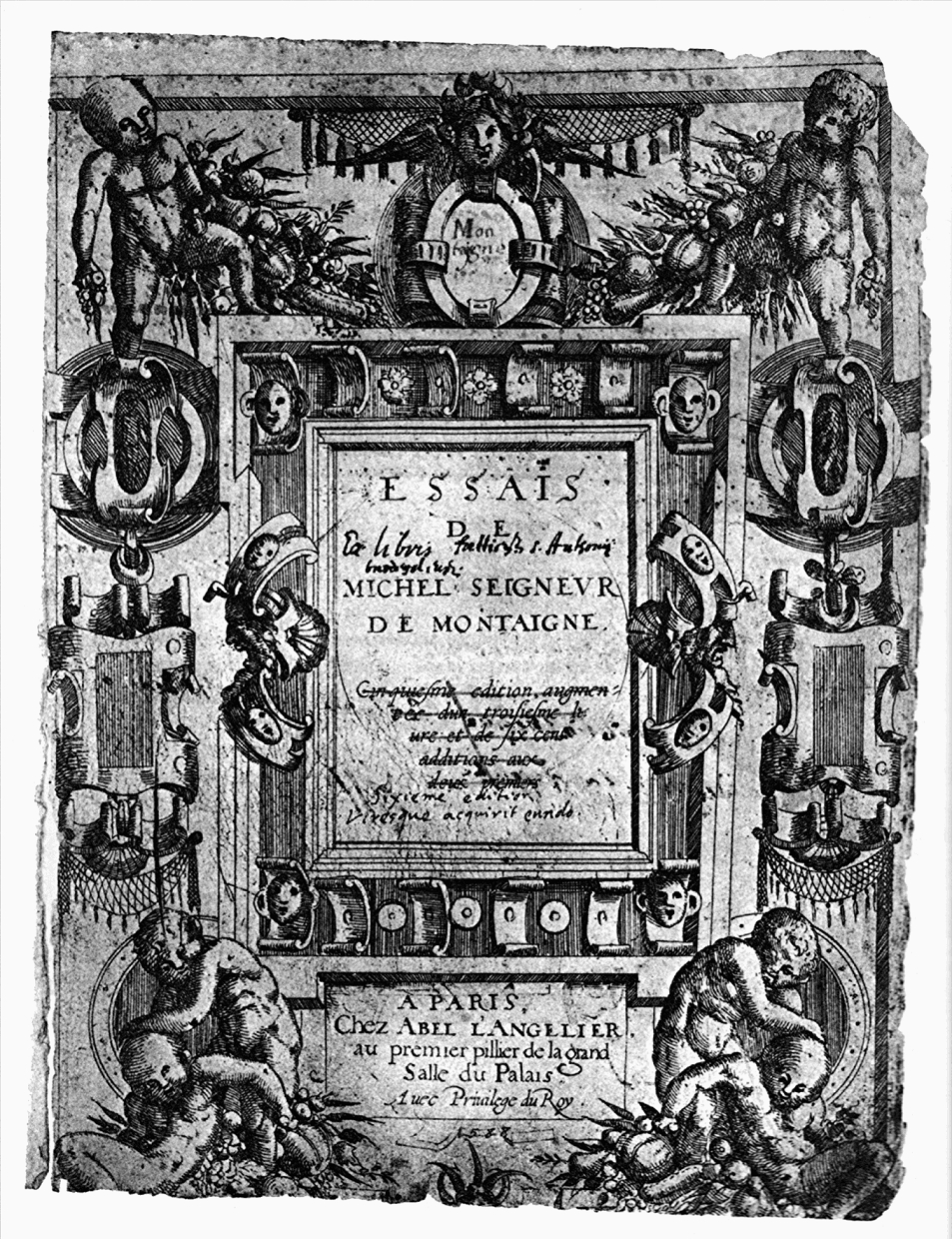 WorkModern European1580
Essays
Montaigne's exploration of himself and the human condition — the birth of the essay.
Read the full pageThe Essays of Michel de Montaigne are contained in three books and 107 chapters of varying length. They were originally written in Middle French and published in the Kingdom of France. Montaigne's stated design in writing, publishing and revising the Essays over the period from approximately 1570 to 1592 was to record "some traits of my character and of my humours." The Essays were first published in 1580 and cover a wide range of topics.
The Essais exercised an important influence on both French and English literature, in thought and style.
Montaigne wrote in a seemingly conversational or informal style that combines a highly literate vocabulary with popular sayings and local slang. The earlier essays are more formal and structured and sometimes quite short ("Of prognostications"), but later essays, and revisions to the essays in later editions, are longer and more complex. In his later style he freely associates one topic with another in the manner of a searching inquiry into an issue from different points of view. His thoughts are often supported with quotations from Ancient Greek, Latin, and Italian texts such as De rerum natura by Lucretius and the works of Plutarch. Furthermore, his Essays were seen as an important contribution to both writing form and skepticism. The name itself comes from the French word essais, meaning "attempts" or "tests", which shows how this new form of writing did not aim to educate or prove. Rather, his essays examine an enormous range of topics to reflect on the diversity of received opinions, the fallibility of human knowledge and the folly of certitude.
- 8
 PhilosopherModern European1561 – 1626
Francis Bacon
Champion of the experimental method and critic of the "idols" that distort the mind.
Read the full pageFrancis Bacon, 1st Viscount St Alban (; 22 January 1561 – 9 April 1626) was an English philosopher and statesman who served as Attorney General and Lord Chancellor of England under King James I. Bacon argued for the importance of natural philosophy, guided by the scientific method, and his works remained influential throughout the Scientific Revolution.
Bacon has been called the father of empiricism. He argued for the possibility of scientific knowledge based only upon inductive reasoning and careful observation of events in nature. He believed that science could be achieved by the use of a sceptical and methodical approach whereby scientists aim to avoid misleading themselves. Although his most specific proposals about such a method, the Baconian method, did not have long-lasting influence, the general idea of the importance and possibility of a sceptical methodology makes Bacon one of the founders of the scientific method. His portion of the method based in scepticism was a new rhetorical and theoretical framework for science, whose practical details are still central to debates on science and methodology. He is famous for his role in the scientific revolution, promoting scientific experimentation as a way of glorifying God and fulfilling scripture.
Bacon was a patron of libraries and developed a system for cataloguing books under three categories – history, poetry, and philosophy – which could further be divided into specific subjects and subheadings. Regarding books, he wrote: "Some books are to be tasted; others swallowed; and some few to be chewed and digested." The Baconian theory of Shakespeare authorship, a fringe theory which was first proposed in the mid-19th century, contends that Bacon wrote at least some and possibly all of the plays conventionally attributed to William Shakespeare.
