Hegel, Marx and the philosophy of history
Hegel saw history as Spirit coming to know itself through dialectic. Marx turned Hegel "on his feet": material conditions and class struggle drive history, and capitalism alienates us.
- 1
 SchoolModern European1790 – 1850
German idealism
Fichte, Schelling and Hegel: reality as the self-unfolding of spirit or reason.
Read the full pageGerman idealism (German: Deutscher Idealismus) was a philosophical movement that emerged in Germany in the late 18th and early 19th centuries. It developed out of the work of Immanuel Kant in the 1780s and 1790s, and was closely linked with both Romanticism and the revolutionary politics of the Enlightenment. The most prominent German idealists were Kant, Johann Gottlieb Fichte, Friedrich Wilhelm Joseph Schelling, and Georg Wilhelm Friedrich Hegel, who is considered the most influential figure of the movement. Other thinkers, such as Friedrich Heinrich Jacobi, Karl Leonhard Reinhold, Friedrich Schlegel, and Novalis, also made major contributions. The period of German idealism is considered one of the most intellectually fertile in modern philosophy, with some comparing its prominence to that of the golden age of philosophy in ancient Athens.
The movement is best understood as a manifestation of the modern demand for rationality and freedom. It originated in Kant's attempt to reconcile the empiricism of thinkers like David Hume with the rationalism of Gottfried Wilhelm Leibniz and Baruch Spinoza. Hume's skepticism had challenged the core tenets of the Enlightenment, arguing that reason was subordinate to custom and habit and that free will was an "unattainable fantasy". All forms of German idealism sought to resolve the crisis of the Enlightenment by attempting to "save criticism from skepticism, and naturalism from materialism". Kant's transcendental idealism asserted that the mind is not a passive recipient of sensory information, but actively structures our experience of the world through an act of "spontaneity". His work, however, limited knowledge to appearances (phenomena) and left the nature of things as they are in themselves (noumena) unknowable.
Fichte, Schelling, and Hegel attempted to overcome this dualism while defending Kant's central insight that the thinking subject is a necessary condition for all experience. They responded to renewed skeptical challenges by pursuing a more rigorously systematic philosophy than Kant, with their characteristic ambition becoming the creation of a complete, systematic philosophy derived from a single foundational principle. Fichte's Wissenschaftslehre centered on the absolute "I" or self-consciousness as the ground of all experience. Schelling's "identity philosophy" replaced Fichte's absolute subject with a monistic "Absolute" as the ground of both nature and mind. Hegel's absolute idealism rejected the foundationalism of his predecessors, arguing that philosophy must be a presuppositionless system that traces the self-development of "the concept" to reveal the rational structure of actuality itself.
- 2
 PhilosopherModern European1770 – 1831
G. W. F. Hegel
Systematic idealist for whom history is the dialectical self-realisation of Spirit and freedom.
- ◆Dialectic
- ◆Absolute Spirit
- ◆The master–slave dialectic
- ◆The real is rational
Read the full pageGeorg Wilhelm Friedrich Hegel (27 August 1770 – 14 November 1831) was a German philosopher and a major figure in the tradition of German idealism. His influence on Western philosophy extends across a wide range of topics—from metaphysical issues in epistemology and ontology, to political philosophy, to philosophy of art and philosophy of religion.
Hegel was born in Stuttgart. His life spanned the transitional period between the Enlightenment and the Romantic movement. His thought was shaped by the French Revolution and the Napoleonic Wars, events which he interpreted from a philosophical perspective. His academic career culminated in his appointment to the chair of philosophy at the University of Berlin, where he remained a prominent intellectual figure until his death.
Throughout his work, Hegel strove to correct what he argued were untenable dualisms common in modern philosophy. His principal achievement was the development of a comprehensive philosophical system, often termed absolute idealism, to account for reality as a unified whole. Central to this system is the concept of "spirit" (Geist), which Hegel presented as humankind coming to know itself through a historical process of rational development. Hegel's characteristic procedure, often termed dialectical or speculative, assesses concepts and forms of consciousness according to their own internal criteria, revealing their contradictions and one-sidedness. This leads to their resolution in a higher, more comprehensive unity, which both cancels and preserves the initial stage. His major works, including the Phenomenology of Spirit (1807) and the Science of Logic (1812–1816), detail this systematic vision. In his political philosophy, he famously asserted that "world history is progress in the consciousness of freedom".
- 3Concept
Dialectic
Reasoning through opposition: from Socratic dialogue to Hegel's movement of contradiction and resolution.
Read the full pageDialectic or dialectics, also known as the dialectical method, is a method of reasoning and philosophical argument that emphasizes the progression of thought through a process of resolving contradictions. The term, rooted in the Ancient Greek dialegesthai ('to converse'), was popularized by Plato's Socratic dialogues, which presented dialectic as a discourse between two or more people holding different points of view about a subject but wishing to establish the truth through reasoned argumentation. In modern philosophy, dialectic has evolved into a distinct practice, often a systematic method of reasoning which seeks to establish a comprehensive framework for understanding development, change, and the interconnectedness of reality.
Throughout its history, the concept of dialectic has undergone significant transformations. In antiquity, it was developed as a form of "objective dialectic" by pre-Socratic philosophers like Heraclitus, who focused on the cosmic principles of change and the unity of opposites. This was followed by a "subjective dialectic" pioneered by the Sophists and Socrates, which shifted the focus to human consciousness and the art of argumentation. Plato elevated dialectic to the supreme method of philosophical inquiry, viewing it as the path to understanding the transcendent Forms. His student, Aristotle, redefined it as a method for critically examining reputable opinions (endoxa).
In the modern era, particularly within German idealism, dialectic was revived and systematized. Immanuel Kant conceptualized it as a "logic of illusion", identifying the inherent contradictions (antinomies) that arise when human reason ventures beyond the limits of possible experience. Building on Kant's work and the contributions of Romantic thinkers like Friedrich Wilhelm Joseph Schelling, Georg Wilhelm Friedrich Hegel developed a system of dialecticals, seeing contradiction not as a flaw but as the driving force of all movement and development. For Hegel, dialectic is both a method of argument and an ontology—the immanent process through which Spirit (Geist) unfolds and achieves self-consciousness.
- 4
 WorkModern European1807
Phenomenology of Spirit
Hegel's journey of consciousness to absolute knowing, including the master–slave dialectic.
Read the full pageThe Phenomenology of Spirit (German: Phänomenologie des Geistes) is an 1807 book by the German philosopher Georg Wilhelm Friedrich Hegel. It is Hegel's first major work and is considered one of the most important and difficult works of German idealism. The book describes a "biography of Spirit" in which consciousness develops from its most basic forms of sensory experience to the highest form of self-knowledge, which Hegel terms "absolute knowing". The book's central argument is that human beings achieve freedom through a process of retrospective self-understanding.
Originally intended as the introduction to Hegel's larger philosophical system, the Phenomenology grew into a substantial work in its own right. Its central purpose is to serve as a "ladder" that guides the reader from the standpoint of "natural consciousness" to the standpoint of philosophical science. In its extensive Preface, Hegel critiques prior philosophical methods—such as mathematical formalism and romantic intuitionism—arguing that truth is not a static proposition but a dynamic, self-developing whole. The book follows a dialectical method, tracing the journey of consciousness through a series of stages or "shapes of consciousness". Each stage is examined through a process of immanent critique, whereby consciousness discovers internal contradictions in its own view of the world, compelling it to move to a new, more sophisticated stage that attempts to resolve these contradictions. The narrative progresses through stages identified as Consciousness, Self-Consciousness, Reason, Spirit, Religion, and finally, Absolute Knowing.
The book was written during a period of historical upheaval, and its composition was famously concluded as Napoleon's army entered the city of Jena in 1806. It contains Hegel's first major public break with his former mentor Friedrich Wilhelm Joseph Schelling and establishes his own distinctive philosophical position. Key themes explored in the work include the dialectical relationship between the universal and the individual, the concept of recognition (Anerkennung), lordship and bondage, and alienation (Entfremdung).
- 5
 PhilosopherModern European1788 – 1860
Arthur Schopenhauer
Pessimist who saw the world as blind Will and found relief in art, compassion and Indian philosophy.
- ◆Animal ethics
- ◆Anthropic principle
- ◆Criticism of religion
- ◆German idealism
- ◆The World as Will and Representation
- ◆Fourfold root of the principle of sufficient reason
Read the full pageArthur Schopenhauer (22 February 1788 – 21 September 1860), also known as the "Philosopher of Pessimism", was a German philosopher and writer. He is known for his 1818 work The World as Will and Representation (expanded in 1844), which characterizes the phenomenal world as the manifestation of a blind and irrational noumenal will. Building on the transcendental idealism of Immanuel Kant, Schopenhauer developed an atheistic, metaphysical and ethical system that rejected the contemporaneous ideas of German idealism.
Schopenhauer was among the first philosophers in the Western tradition to share and affirm significant tenets of Indian philosophy, such as asceticism, denial of the self, and the notion of the world-as-appearance. His work has been described as an exemplary manifestation of philosophical pessimism. Though his work failed to garner substantial attention during his lifetime, he had a posthumous impact across various disciplines, including philosophy, literature, and science. His writing on aesthetics, morality, and psychology has influenced many thinkers and artists.
Arthur Schopenhauer was born on 22 February 1788, in Danzig (then part of the Polish–Lithuanian Commonwealth; present-day Gdańsk, Poland) on Heiliggeistgasse (present-day Św. Ducha 47), the son of Heinrich Floris Schopenhauer and his wife Johanna Schopenhauer (née Trosiener), both descendants of wealthy German patrician families. While they both came from Protestant backgrounds, they were not very religious; they supported the French Revolution and were republicans, cosmopolitans, and Anglophiles. When Danzig became part of Prussia in 1793, Heinrich moved to Hamburg—a free city with a republican constitution. His firm continued trading in Danzig, where most of their extended families remained. Adele, Arthur's only sibling, was born on 12 July 1797.
- 6
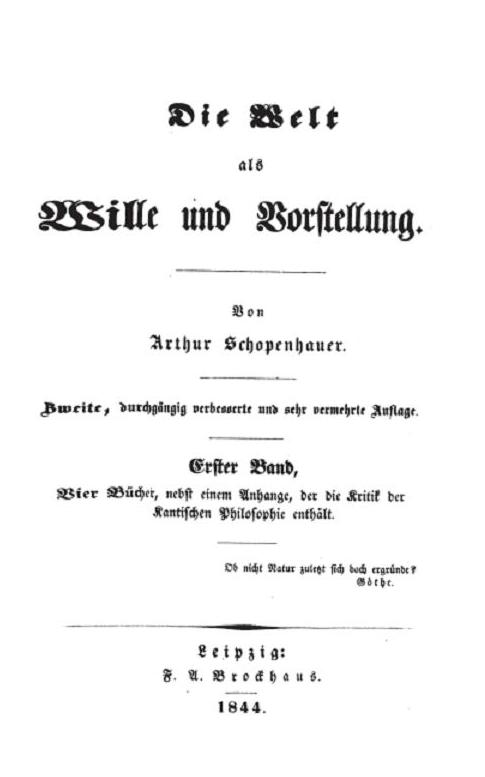 WorkModern European1818
The World as Will and Representation
Schopenhauer's pessimistic metaphysics of the Will.
Read the full pageThe World as Will and Representation (WWR; German: Die Welt als Wille und Vorstellung), sometimes translated as The World as Will and Idea, is the central work of the German philosopher Arthur Schopenhauer. The first edition was published in late 1818, with the date 1819 on the title page. A second, two-volume edition appeared in 1844: volume one was an edited version of the 1818 edition, while volume two consisted of commentary on the ideas expounded in volume one. A third expanded edition was published in 1859, the year before Schopenhauer's death. In 1948, an abridged version was edited by Thomas Mann.
In the summer of 1813, Schopenhauer submitted his doctoral dissertation—On the Fourfold Root of the Principle of Sufficient Reason—and was awarded a doctorate from the University of Jena. After spending the following winter in Weimar, he lived in Dresden and published his treatise On Vision and Colours in 1816. Schopenhauer spent the next several years working on his chief work, The World as Will and Representation. Schopenhauer asserted that the work is meant to convey a "single thought" from various perspectives. He develops his philosophy over four books covering epistemology, ontology, aesthetics, and ethics. Following these books is an appendix containing Schopenhauer's detailed Criticism of the Kantian Philosophy.
Taking the transcendental idealism of Immanuel Kant as his starting point, Schopenhauer argues that the world humans experience around them—the world of objects in space and time and related in causal ways—exists solely as "representation" (Vorstellung) dependent on a cognizing subject, not as a world that can be considered to exist in itself (i.e., independently of how it appears to the subject's mind). One's knowledge of objects is thus knowledge of mere phenomena rather than things in themselves. Schopenhauer identifies the thing-in-itself — the inner essence of everything — as will: a blind, unconscious, aimless striving devoid of knowledge, outside of space and time, and free of all multiplicity. The world as representation is, therefore, the "objectification" of the will. Aesthetic experiences release one briefly from one’s endless servitude to the will, which is the root of suffering. True redemption from life, Schopenhauer asserts, can only result from the total ascetic negation of the "will to life". Schopenhauer notes fundamental agreements between his philosophy, Platonism, and the philosophy of the ancient Indian Vedas.
- 7
 PhilosopherModern European1818 – 1883
Karl Marx
Philosopher of history and critic of capitalism: "philosophers have only interpreted the world; the point is to change it".
- ◆Historical materialism
- ◆Class struggle
- ◆Alienation of labour
- ◆Surplus value
Read the full pageKarl Marx (German: [ˈkaʁl ˈmaʁks]; 5 May 1818 – 14 March 1883) was a German philosopher, social and political theorist, journalist, and revolutionary socialist. He developed the theory of historical materialism to analyse societal development, focusing on class struggle under capitalism and predicting the system's ultimate replacement by communism. Marx co-authored The Communist Manifesto (1848) with Friedrich Engels, and undertook a critique of political economy in his magnum opus, Das Kapital (1867–1894). His ideas and their later development, collectively known as Marxism, have had enormous influence on intellectual, political, and social history, and have inspired revolutionary movements in many countries.
Born in Trier in the Kingdom of Prussia, Marx earned a doctoral degree in philosophy from the University of Jena in 1841. He became involved in radical journalism and was influenced by the philosophy of Georg Wilhelm Friedrich Hegel and the Young Hegelians, whose ideas he critiqued in works such as The German Ideology. In Paris, Marx wrote his Economic and Philosophic Manuscripts of 1844 and began a close collaboration with Engels. After moving to Brussels, they were active in the Communist League, and in 1848 wrote The Communist Manifesto, which lays out a programme for revolution. Expelled from Germany after the Revolutions of 1848, Marx moved to London, where he wrote his Grundrisse notebooks and the three volumes of Das Kapital. He became a leading figure in the International Workingmen's Association (First International), in which he battled the influence of anarchists led by Mikhail Bakunin and celebrated the Paris Commune of 1871. In his late studies and his Critique of the Gotha Programme (1875), Marx theorized on the transition to a communist society. He died in 1883 and was buried in Highgate Cemetery.
Marx's critiques of history, society and political economy hold that human societies develop through class conflict. In the capitalist mode of production, this manifests itself in the conflict between the bourgeoisie, the ruling class that controls the means of production, and the proletariat, the working class that enables these means by selling their labour power for wages. Employing his dialectical approach, Marx observed that capital accumulation produced internal contradictions like previous socioeconomic systems, and predicted that these tensions would lead to its self-destruction. For Marx, the exploitative, alienating, and crisis-prone nature of capitalism would eventuate the working class's development of class consciousness, leading to their conquest of political power and establishment of a classless, stateless, moneyless society constituted by a free association of producers. Marx actively pressed for its realisation, advocating for organised proletarian revolutionary action to achieve human emancipation from economic and social domination.
- 8SchoolModern European1848 – present
Marxism
History is driven by material and economic forces and class struggle; capitalism will give way to communism.
- ◆Historical materialism
- ◆Class struggle
- ◆Alienation
- ◆Critique of capitalism
Read the full pageMarxism is a political philosophy and method of socioeconomic analysis that uses a materialist interpretation of historical development, known as historical materialism, to understand class relations and social conflict. Originating in the works of 19th-century German philosophers Karl Marx and Friedrich Engels, the Marxist approach views class struggle as the central driving force of historical change.
Marxist analysis views a society's economic mode of production as the foundation of its social, political, and intellectual life, a concept known as the base and superstructure model. In its critique of capitalism, Marxism posits that the capitalist ruling class (the bourgeoisie), who own the means of production, systematically exploit the working class (the proletariat), who must sell their labour power to survive. This relationship, according to Marx, leads to alienation among people, periodic economic crises, and escalating class conflict. Marx theorised that these internal contradictions would fuel workers' revolutions, leading to the overthrow of capitalism and the establishment of a socialist mode of production. For Marxists, this transition represents a necessary step towards a classless, stateless and moneyless society.
Since Marx's death, his ideas have been elaborated and adapted by numerous thinkers and political movements, resulting in a wide array of schools of thought. The most prominent of these in the 20th century was Marxism–Leninism, which was developed after Vladimir Lenin's death and served as the official ideology of the Soviet Union and other Marxist states.
- 9
 ConceptModern European
Alienation
Under capitalism, workers are estranged from their labour, its products, each other and their own nature.
Read the full pageMarx's theory of alienation describes the estrangement of people from aspects of their essential human nature as a consequence of living in a society structured by private property and wage labour. Developed by the German philosopher Karl Marx and first articulated in his Economic and Philosophic Manuscripts of 1844, the theory is a foundational concept of Marxism. At its core, it posits that under the capitalist mode of production, workers are inevitably separated from the products they create, the activity of production, their fellow human beings, and their own creative potential.
The theory has roots in a long intellectual tradition, particularly in the work of the German idealist philosopher Georg Wilhelm Friedrich Hegel. For Hegel, alienation was a necessary stage in the development of Spirit (Geist), in which it externalises itself in the material world to achieve self-awareness. Marx adapted Hegel's dialectical framework but rejected its idealism, grounding the concept in material reality. Influenced by Ludwig Feuerbach's critique of religious alienation, Marx argued that alienation was not an abstract philosophical condition but a concrete, historical consequence of the capitalist system that could be overcome.
In his analysis, Marx identified four key aspects of alienated labour. First, the worker is alienated from the product of their labour, which is appropriated by the capitalist and confronts the worker as a hostile power. Second, they are alienated from the activity of production itself, which is experienced not as a fulfilling expression of creativity but as coerced, meaningless toil. Third, this leads to alienation from their own human nature, or species-being (Gattungswesen), as free, conscious activity is reduced to a mere means of survival. Finally, the worker is alienated from other people, as social relationships become reified and mediated by market exchange, fostering competition and indifference rather than community.
- 10
 WorkModern European1848
The Communist Manifesto
"The history of all hitherto existing society is the history of class struggles."
Read the full pageThe Communist Manifesto, originally the Manifesto of the Communist Party, is a political pamphlet written by Karl Marx and Friedrich Engels. It was commissioned by the Communist League and published in London in 1848. The text represents the first and most systematic attempt by the two founders of scientific socialism to codify for wide consumption the historical materialist idea; namely, that "the history of all hitherto existing society is the history of class struggles", in which social classes are defined by the relationship of people to the means of production. Published amid the Revolutions of 1848 in Europe, the manifesto has become one of the world's most influential political documents. "A spectre is haunting Europe — the spectre of communism." and "Workers of the world, unite!" stand as two iconic lines that frame the text, marking its opening and its close, respectively, with the latter being reworked and popularized into a famous slogan of working-class solidarity.
In the Manifesto, Marx and Engels combine philosophical materialism with the Hegelian dialectical method in order to analyze the development of European society through its modes of production, including primitive communism, antiquity, feudalism, and capitalism, noting the emergence of a new, dominant class at each stage. The text outlines the relationship between the means of production, relations of production, forces of production, and mode of production, and posits that changes in society's economic "base" affect changes in its "superstructure". The authors assert that capitalism is marked by the exploitation of the proletariat (working class or wage labourers) by the ruling bourgeoisie, which is "constantly revolutionising the instruments [and] relations of production, and with them the whole relations of society". They argue that capital's need for a flexible labour force dissolves the old relations, and that its global expansion in search of new markets creates "a world after its own image".
The Manifesto concludes that capitalism does not offer humanity the possibility of self-realization, instead ensuring that human beings are perpetually stunted and alienated. It theorizes that capitalism will bring about its own destruction by polarizing and unifying the proletariat, and predicts that a revolution will lead to the emergence of communism, a classless society in which "the free development of each is the condition for the free development of all". Marx and Engels proposed ten measures that they said a society transitioning towards Communism should take, measures which in the 1872 preface of the Manifesto they said weren’t applicable to the current situation.


