Islamic thinkers, early 20th century
- 1
 PhilosopherIslamic1883 – 1931
Kahlil Gibran
Lebanese-American poet-philosopher of The Prophet, on love, freedom and the soul.
- ◆Modern Arabic literature
Read the full pageJubrān Khalīl Jubrān (Arabic: جُبْرَان خَلِيل جُبْرَان; January 6, 1883 – April 10, 1931), usually referred to in English as Kahlil Gibran, was a Lebanese-American writer, poet and visual artist. He was also considered a philosopher, although he himself rejected the title. He is best known as the author of The Prophet, which was first published in the United States in 1923 and has since become one of the best-selling books of all time, having been translated into more than 100 languages.
Born in Bsharri, a village of the Ottoman-ruled Mount Lebanon Mutasarrifate to a Maronite Christian family, young Gibran immigrated with his mother and siblings to the United States in 1895. As his mother worked as a seamstress, he was enrolled at a school in Boston, where his creative abilities were quickly noticed by a teacher who presented him to photographer and publisher F. Holland Day. Gibran was sent back to his native land by his family at the age of fifteen to enroll at the Collège de la Sagesse in Beirut. Returning to Boston upon his youngest sister's death in 1902, he lost his older half-brother and his mother the following year, seemingly relying afterwards on his remaining sister's income from her work at a dressmaker's shop for some time.
- 2
 PhilosopherIslamic1886 – 1955
Garegin Nzhdeh
Garegin Ter-Harutyunyan, better known by his nom de guerre Garegin Nzhdeh, was an Armenian statesman, military commander and nationalist revolutionary. As a member of the Armenian Revolutionary Federation, he was involved in the national liberation struggle and revolutionary activities during the First Balkan War and W
Read the full pageGaregin Ter-Harutyunyan, better known by his nom de guerre Garegin Nzhdeh, was an Armenian statesman, military commander and nationalist revolutionary. As a member of the Armenian Revolutionary Federation, he was involved in the national liberation struggle and revolutionary activities during the First Balkan War and World War I and became one of the key political and military leaders of the First Republic of Armenia (1918–1921). He is widely admired as a charismatic national hero by Armenians.
In 1921, he was a key figure in the establishment of the Republic of Mountainous Armenia, an anti-Bolshevik state that became a key factor that led to the inclusion of the province of Syunik into Soviet Armenia. During World War II, he cooperated with Nazi Germany, hoping to secure Soviet Armenia's existence in case of Germany's victory over the USSR and a potential Turkish invasion of the Caucasus. Following an abortive attempt to cooperate with the Soviet Union against Turkey, Nzhdeh was arrested in Bulgaria in 1944 and sentenced to 25 years of imprisonment in the Soviet Union. He died in Vladimir Central Prison in 1955.
- 3
 PhilosopherIslamic1892 – 1981
Muhammad Husayn Tabatabaei
Muhammad Husayn Tabataba'i was an Iranian scholar, theorist, philosopher and one of the most prominent thinkers of modern Shia Islam. He is perhaps best known for his Tafsir al-Mizan, a twenty-seven-volume work of tafsir (Quranic exegesis), which he produced between 1954 and 1972.
- ◆Tafsir al-Mizan
- ◆Qur'an
- ◆Islamic philosophy
Read the full pageMuhammad Husayn Tabataba'i (Persian: سید محمدحسین طباطبائی, romanized: Muḥammad Ḥusayn Ṭabāṭabāʾī; 16 March 1903 – 15 November 1981) was an Iranian scholar, theorist, philosopher and one of the most prominent thinkers of modern Shia Islam. He is perhaps best known for his Tafsir al-Mizan, a twenty-seven-volume work of tafsir (Quranic exegesis), which he produced between 1954 and 1972. He is commonly known as Allameh Tabataba'i, and the Allameh Tabataba'i University in Tehran is named after him.
He received his earlier education in his native Tabriz, mastering the elements of Arabic and the religious sciences, and at about the age of twenty set out for the Shiite seminary of Najaf to continue more advanced studies. He studied under masters such as Ali Tabatabaei (in gnosis), Mirza Muhammad Husain Na'ini, Sheykh Muhammad Hossein Qaravi Esfahani (in Fiqh and Jurisprudence), Sayyid Abu'l-Qasim Khwansari (in Mathematics), as well as studying the standard texts of Avicenna's Shifa, the Asfar of Sadr al-Din Shirazi, and the Tamhid al-qawa'id of Ibn Turkah.
- 4
 PhilosopherIslamic1906 – 1966
Sayyid Qutb
Sayyid Ibrahim Husayn Shadhili Qutb was an Egyptian political theorist and revolutionary who was a leading member of the Muslim Brotherhood. As the author of 24 published books, with around 30 unpublished for different reasons (mainly due to destruction by the state), and at least 581 articles, including novels, litera
- ◆Jahiliyyah
Read the full pageSayyid Ibrahim Husayn Shadhili Qutb (9 October 1906 – 29 August 1966) was an Egyptian political theorist and revolutionary who was a leading member of the Muslim Brotherhood.
As the author of 24 published books, with around 30 unpublished for different reasons (mainly due to destruction by the state), and at least 581 articles, including novels, literary arts critique and works on education, Qutb is best known in the Muslim world for his work on what he believed to be the social and political role of Islam, particularly in his books Social Justice and Ma'alim fi al-Tariq (Milestones). His magnum opus, Fi Zilal al-Qur'an (In the Shade of the Qur'an), is a 30-volume commentary on the Quran. Even though most of his observations and criticism were leveled at the Muslim world, Qutb also intensely disapproved of the society and culture of the United States, which he saw as materialistic, and obsessed with violence and sexual pleasures. He advocated offensive jihad.
- 5
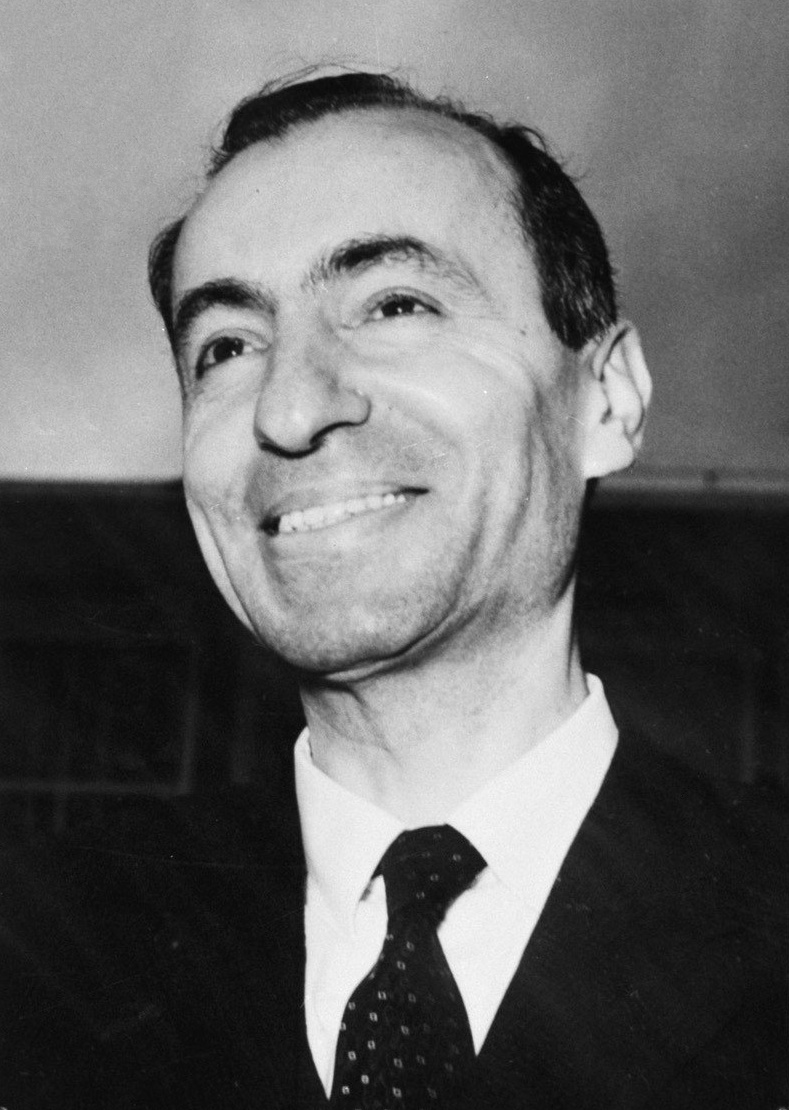 PhilosopherIslamic1910 – 1989
Michel Aflaq
Michel Aflaq was a Syrian philosopher, sociologist and Arab nationalist. His ideas played a significant role in the development of Ba'athism and its political movement; he is considered by several Ba'athists to be the principal founder of Ba'athist thought.
Read the full pageMichel Aflaq (Arabic: ميشيل عفلق, romanized: Mīšīl ʿAflaq, Arabic pronunciation: [miˈʃel ˈʕaflaq]; 9 January 1910 – 23 June 1989) was a Syrian philosopher, sociologist and Arab nationalist. His ideas played a significant role in the development of Ba'athism and its political movement; he is considered by several Ba'athists to be the principal founder of Ba'athist thought. Aflaq published various books during his lifetime, such as The Road to Renaissance (1940), The Battle for One Destiny (1958) and The Struggle Against Distorting the Movement of Arab Revolution (1975).
Born into a middle-class family in Damascus, Syria, he studied at the Sorbonne, where he met his future political companion Salah al-Din al-Bitar. Aflaq returned to Syria (at that time part of the French-ruled Mandate for Syria and the Lebanon) in 1932, beginning his political career in communist politics. He became a communist activist, but broke his ties with the communist movement when the Syrian–Lebanese Communist Party supported colonial policies through the Popular Front under the French Mandate of Syria. In 1940, Aflaq and al-Bitar established the Arab Ihya Movement (later renaming itself the Arab Ba'ath Movement, taking the name from Zaki al-Arsuzi's group by the same name). The movement proved successful, and in 1947 the Arab Ba'ath Movement merged with al-Arsuzi's Arab Ba'ath organisation to establish the Arab Ba'ath Party. Aflaq was elected to the party's executive committee and was elected "'Amid" (meaning the party's leader).
- 6
 PhilosopherIslamic1921 – 1986
Ismail al-Faruqi
Ismaʿil Raji al-Faruqi was a Palestinian-American Muslim philosopher and scholar of religion. He contributed significantly to Islamic studies, ethics, and interfaith dialogue, and is best known for pioneering the Islamization of knowledge and articulating tawhid (monotheism) as a comprehensive worldview.
- ◆Meta-religion
- ◆Islamization of knowledge
- ◆ijtihad
Read the full pageIsmaʿil Raji al-Faruqi was a Palestinian-American Muslim philosopher and scholar of religion. He contributed significantly to Islamic studies, ethics, and interfaith dialogue, and is best known for pioneering the Islamization of knowledge and articulating tawhid (monotheism) as a comprehensive worldview. He proposed a model of meta-religion based on shared ethical values and the universal concept of divine unity.
Following his early education in Jaffa, al-Faruqi studied philosophy and theology at the American University of Beirut, Indiana University, and Al-Azhar University in Cairo. He taught at McGill University in Canada, then in Pakistan, and later at Syracuse University, where he produced the Historical Atlas of the Religions of the World (1974), a widely referenced work. He subsequently joined Temple University, where he founded and chaired the Islamic Studies program. A prolific author, he published over 100 scholarly articles and 25 books, including Christian Ethics: A Historical and Systematic Analysis of Its Dominant Ideas (1967) and Al-Tawhid: Its Implications for Thought and Life (1982). He also co-founded the International Institute of Islamic Thought (IIIT) and played an active role in interfaith and Muslim educational initiatives.
- 7
 PhilosopherIslamic1923 – 1969
Jalal Al-e-Ahmad
Seyyed Jalāl Āl-e-Ahmad was a prominent Iranian novelist, short-story writer, translator, philosopher, socio-political critic, sociologist, as well as an anthropologist who was "one of the earliest and most prominent of contemporary Iranian ethnographers". He popularized the term gharbzadegi — variously translated in E
Read the full pageSeyyed Jalāl Āl-e-Ahmad (Persian: جلال آلاحمد; 2 December 1923 – 9 September 1969) was a prominent Iranian novelist, short-story writer, translator, philosopher, socio-political critic, sociologist, as well as an anthropologist who was "one of the earliest and most prominent of contemporary Iranian ethnographers". He popularized the term gharbzadegi — variously translated in English as "westernstruck", "westoxification", and "Occidentosis" — producing a holistic ideological critique of the West "which combined strong themes of Frantz Fanon and Marx".
Jalal Al-e-Ahmad was born in Tehran, into a religious family — his father was a cleric — "originally from the village of Aurazan in the Taliqan district bordering Mazandaran in northern Iran, and in due time Al-e-Ahmad was to travel there, exerting himself actively for the welfare of the villagers and devoting to them the first of his anthropological monographs". He was a cousin of Mahmoud Taleghani. After elementary school Al-e-Ahmad was sent to earn a living in the Tehran bazaar, but also attended Marvi Madreseh for a religious education, and without his father's permission, night classes at the Dar ul-Fonun. He went to Seminary of Najaf in 1944 but returned home very quickly. He became "acquainted with the speech and words of Ahmad Kasravi" and was unable to commit to the clerical career his father and brother had hoped he would take, describing it as "a snare in the shape of a cloak and an aba." He describes his family as religious in an autobiographical sketch written in 1967.
- 8
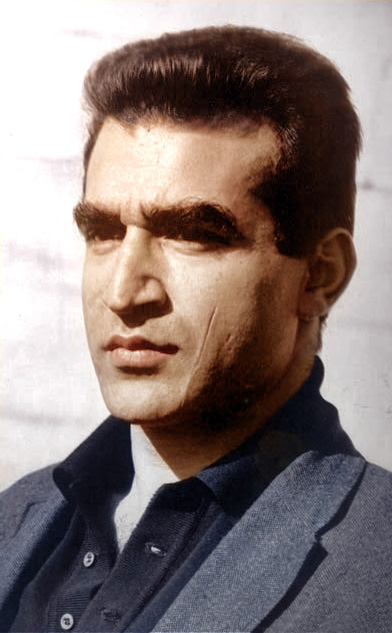 PhilosopherIslamic1930 – 2000
FM-2030
FM-2030 was a Belgian-born Iranian-American author, teacher, transhumanist philosopher, futurist, consultant, and Olympic athlete. He became notable as a transhumanist with the book Are You a Transhuman?: Monitoring and Stimulating Your Personal Rate of Growth in a Rapidly Changing World, published in 1989.
Read the full pageFM-2030 (born Fereidoun M. Esfandiary; Persian: فریدون اسفندیاری; October 15, 1930 – July 8, 2000) was a Belgian-born Iranian-American author, teacher, transhumanist philosopher, futurist, consultant, and Olympic athlete.
He became notable as a transhumanist with the book Are You a Transhuman?: Monitoring and Stimulating Your Personal Rate of Growth in a Rapidly Changing World, published in 1989. He wrote a number of works of fiction under his original name F. M. Esfandiary.
- 9
 PhilosopherIslamic1935 – 1980
Muḥammad Bāqir aṣ-Ṣadr
Muhammad Baqir al-Sadr, also known as al-Shahid al-Khamis (Arabic: الشهيد الخامس, romanized: al-Shahīd al-Khāmis, lit. 'the fifth martyr'), was an Iraqi Islamic scholar, philosopher, and the ideological founder of the Islamic Dawa Party. He was the father-in-law to Muqtada al-Sadr, a cousin of Muhammad Sadiq al-Sadr an
Read the full pageMuhammad Baqir al-Sadr (Arabic: محمد باقر الصدر, romanized: Muḥammad Bāqir aṣ-Ṣadr; March 1, 1935 – April 9, 1980), also known as al-Shahid al-Khamis (Arabic: الشهيد الخامس, romanized: al-Shahīd al-Khāmis, lit. 'the fifth martyr'), was an Iraqi Islamic scholar, philosopher, and the ideological founder of the Islamic Dawa Party. He was the father-in-law to Muqtada al-Sadr, a cousin of Muhammad Sadiq al-Sadr and Musa al-Sadr. His father Haydar al-Sadr was a well-respected high-ranking Shi'a cleric. His lineage can be traced back to Muhammad through the seventh Shia Imam Musa al-Kazim. Muhammad Baqir al-Sadr was executed in 1980 by the regime of Saddam Hussein along with his sister, Amina Sadr bint al-Huda.
Muhammad Baqir al-Sadr was born in al-Kazimiya, Iraq, into the prominent al-Sadr family, which originated in Jabal Amel in present-day Lebanon. His father died in 1937, leaving the family in difficult economic circumstances. In 1945, the family relocated to the holy city of Najaf, where al-Sadr spent the remainder of his life.
- 10
 PhilosopherIslamicborn 1940
I. Bartholomeos
Ecumenical Patriarch Bartholomew I the Great is the current ecumenical patriarch of Constantinople, serving as the 270th successor of the Apostolic See of St. Andrew.
Read the full pageEcumenical Patriarch Bartholomew I the Great (born Dimitrios Archontonis, 29 February 1940) is the current ecumenical patriarch of Constantinople, serving as the 270th successor of the Apostolic See of St. Andrew. Since his election on 22 October 1991, he has become the longest-serving Ecumenical Patriarch in history. As the primus inter pares (first among equals), he occupies the First See of the Eastern Orthodox Church, acting as the highest-ranking primate and the spiritual leader of Eastern Orthodox Christianity worldwide.
Bartholomew I was born in the village of Agios Theodoros (officially called Zeytinliköy) on the island of Imbros. Following his studies, he held a prominent position at the Theological School of Halki, where he was ordained a priest. Prior to his election and enthronement as patriarch, he served as metropolitan of Philadelphia and later of Chalcedon, and was an influential member of the Holy and Sacred Synod, shaping the Ecumenical Patriarchate's modern trajectory.
- 11PhilosopherIslamicd. 160
Valentinus
Valentinus was the best known and, for a time, most successful early Christian Gnostic theologian. He founded his school in Rome.
Read the full pageValentinus (Greek: Οὐαλεντῖνος; c. 100 – c. 165 CE) was the best known and, for a time, most successful early Christian Gnostic theologian. He founded his school in Rome.
Valentinus produced a variety of writings, but only fragments survive, largely those quoted in rebuttal arguments in the works of his opponents, not enough to reconstruct his system except in broad outline. His doctrine is known only in the developed and modified form given to it by his disciples, the Valentinians. He taught that there were three kinds of people, the spiritual (pneumatics), psychical (psychics), and material (hylics); and that only those of a spiritual nature received the gnosis (knowledge) that allowed them to return to the divine Pleroma, while those of a psychic nature (ordinary Christians) would attain a lesser or uncertain form of salvation, and that those of a material nature were doomed to perish.
- 12PhilosopherIslamicd. 45
Apion
Apion, also called Apion Pleistoneices (Greek: Ἀπίων Πλειστονίκου, Apíōn Pleistoníkēs) and Apion Mochthos (μόχθος) was an Egyptian grammarian and sophist in first century Egypt. Apion wrote several works, none of which have survived.
Read the full pageApion (Greek: Ἀπίων; fl. 1st century CE), also called Apion Pleistoneices (Greek: Ἀπίων Πλειστονίκου, Apíōn Pleistoníkēs) and Apion Mochthos (μόχθος) was an Egyptian grammarian and sophist in first century Egypt. Apion wrote several works, none of which have survived.
Apion was an Egyptian or Graeco-Egyptian scholar of Ptolemaic Egypt, born in the El Kargeh oasis. He studied under Didymus Chalcenterus and later succeeded Theon as head of the Alexandrian school. Apion gained recognition as a lecturer, speaking in Rome and elsewhere.