Indian thinkers, ancient: Aryadeva to Bodhidharma
- 1
 PhilosopherIndian200 – 250
Aryadeva
Āryadeva (IAST: Āryadeva; Tibetan: འཕགས་པ་ལྷ་, Wylie: 'phags pa lha, Chinese: 提婆 菩薩 Tipo pusa meaning Deva Bodhisattva), was a Mahayana Buddhist monk, a disciple of Nagarjuna and a Madhyamaka philosopher. Most sources agree that he was from "Siṃhala", which some scholars identify with Sri Lanka.
Read the full pageĀryadeva (fl. 3rd century CE) (IAST: Āryadeva; Tibetan: འཕགས་པ་ལྷ་, Wylie: 'phags pa lha, Chinese: 提婆 菩薩 Tipo pusa meaning Deva Bodhisattva), was a Mahayana Buddhist monk, a disciple of Nagarjuna and a Madhyamaka philosopher. Most sources agree that he was from "Siṃhala", which some scholars identify with Sri Lanka. After Nagarjuna, he is considered to be the next most important figure of the Indian Madhyamaka school.
Āryadeva's writings are important sources of Madhyamaka in East Asian Buddhism. His Catuḥśataka (Four Hundred Verses) was influential on Madhyamaka in India and China and his *Śataka (Bailun, 百論, T. 1569) and Dvādaśamukhaśāstra (both translated by Kumārajīva in the 4th century) were important sources for the East Asian Madhyamaka school. Āryadeva is also known as Kanadeva, recognized as the 15th patriarch in Chan/Zen Buddhism and some Sinhalese sources also mention an elder (thera) called Deva which may also be the same person. He is known for his association with the Nalanda monastery in modern-day Bihar, India.
- 2
 PhilosopherIndian203
Mahavatar Babaji
Mahavatar Babaji (IAST: Mahāvatāra Bābājī; lit. 'Great Avatar (Revered) Father') is a legendary immortal yogi and guru, who is said to be living in the Himalayas. He is said to have taught multiple revered historic yogis, including Lahiri Mahasaya, appearing to Lahiri Mahasaya and several of his disciples between 1861
Read the full pageMahavatar Babaji (IAST: Mahāvatāra Bābājī; lit. 'Great Avatar (Revered) Father') is a legendary immortal yogi and guru, who is said to be living in the Himalayas. He is said to have taught multiple revered historic yogis, including Lahiri Mahasaya (1828–1895), appearing to Lahiri Mahasaya and several of his disciples between 1861 and 1985, as described in various publications and biographies. Babaji's existence was first claimed in the writings of Paramahansa Yogananda, who wrote a chapter of his Autobiography of a Yogi about Babaji and founded Self-Realization Fellowship, a modern yoga movement that Babaji is associated with. According to Paramahansa Yogananda's autobiography, Babaji is said to have resided for at least hundreds of years in the remote Himalayan regions of India, seen in person by only a small number of disciples and others. The cave near Ranikhet where Lahiri Mahasaya said he met Babaji became a tourist attraction and pilgrimage site in India.
The first reported encounter with Mahavatar Babaji (commonly known as Babaji) was in 1861, when Shyāmacharan Lahirī (called "Mahāsaya" by disciples, devotees, and admirers) was posted to Ranikhet in his work as an accountant for the British government. One day while walking in the hills of Dunagiri above Ranikhet, he heard a voice calling his name. Following the voice up the mountain, he met a "tall, divinely radiant sadhu." He was amazed to find that the sadhu knew his name. This sadhu was Mahavatar Babaji.
- 3
 PhilosopherIndian300 – 301
Asanga
Asaṅga (Sanskrit: असंग, Tibetan: ཐོགས་མེད།, Wylie: thogs med, traditional Chinese: 無著;; pinyin: Wúzhuó; Romaji: Mujaku) (fl. 4th century C.E.) was one of the most important spiritual figures of Mahayana Buddhism and the founder of the Yogachara school. Traditionally, he and his half-brother Vasubandhu are regarded as t
Read the full pageAsaṅga (Sanskrit: असंग, Tibetan: ཐོགས་མེད།, Wylie: thogs med, traditional Chinese: 無著; ; pinyin: Wúzhuó; Romaji: Mujaku) (fl. 4th century C.E.) was one of the most important spiritual figures of Mahayana Buddhism and the founder of the Yogachara school. Traditionally, he and his half-brother Vasubandhu are regarded as the major classical Indian Sanskrit exponents of Mahayana Abhidharma, Vijñanavada (awareness only; also called Vijñaptivāda, the doctrine of ideas or percepts, and Vijñaptimātratā-vāda, the doctrine of 'mere representation) thought and Mahayana teachings on the bodhisattva path. He is also traditionally considered as one of the seventeen Nalanda masters who taught at the monastery which is located in modern-day Bihar.
There are differing views as to Asaṅga's birthplace. Some sources record that he was born in Puruṣapura (present day Peshawar in Pakistan) in a Brahmin family, which at that time was part of the ancient kingdom of Gandhāra. However the writings of Buton Rinchen Drub state that Asanga and his brother, Vasubandhu, were born in Central India. Current scholarship places him in the fourth century CE. He was perhaps originally a member of the Mahīśāsaka school or the Mūlasarvāstivāda school but later converted to Mahāyāna. According to some scholars, Asaṅga's frameworks for Abhidharma writings retained many underlying Mahīśāsaka traits, but other scholars argue that there is insufficient data to determine which school he originally belonged to.
- 4
 PhilosopherIndian334 – 416
Huiyuan
Lushan Huiyuan, meaning "Huiyuan of Mount Lu", was a Chinese Buddhist teacher who founded Donglin Temple at the foot of Mount Lu in Jiujiang city region and wrote the text On Why Monks Do Not Bow Down Before Kings in 404 AD. He was born in Shanxi province but moved to Jiujiang, where he died in 416.
Read the full pageLushan Huiyuan (simplified Chinese: 庐山慧远; traditional Chinese: 廬山慧遠; pinyin: Lúshān Huìyuǎn; Wade–Giles: Lushan Hui-yüan; 334–416 AD), meaning "Huiyuan of Mount Lu", was a Chinese Buddhist teacher who founded Donglin Temple at the foot of Mount Lu in Jiujiang city region and wrote the text On Why Monks Do Not Bow Down Before Kings in 404 AD. He was born in Shanxi province but moved to Jiujiang, where he died in 416. Although he was born in the north, he moved south to live within the bounds of the Eastern Jin Dynasty.
Huiyuan was posthumously named First Patriarch of the Pure Land School of Buddhism, and founder of the White Lotus Society, an early Buddhist community devoted to Amitabha Buddha. His disciples included Huiguan (慧觀), Sengji (僧濟), and Faan (法安).
- 5
 PhilosopherIndian340 – 422
Faxian
Faxian, formerly romanized as Fa-hien or Fa-hsien, was a Chinese Buddhist monk and translator who traveled on foot from the Later Qin state to classical India to acquire Buddhist scriptures. His birth surname was Gong.
Read the full pageFaxian (337–c. 422 CE), formerly romanized as Fa-hien or Fa-hsien, was a Chinese Buddhist monk and translator who traveled on foot from the Later Qin state to classical India to acquire Buddhist scriptures. His birth surname was Gong. Starting his journey about age 60, he traveled west along the overland Silk Road, visiting Buddhist sites in Central, South, and Southeast Asia. The journey and return took from 399 to 412, with 10 years spent in India.
Faxian's account of his pilgrimage, the Foguoji or Record of the Buddhist Kingdoms, is a notable independent record of early Buddhism in India. He returned to China with a large number of Sanskrit texts, whose translations greatly influenced East Asian Buddhism and provide a terminus ante quem for many historical names, events, texts, and ideas therein.
- 6PhilosopherIndian401 – 500
Buddhaghosa
Buddhaghosa was a 5th-century Indian Theravādin Buddhist commentator, translator, and philosopher. He worked in the great monastery (mahāvihāra) at Anurādhapura, Sri Lanka and saw himself as being part of the Vibhajyavāda school and in the lineage of the Sinhalese mahāvihāra.
Read the full pageBuddhaghosa was a 5th-century Indian Theravādin Buddhist commentator, translator, and philosopher. He worked in the great monastery (mahāvihāra) at Anurādhapura, Sri Lanka and saw himself as being part of the Vibhajyavāda school and in the lineage of the Sinhalese mahāvihāra.
His best-known work is the Visuddhimagga ("Path of Purification"), a comprehensive summary of older Sinhala commentaries on the scriptural canon of the Theravāda school. According to Sarah Shaw, in Theravāda Buddhism this systematic work is "the principal text on the subject of meditation." The interpretations provided by Buddhaghosa have generally constituted the orthodox understanding of Theravādin scriptures since at least the 12th century CE.
- 7
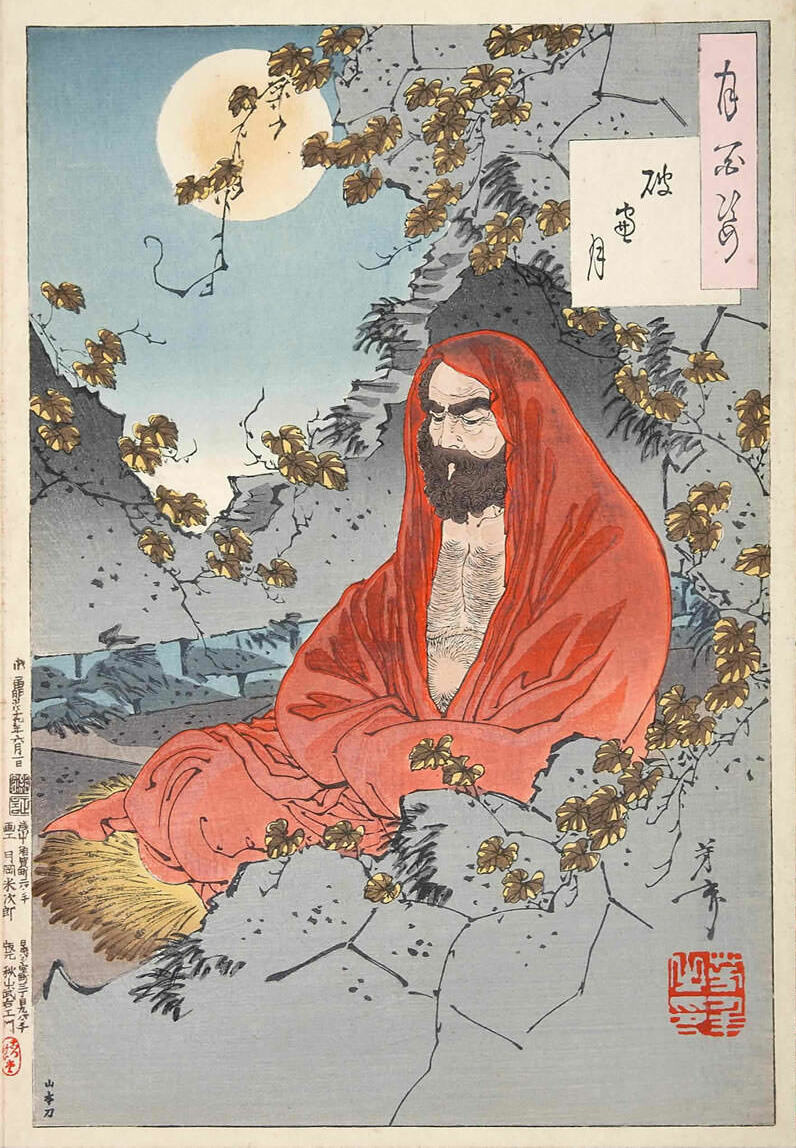 PhilosopherIndian483 – 540
Bodhidharma
Bodhidharma was a semi-legendary Buddhist monk who lived during the 5th or 6th century CE. He is traditionally credited as the transmitter of Chan Buddhism to China, and is regarded as its first Chinese patriarch.
Read the full pageBodhidharma was a semi-legendary Buddhist monk who lived during the 5th or 6th century CE. He is traditionally credited as the transmitter of Chan Buddhism to China, and is regarded as its first Chinese patriarch. He is also popularly regarded as the founder of Shaolin kung fu, an idea popularized in the 20th century, but based on the 17th-century Yijin Jing and the Daoist association of daoyin gymnastics with Bodhidharma.
Little contemporary biographical information on Bodhidharma exists, and subsequent accounts are layered with legend and unreliable details. According to the principal Chinese sources, Bodhidharma came from the Western Regions, which typically refers to modern-day Xinjiang and Central Asia but can also include the Indian subcontinent. He is described as either a "Persian Central Asian" or a "South Indian [...] the third son of a great Indian king." Aside from the Chinese accounts, several popular traditions also exist regarding Bodhidharma's origins. Throughout Buddhist art, Bodhidharma is depicted as an ill-tempered, large-nosed, profusely bearded, wide-eyed non-Chinese person.