Madhyamaka
The "Middle Way" school of Nāgārjuna: all things are empty (śūnya) of intrinsic nature.
- 1
 SchoolIndian150 – present
Madhyamaka
The "Middle Way" school of Nāgārjuna: all things are empty (śūnya) of intrinsic nature.
- ◆Emptiness (śūnyatā)
- ◆Two truths
- ◆Refutation of all fixed views
Read the full pageMadhyamaka (Sanskrit: माध्यमक, romanized: Mādhyamaka, lit. 'middle way; centrism'; Chinese: 中觀見; pinyin: Zhōngguān jiàn; Vietnamese: Trung quán tông, chữ Nôm: 中觀宗; Tibetan: དབུ་མ་པ་, Wylie: dbu ma pa) also known as Madhyamika (Sanskrit: माध्यमिक, romanized: Mādhyamika) refers to a tradition of Buddhist philosophy and practice founded by the Indian Buddhist monk and philosopher Nāgārjuna (c. 150 – c. 250 CE). The foundational text of the Mādhyamaka tradition is Nāgārjuna's Mūlamadhyamakakārikā ("Root Verses on the Middle Way"). More broadly, Madhyamaka also refers to the ultimate nature of phenomena as well as the non-conceptual realization of ultimate reality that is experienced in meditation.
Since the 4th century CE onwards, Madhyamaka philosophy had a major influence on the subsequent development of the Mahāyāna Buddhist tradition, especially following the spread of Buddhism throughout Asia. It is the dominant interpretation of Buddhist philosophy in Tibetan Buddhism and has also been influential in East Asian Buddhist thought.
- 2
 PhilosopherIndianc. 150 – 250
Nāgārjuna
Founder of the Madhyamaka school, who argued that all things are empty of intrinsic existence — even emptiness itself.
- ◆Emptiness (śūnyatā)
- ◆Two truths: conventional and ultimate
- ◆Tetralemma (catuṣkoṭi)
- ◆Saṃsāra and nirvāṇa are not different
Read the full pageNāgārjuna is often called the second Buddha. His Mūlamadhyamakakārikā ("Fundamental Verses on the Middle Way") takes the Buddha's teaching of dependent origination to its radical conclusion: if everything arises in dependence on other things, then nothing has svabhāva — intrinsic, independent existence. Everything is śūnya, empty.
His method is relentless dialectic. Taking concepts such as causation, motion, time and the self, he shows that every attempt to treat them as intrinsically real leads to contradiction, using the four-cornered catuṣkoṭi: a thing is not existent, not non-existent, not both, not neither.
- 3PhilosopherIndianc. 150 – 250
Nāgārjuna
Founder of the Madhyamaka school, who argued that all things are empty of intrinsic existence — even emptiness itself.
- ◆Emptiness (śūnyatā)
- ◆Two truths: conventional and ultimate
- ◆Tetralemma (catuṣkoṭi)
- ◆Saṃsāra and nirvāṇa are not different
Read the full pageNāgārjuna is often called the second Buddha. His Mūlamadhyamakakārikā ("Fundamental Verses on the Middle Way") takes the Buddha's teaching of dependent origination to its radical conclusion: if everything arises in dependence on other things, then nothing has svabhāva — intrinsic, independent existence. Everything is śūnya, empty.
His method is relentless dialectic. Taking concepts such as causation, motion, time and the self, he shows that every attempt to treat them as intrinsically real leads to contradiction, using the four-cornered catuṣkoṭi: a thing is not existent, not non-existent, not both, not neither.
- 4
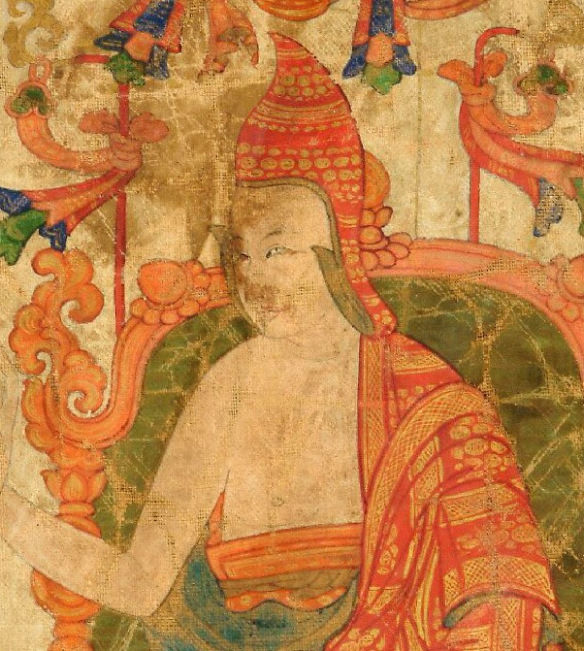 PhilosopherIndian685 – 763
Shantideva
Shantideva (Sanskrit: Śāntideva; Chinese: 寂天; Tibetan: ཞི་བ་ལྷ།, THL: Zhiwa Lha; Mongolian: Шантидэва гэгээн; Vietnamese: Tịch Thiên) was an 8th-century CE Indian philosopher, Buddhist monk, poet, and scholar at the mahavihara of Nalanda. He was an adherent of the Mādhyamaka philosophy of Nāgārjuna.
Read the full pageShantideva (Sanskrit: Śāntideva; Chinese: 寂天; Tibetan: ཞི་བ་ལྷ།, THL: Zhiwa Lha; Mongolian: Шантидэва гэгээн; Vietnamese: Tịch Thiên) was an 8th-century CE Indian philosopher, Buddhist monk, poet, and scholar at the mahavihara of Nalanda. He was an adherent of the Mādhyamaka philosophy of Nāgārjuna. Abhayadatta Sri also lists Shantideva as one of the eighty-four mahasiddhas and is known as Bhusuku Pa (布苏固巴).
Two works of Shantideva are extant, the Bodhisattvacaryāvatāra and the Śikṣāsamuccaya, both of which were written with the intention of being training manuals for one who intends to follow the path of the bodhisattva. The Bodhisattvacaryāvatāra, in particular, was the subject of both Indian and Tibetan commentaries during the period it was written and has also received large amounts of attention from both academics and lay practitioners in recent years as well including a commentary written by the 14th Dalai Lama.
- 5
 PhilosopherIndianborn 1935
Tenzin Gyatso, 14th Dalai Lama
Tibetan Buddhist leader whose teaching on compassion, secular ethics and dialogue with science has reached the world.
- ◆Compassion as the basis of ethics
- ◆Secular ethics
- ◆Dialogue between Buddhism and science
Read the full pageThe 14th Dalai Lama (born Lhamo Thondup, 6 July 1935; full spiritual name: Jetsun Jamphel Ngawang Lobsang Yeshe Tenzin Gyatso, shortened as Tenzin Gyatso) is the current Dalai Lama, the highest spiritual leader and head of Tibetan Buddhism. He served as the resident spiritual and temporal leader of Tibet before 1959, and subsequently led the Tibetan government in exile represented by the Central Tibetan Administration in Dharamshala, India. The 14th Dalai Lama is also known to Tibetans as Gyalwa Rinpoche ("The Precious Jewel-like Buddha-Master"), Kundun ("The Presence"), and Yizhin Norbu ("The Wish-Fulfilling Gem"). His devotees, as well as much of the Western world, often call him His Holiness the Dalai Lama. The Mongolic word dalai means ocean. He is the leader and a monk of the newest Gelug school of Tibetan Buddhism.
The 14th Dalai Lama was born to a farming family in Taktser (Hongya village), in the traditional Tibetan region of Amdo, at the time a Chinese frontier district. He was selected as the tulku of the 13th Dalai Lama in 1937, and formally recognised as the 14th Dalai Lama in 1939. As with the recognition process for his predecessor, a Golden Urn selection process was waived and approved by the Nationalist government of China. His enthronement ceremony was held in Lhasa on 22 February 1940. A belief central to the Tibetan Buddhist tradition as well as the institution of the Dalai Lama is that the reincarnated person is a living Bodhisattva, specifically an emanation of Avalokiteśvara (in Sanskrit) or Chenrezig (in Tibetan), the Bodhisattva of Compassion.
