Where philosophy happened, Q–V
- Read the full page
Qufu is a county-level city in southwestern Shandong province, East China. It is located about 130 kilometres (81 mi) south of the provincial capital Jinan and 45 km (28 mi) northeast of the prefectural seat of Jining. Qufu has an area of 815 square kilometers, and a total population of 653,000 inhabitants, of which, 188,000 live in urban areas.
Qufu is best known as the hometown of Confucius, who is traditionally believed to have been born at nearby Mount Ni. Qufu, being the capital of Lu and birthplace of Confucius, is known collectively with Zoucheng, the birthplace of Mencius, as "Zoulu". The city contains numerous historic palaces, temples and cemeteries. The three most famous cultural sites of the city, collectively known as San Kong (三孔; 'the Three Confucian [sites]', are the Temple of Confucius (Chinese: 孔庙; pinyin: Kǒngmiào), the Cemetery of Confucius (孔林; Kǒnglín), and the Kong Family Mansion (孔府; Kǒngfǔ). Together, these three sites have been listed as a UNESCO World Heritage Site since 1994.
- 2
 PlaceGreek & Roman
Rome
Seneca, Epictetus (in his early life) and Marcus Aurelius made Stoicism a Roman philosophy.
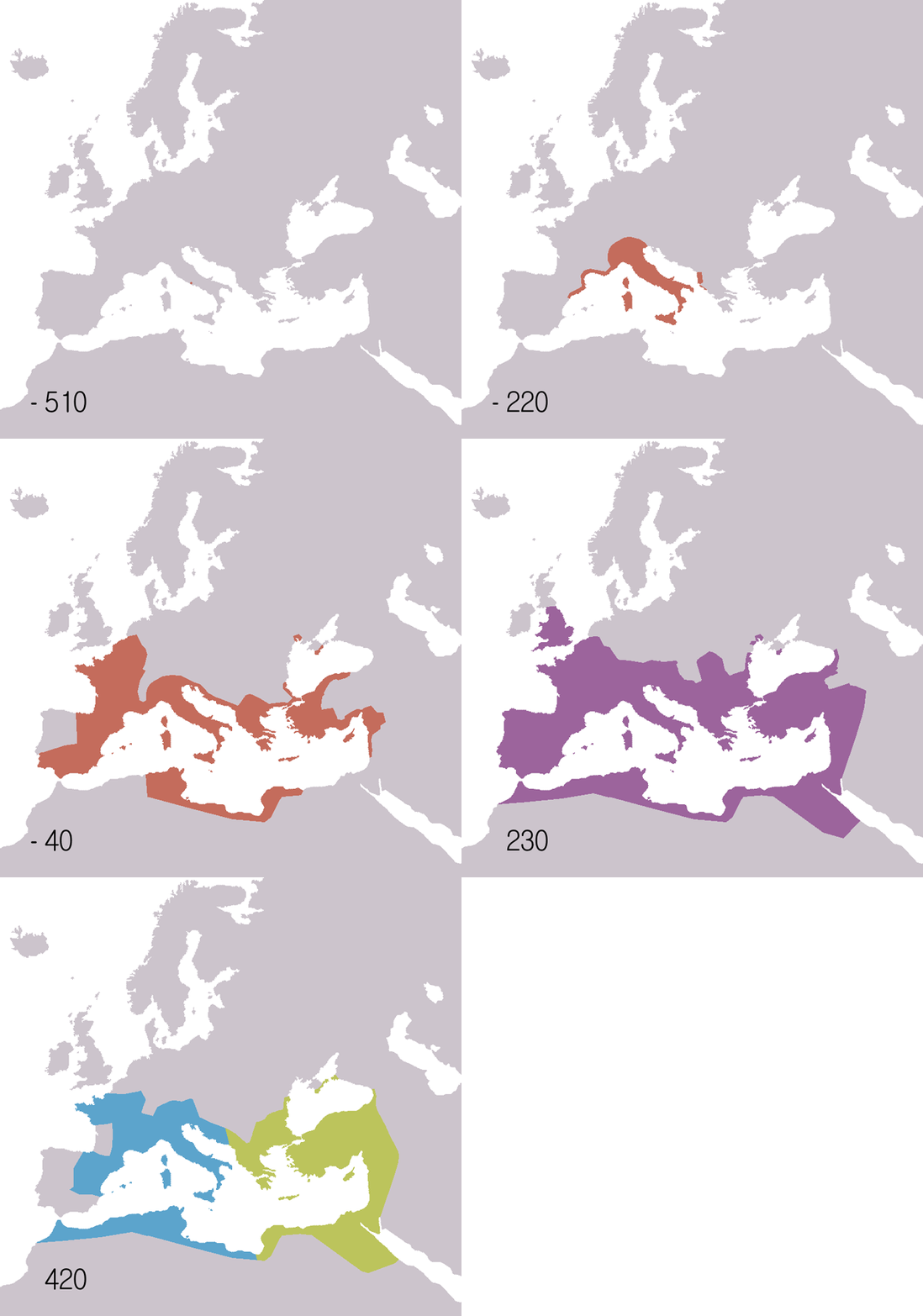
Read the full pageIn modern historiography, ancient Rome is the Roman civilisation from the founding of the Italian city of Rome in the 8th century BC to the collapse of the Western Roman Empire in the 5th century AD. It encompasses the Roman Kingdom (753–509 BC), the Roman Republic (509–27 BC), and the Roman Empire (27 BC – 476 AD) until the fall of the western empire.
Ancient Rome began as an Italic settlement, traditionally dated to 753 BC, beside the River Tiber in the Italian Peninsula. The settlement grew into the city and polity of Rome, and came to control its neighbours through a combination of treaties and military strength. It eventually controlled the whole Italian Peninsula, assimilating the Greek culture of Magna Graecia (in southern Italy) and the Etruscan culture in north-central Italy, and then became the dominant power in the Mediterranean region and parts of Europe. At its height it controlled the North African coast, the Iberian and Balkan peninsulas and most of Southern and Western Europe, and much of the Middle East, including Anatolia, the Levant, Egypt, and parts of Mesopotamia and Arabia, and Crimea. That empire was among the largest empires in the ancient world, covering around 5 million square kilometres (1.9 million square miles) in AD 117, with an estimated 50 to 90 million inhabitants, roughly 20% of the world's population at the time. The Roman state evolved from an elective monarchy to a classical republic and then to an increasingly autocratic military dictatorship during the Empire.
- Read the full page
Lu (Chinese: 魯; c. 1042 – 249 BC) was a vassal state during the Zhou dynasty of ancient China located around modern southwest Shandong. Founded in the 11th century BC, its rulers were from a cadet branch of the House of Ji (姬) that ruled the Zhou dynasty. The first duke was Boqin, a son of the Duke of Zhou, who was brother of King Wu of Zhou and regent to King Cheng of Zhou.
Lu was the home state of Confucius as well as Mozi, and, as such, has an outsized cultural influence among the states of the Eastern Zhou and in history. The Annals of Spring and Autumn, for instance, was written with the Lu rulers' years as their basis. Another great work of Chinese history, the Zuo Zhuan or Commentary of Zuo, was traditionally considered to have been written in Lu by Zuo Qiuming.
- Read the full page
Taxila (Punjabi: ٹيکسلا, romanized: Ṭeksilā; Urdu: تکشیلا, romanized: Takshila), historically known as Takṣaśilā, is a city and a World Heritage Site in the Rawalpindi District of Punjab, Pakistan. Founded around c. 1000 BC, it is one of the oldest cities in Asia, and has a population of over 136,900 as of 2023.
Situated on the eastern bank of the Indus River — the pivotal junction of the South Asia and Central Asia — it was possibly founded around 1000 BCE. Ancient Taxila, along with Puṣkalāvatī, was one of the capitals of the Gandhāra civilisation. The city has been suggested to be the capital of the Achaemenid province of Hinduš during c. 500 – c. 330 BCE. It is named in the writings of Pāṇini and its king, called Taxiles by the ancient Greeks, readily recognised the suzerainty of Alexander the Great in 326 BCE once he appeared on the scene after overthrowing the Achaemenids. Mauryans took over the city in the following decades, and as per Buddhist texts, Ashoka was the governor at Taxila before becoming king. Some scholars consider the conventionally called University of ancient Taxila to be one of the earliest universities or education centres in Asia.
- 5
 PlaceGreek & Roman335 – 86 BCE
The Lyceum
Aristotle's school, where the "Peripatetics" are said to have walked while they taught.
Read the full pageThe Lyceum was a temple in Athens dedicated to Apollo ().
It was best known for the Peripatetic school of philosophy founded there by Aristotle in 334 BC. Aristotle fled Athens in 323 BC, and the school continued to function after his lifetime under a series of leaders until the Roman general Sulla destroyed it during his assault on Athens in 86 BC.
- Read the full page
Varanasi (Hindi pronunciation: [ʋaːˈɾaːɳəsi], also Benares, Banaras Hindustani pronunciation: [bəˈnaːɾəs]), or Kashi, is a city on the Ganges river in northern India that has a central place in the traditions of pilgrimage, death, and mourning in the Hindu world. The city also has a syncretic tradition of Islamic artisanship that underpins its religious tourism. Located in the middle-Ganges valley in the southeastern part of the state of Uttar Pradesh, Varanasi lies on the left bank of the river. It is 692 kilometres (430 mi) to the southeast of India's capital New Delhi and 320 kilometres (200 mi) to the southeast of the state capital, Lucknow. It lies 121 kilometres (75 mi) downstream of Prayagraj, where the confluence with the Yamuna river is another major Hindu pilgrimage site.
Varanasi is one of the world's oldest continually inhabited cities. Kashi, its ancient name, was associated with a kingdom of the same name in the first millennium BCE. The Lion capital of Ashoka at nearby Sarnath has been interpreted to be a commemoration of the Buddha's first sermon there in the fifth century BCE. In the 8th century, Adi Shankara established the worship of Shiva as an official sect of Varanasi. In the mid-second millennium several figures of the Bhakti movement were born here. They included Kabir, Ravidas and Tulsidas. Kabir came to influence traditions in Hinduism, Sikhism, and Sufism. Tulsidas wrote his Awadhi language epic, the Ramcharitmanas, which is a popular vernacular reworking of the Sanskrit Ramayana. In the 16th century, Rajput nobles in the service of the Mughal emperor Akbar, sponsored work on Hindu temples in the city. In 1740, Benares Estate, a zamindari estate, was established in the vicinity of the city in the semi-autonomous Mughal province of Awadh. In 1775, the East India Company acquired Benares city under the Treaty of Faizabad. Subsequently, the city became a part of the Benares Division of British India's Ceded and Conquered Provinces in 1805, the North-Western Provinces in 1836, United Provinces in 1902, and of the Republic of India's state of Uttar Pradesh in 1950.
- Read the full page
The Vienna Circle (German: Wiener Kreis) of logical empiricism was a group of philosophers and scientists drawn from the natural and social sciences, logic and mathematics who met regularly from 1924 to 1936 at the University of Vienna, chaired by Moritz Schlick. The Vienna Circle had an influence on 20th-century philosophy, especially philosophy of science and analytic philosophy.
The philosophical position of the Vienna Circle was called logical empiricism (German: logischer Empirismus), logical positivism or neopositivism. It was influenced by Ernst Mach, David Hilbert, French conventionalism (Henri Poincaré and Pierre Duhem), Gottlob Frege, Bertrand Russell, Ludwig Wittgenstein and Albert Einstein. The Vienna Circle was pluralistic and committed to the ideals of the Enlightenment. It was unified by the aim of making philosophy scientific with the help of modern logic. Main topics were foundational debates in the natural and social sciences, logic and mathematics; the modernization of empiricism by modern logic; the search for an empiricist criterion of meaning; the critique of metaphysics and the unification of the sciences in the unity of science.


