Indian ideas, A–H
- 1
 ConceptIndian
Anandpur Sahib
Sri Anandpur Sahib, also referred simply as Anandpur (lit. 'city of bliss'), is a city in Rupnagar district (Ropar), on the edge of Shivalik Hills, in the Indian state of Punjab. Located near the Sutlej River, the city is one of the most sacred religious places in Sikhism, being the place where the last two Sikh Gurus,
Read the full pageSri Anandpur Sahib, also referred simply as Anandpur (lit. 'city of bliss'), is a city in Rupnagar district (Ropar), on the edge of Shivalik Hills, in the Indian state of Punjab. Located near the Sutlej River, the city is one of the most sacred religious places in Sikhism, being the place where the last two Sikh Gurus, Guru Tegh Bahadur and Guru Gobind Singh, lived. It is also the place where Guru Gobind Singh founded the Khalsa Panth in 1699. The city is home to Takht Sri Kesgarh Sahib, the third of the five Takhts in Sikhism. The town was founded by the ninth Sikh guru, Guru Tegh Bahadur.
The city is a pilgrimage site in Sikhism. It is the venue of the largest annual Sikh gathering and festivities during the Hola Mohalla in the spring season. The Virasat-e-Khalsa museum is located in the city.
- 2ConceptIndian
Anubhava Mantapa
Anubhava Mantapa, established by Basavanna in the 12th century C.E., is a religious complex located in Tipranth, Basavakalyan, in the Bidar district of Karnataka. It is the first religious parliament in the world, whose name is literally translated as "experience pavilion", and was an academy of mystics, saints and phi
Read the full pageAnubhava Mantapa, established by Basavanna in the 12th century C.E., is a religious complex located in Tipranth, Basavakalyan, in the Bidar district of Karnataka. It is the first religious parliament in the world, whose name is literally translated as "experience pavilion", and was an academy of mystics, saints and philosophers of the lingayat faith in the 12th century. It was the source of essentially all religious and philosophical thought pertaining to the lingayat, and was presided over by the mystic Allama Prabhu, with numerous Sharanas from all over Karnataka and other parts of India participating.
This institution was also the fountainhead of Vachana literature, which was used as the means by which Veerashaiva religious and philosophical thought was propagated. Other giants of veerashaiva theosophy, including Akka Mahadevi, Channabasavanna, and Basavanna himself, were active at the Anubhava Mantapa. The Anubhava Mantapa is also called the Mahaamane.
- 3
 ConceptIndian
Bairagi Brahmin (caste)
Bairagi Brahmin or Vaishnav Bairagi or Vaishnav Brahmin is a Hindu caste. They are Hindu priests.
Read the full pageBairagi Brahmin or Vaishnav Bairagi or Vaishnav Brahmin is a Hindu caste. They are Hindu priests. They are sedentary rasik (temple dwelling or temple priest) Brahmin members of the Vaishnava sampradayas, especially the Ramanandi Sampradaya. According to K.S. Singh, the community uses different surnames/titles in different states and union territories of India; these are: Swami, Bairagi, Mahanta, Maharaj, Vaishnav, Bawa, Pandit, Purohit, Goswami, Sharma, Das, Adhikari, Brahmachari. They are Vaishnav, and wear the sacred thread. A majority of Bairagi Brahmin is found in Uttar Pradesh, Bihar, Jharkhand, Gujarat, Rajasthan, West Bengal, Assam, and Odisha. Vaishnavas are considered to be part of the 'upper castes' of India.
Members of Vaishnava sampradayas are called Bairagi or Vairagi. And these members are divided into three categories – renunciant (Virakt), warrior (Naga) and temple-dwelling (temple priest) ascetics. The most of renunciant and warrior are unmarried ascetics. Anyone can be member of these communities. But there are evidences of different meetings of vaishnava mahants who have decided that member of anyone caste could not be member of the community.
- 4
 ConceptIndian
British Raj
The British Raj ( RAHJ; from Hindustani rāj, 'reign', 'rule' or 'government') was the period of rule of the British Crown on the Indian subcontinent, lasting from 1858 to 1947. It is also called Crown rule in India, or direct rule in India.
Read the full pageThe British Raj ( RAHJ; from Hindustani rāj, 'reign', 'rule' or 'government') was the period of rule of the British Crown on the Indian subcontinent, lasting from 1858 to 1947. It is also called Crown rule in India, or direct rule in India. The region under British control was commonly called India in contemporaneous usage and included areas directly administered by the United Kingdom, which were collectively called British India, and areas ruled by indigenous rulers, but under British paramountcy, called the princely states. The region was sometimes called the Indian Empire, though not officially. As India, it was a founding member of the League of Nations and a founding member of the United Nations in San Francisco in 1945. India was a participating state in the Summer Olympics in 1900, 1920, 1928, 1932, and 1936.
This system of governance was instituted on 28 June 1858, when, after the Indian Rebellion of 1857, the rule of the East India Company was transferred to the Crown in the person of Queen Victoria (who, in 1876, was proclaimed Empress of India). It lasted until 1947 when the British Raj was partitioned into two sovereign dominion states: the Union of India (later the Republic of India) and Dominion of Pakistan (later the Islamic Republic of Pakistan and People's Republic of Bangladesh after the 1971 Proclamation of Bangladeshi Independence). At the inception of the Raj in 1858, Lower Burma was already a part of British India; Upper Burma was added in 1886, and the resulting union, Burma, was administered as an autonomous province until 1937, when it became a separate British colony, gaining its independence in 1948. It was renamed Myanmar in 1989. The Chief Commissioner's Province of Aden was also part of British India at the inception of the British Raj and became a separate colony known as Aden Colony in 1937 as well. Another dependency, the Persian Gulf Residency, was separated from India upon independence.
- 5
 ConceptIndian
Buddhism
Buddhism, also known as Buddhadharma and Dharmavinaya (transl. "doctrines and disciplines"), is an Indian religion and philosophy based on teachings attributed to the Buddha, a śramaṇa (wandering ascetic) and religious teacher who lived sometime between the 7th and 5th centuries BCE. It is the world's fourth-largest re
Read the full pageBuddhism, also known as Buddhadharma and Dharmavinaya (transl. "doctrines and disciplines"), is an Indian religion and philosophy based on teachings attributed to the Buddha, a śramaṇa (wandering ascetic) and religious teacher who lived sometime between the 7th and 5th centuries BCE. It is the world's fourth-largest religion, with an estimated 320 million followers, representing approximately 4.1% of the global population. It originated in the eastern Gangetic plain as a śramaṇa movement sometime between 6th and 5th centuries BCE, and gradually spread throughout much of Asia via the Silk Road. Buddhism has since played a significant role in Asian culture and spirituality, eventually spreading to the West in the 19th century.
According to tradition, the Buddha taught a path of cultivation that leads to awakening and liberation from dukkha (lit. 'suffering', also rendered 'unsatisfactoriness'; in context "unreliable", "precarity, instability, an unreliable place to stand") by attaining nirvana, the 'blowing out' (extinguishing) of the passions. He regarded this path as a Middle Way between extreme asceticism and sensory indulgence, and also between the extremes of eternalism and nihilism. Teaching that dukkha arises alongside attachment or clinging, the Buddha advised meditation practices and ethical precepts rooted in non-harming. Widely observed teachings include the Four Noble Truths, the Noble Eightfold Path, and the doctrines of dependent origination, karma, and the three marks of existence. Other commonly observed elements include the Triple Gem, the taking of monastic vows, and the cultivation of perfections (pāramitā).
- 6
 ConceptIndian
Diwali
Dipavali (IAST: Dīpāvalī), commonly known as Diwali (, Hindi: [d̪ɪʋaːliː, d̪iːpaːʋəliː]), is the Hindu festival of lights, with variations celebrated in other Indian religions such as Jainism and Sikhism. It is associated with the spiritual victory or triumph of Dharma over Adharma, light over darkness, good over evil,
Read the full pageDipavali (IAST: Dīpāvalī), commonly known as Diwali (, Hindi: [d̪ɪʋaːliː, d̪iːpaːʋəliː]), is the Hindu festival of lights, with variations celebrated in other Indian religions such as Jainism and Sikhism. It is associated with the spiritual victory or triumph of Dharma over Adharma, light over darkness, good over evil, and knowledge over ignorance. Diwali is celebrated during the Hindu lunisolar months of Ashvin (according to the amanta tradition) and Kārtika – between around mid-October and mid-November. The celebrations generally last five or six days.
Diwali is connected to various religious events, deities, and personalities, such as being the day Rama returned to his kingdom in Ayodhya with his wife Sita and his brother Lakshmana after defeating the demon king Ravana. It is also widely associated with Lakshmi, the goddess of prosperity, and Ganesha, the god of wisdom and the remover of obstacles. Other regional traditions connect the holiday to Vishnu, Krishna, Durga, Shiva, Kali, Hanuman, Kubera, Yama, Yami, Dhanvantari, or Vishvakarman.
- 7ConceptIndian
Eastern philosophy
Eastern philosophy (also called Asian philosophy or Oriental philosophy) includes the various philosophies that originated in East, Southeast and South Asia, including Chinese philosophy, Japanese philosophy, Korean philosophy, and Vietnamese philosophy, which are dominant in East Asia; and Indian philosophy (including
Read the full pageEastern philosophy (also called Asian philosophy or Oriental philosophy) includes the various philosophies that originated in East, Southeast and South Asia, including Chinese philosophy, Japanese philosophy, Korean philosophy, and Vietnamese philosophy, which are dominant in East Asia; and Indian philosophy (including Hindu philosophy, Jain philosophy, Buddhist philosophy), which are dominant in South Asia, Southeast Asia, Tibet, Japan and Mongolia.
Indian philosophy refers to ancient philosophical traditions (Sanskrit: dárśana; 'world views', 'teachings') of the Indian subcontinent. Hinduism may have roots dating back to the times of the Indus Valley civilization. The major orthodox schools arose sometime between the start of the Common Era and the Gupta Empire. These Hindu schools developed what has been called the "Hindu synthesis" merging orthodox Brahmanical and unorthodox elements from Buddhism and Jainism. Hindu thought also spread east to the Indonesian Srivijaya empire and the Cambodian Khmer Empire. These religio-philosophical traditions were later grouped under the label Hinduism. Hinduism is the dominant religion, or way of life, in South Asia. It includes Shaivism, Vaishnavism, and Shaktism among numerous other traditions, and a wide spectrum of laws and prescriptions of "daily morality" based on karma, dharma, and societal norms. Hinduism is a categorization of distinct intellectual or philosophical points of view, rather than a rigid, common set of beliefs. Hinduism, with about one billion followers is the world's third-largest religion, after Christianity and Islam. Hinduism has been called the "oldest religion" in the world and is traditionally called Sanātana Dharma, "the eternal law" or the "eternal way"; beyond human origins. Western scholars regard Hinduism as a fusion or synthesis of various Indian cultures and traditions, with diverse roots and no single founder.
- 8
 ConceptIndian
Gaudiya Vaishnavism
Gaudiya Vaishnavism (IAST: Gauḍīya Vaiṣṇavasampradāyaḥ), also known as Chaitanya Vaishnavism, is a Vaishnava religious movement inspired by Chaitanya Mahaprabhu in India. "Gaudiya" refers to the Gaura or Gauḍa region of Bengal (present-day Malda division of West Bengal and Rajshahi division of Bangladesh) or the ancien
Read the full pageGaudiya Vaishnavism (IAST: Gauḍīya Vaiṣṇavasampradāyaḥ), also known as Chaitanya Vaishnavism, is a Vaishnava religious movement inspired by Chaitanya Mahaprabhu (1486–1534) in India. "Gaudiya" refers to the Gaura or Gauḍa region of Bengal (present-day Malda division of West Bengal and Rajshahi division of Bangladesh) or the ancient Gauda Kingdom (present-day West Bengal and Bangladesh), while Vaishnavism means "the worship of Vishnu". The tradition is part of Krishnaism, a Krishna-centric branch of Vaishnavism.
The theological basis of Gaudiya Vaishnavism is primarily the Bhagavad Gita and Bhagavata Purana, and it was systemetized by the Six Goswamis of Vrindavan and others.
- 9
 SchoolIndian1409 – present
Gelug
Tsongkhapa's "virtuous" school, famed for logic, debate and a rigorous reading of Madhyamaka; the school of the Dalai Lamas.
Read the full pageThe Gelug (, also Geluk; lit. 'virtuous') is the youngest of the four major schools of Tibetan Buddhism. It was founded by Je Tsongkhapa (1357–1419), a Tibetan philosopher, tantric yogi and lama and further expanded and developed by his disciples (such as Khedrup Je, Gyaltsap Je, Dulzin Drakpa Gyaltsen, and Gendün Drubpa).
The Gelug school is alternatively known as Kadam (bKa’-gdams gsar-pa), since it sees itself as a continuation of the Kadam tradition of Atisha (c. 11th century). The school of New Kadam, or New Kadampa is an offshoot of the Gelug-tradition. Furthermore, it is also called the Ganden school, after the first monastery established by Tsongkhapa. The Ganden Tripa ("Ganden Throne Holder") is the official head of the school, though its most influential political figure is the Dalai Lama ("Ocean Teacher"). Allying themselves with the Mongol Khans, the Gelug school emerged as the dominant Buddhist school in Tibet and Mongolia since the end of the 16th century (religiously and politically). Another alternative name for this tradition is the Yellow Hat school or sect.
- 10
 ConceptIndian
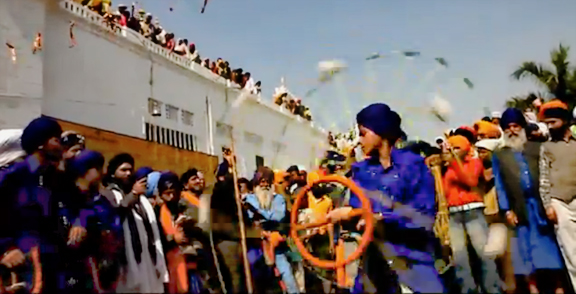
Hola Mohalla
Hola Mohalla (Gurmukhi: ਹੋਲਾ-ਮਹੱਲਾ hōlā muhalā), also called Hola, is a three-day long Sikh festival which normally falls in March. It takes place on the second day of the lunar month of Chett, usually a day after the Hindu spring festival of Holi, but sometimes coincides with it.
Read the full pageHola Mohalla (Gurmukhi: ਹੋਲਾ-ਮਹੱਲਾ hōlā muhalā), also called Hola, is a three-day long Sikh festival which normally falls in March. It takes place on the second day of the lunar month of Chett, usually a day after the Hindu spring festival of Holi, but sometimes coincides with it.
Hola Mohalla is a big festive event for Sikhs around the world.
- 11ConceptIndian
Human development (economics)
The concept of human development expands upon the notion of economic development to include social, political and even ethical dimensions. Since the mid-twentieth century, international organisations such as the United Nations and the World Bank have adopted human development as a holistic approach to evaluate a countr
Read the full pageThe concept of human development expands upon the notion of economic development to include social, political and even ethical dimensions. Since the mid-twentieth century, international organisations such as the United Nations and the World Bank have adopted human development as a holistic approach to evaluate a country’s progress that considers living conditions, social relations, individual freedoms and political institutions that contribute to freedom and well-being, in addition to standard measures of income growth.
The United Nations Development Programme defines human development as "the process of enlarging people's choices", such choices allowing people to "lead a long and healthy life, to get educated, to enjoy a decent standard of living", as well as "political freedom, other guaranteed human rights and various ingredients of self-respect". Thus, human development is about much more than economic growth, which is only a means of enlarging people's choices. Some organizations, such as the Catholic Church and the Organization of American States, use the term "integral development" to reflect something wider than "economic" development.


