Modern European ideas, C
- 1
 ConceptModern European
Counter-Enlightenment
The Counter-Enlightenment refers to a loose collection of intellectual stances that arose during the European Enlightenment in opposition to its mainstream attitudes and ideals. The Counter-Enlightenment is generally seen to have continued from the 18th century into the early 19th century, especially with the rise of R
Read the full pageThe Counter-Enlightenment refers to a loose collection of intellectual stances that arose during the European Enlightenment in opposition to its mainstream attitudes and ideals. The Counter-Enlightenment is generally seen to have continued from the 18th century into the early 19th century, especially with the rise of Romanticism. Its thinkers did not necessarily agree to a set of counter-doctrines but instead each challenged specific elements of Enlightenment thinking, such as the belief in progress, the rationality of all humans, liberal democracy, and the increasing secularisation of European society.
Scholars differ on who is to be included among the major figures of the Counter-Enlightenment. In Italy, Giambattista Vico criticised the spread of reductionism and the Cartesian method, which he saw as unimaginative and stifling creative thinking. Decades later, Joseph de Maistre in Sardinia-Piedmont and Edmund Burke in Britain both criticised the anti-religious ideas of the Enlightenment for leading to the Reign of Terror and a totalitarian police state following the French Revolution. The ideas of Jean-Jacques Rousseau and Johann Georg Hamann were also significant to the rise of the Counter-Enlightenment with French and German Romanticism respectively.
- 2ConceptModern European
Counter-experience
Counter-experience describes a perception of a non-objective (typically spiritual) phenomenon. First coined by the French phenomenologist Jean-Luc Marion, it has been elevated to book title status by the Marion scholar Kevin Hart.
Read the full pageCounter-experience describes a perception of a non-objective (typically spiritual) phenomenon. First coined by the French phenomenologist Jean-Luc Marion, it has been elevated to book title status by the Marion scholar Kevin Hart.
One may experience physical objects using the five senses. In contrast, one may counter-experience revelation, a spiritual presence, or an awareness. Feelings of sublimity or awe are often indicators of counter-experience.
- 3
 ConceptModern European
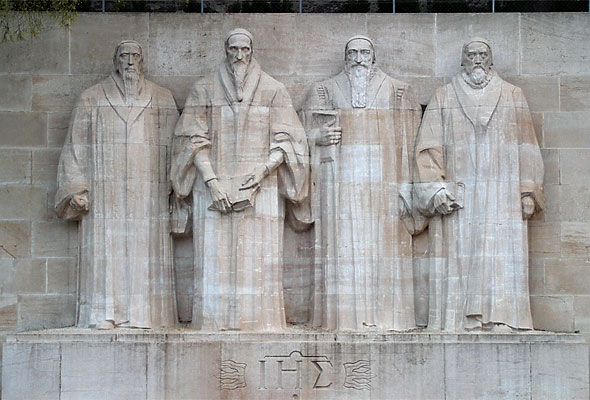
Covenant theology
Covenant theology (also known as covenantalism, federal theology, or federalism) is a biblical theology, a conceptual overview and interpretive framework for understanding the overall structure of the Bible. It is often distinguished from dispensational theology, a competing form of biblical theology.
Read the full pageCovenant theology (also known as covenantalism, federal theology, or federalism) is a biblical theology, a conceptual overview and interpretive framework for understanding the overall structure of the Bible. It is often distinguished from dispensational theology, a competing form of biblical theology. It uses the theological concept of a covenant as an organizing principle for Christian theology. In the words of Daniel R. Hyde, What unifies all the act in the "greatest drama ever staged" is that they are expressed in the Bible through the concept of covenant.The standard form of covenant theology views the history of God's dealings with mankind, from Creation to Fall to Redemption to Consummation, under the framework of three overarching theological covenants: those of works, grace, and redemption.
These three covenants are called theological because they are thought of as theologically implicit, describing and summarizing a wealth of scriptural data. Historical Reformed systems of thought treat classical covenant theology not merely as a point of doctrine or as a central dogma, but as the structure by which the biblical text organizes itself. Covenant theology is upheld by Christians of the Reformed tradition, including the Continental Reformed, Presbyterian, Congregationalist, Baptist (specifically Particular Baptists), and Reformed Anglican traditions. The most well-known form of Covenant Theology is associated with Presbyterians and comes from the Westminster Confession of Faith. A variant of the Westminster form is the Baptist federalism, also called Baptist covenant theology, a credobaptist version of the paedobaptist Presbyterian covenant theology. It is usually associated with the Particular Baptist strand and the Second London Confession of Faith of 1689. Methodist hermeneutics traditionally use a variation of this, known as Wesleyan covenant theology, which is consistent with Arminian soteriology.
- 4
 ConceptModern European
Critical philosophy
Critical philosophy (German: kritische Philosophie) is a movement inaugurated by Immanuel Kant. It is dedicated to the self-examination of reason with the aim of exposing its inherent limitations, that is, to defining the possibilities of knowledge as a prerequisite to advancing to knowledge itself.
Read the full pageCritical philosophy (German: kritische Philosophie) is a movement inaugurated by Immanuel Kant (1724–1804). It is dedicated to the self-examination of reason with the aim of exposing its inherent limitations, that is, to defining the possibilities of knowledge as a prerequisite to advancing to knowledge itself. According to Kant, only after such self-criticism does it become possible to develop metaphysics in a non-dogmatic way.
The three critical texts of the Kantian corpus are the Critique of Pure Reason, Critique of Practical Reason and Critique of Judgement, published between 1781 and 1790 and primarily concerned, respectively, with metaphysics, morality, and teleology.
- 5ConceptModern European
Critical rationalism
Critical rationalism is Karl Popper's answer to what he considered the most important problems of epistemology and philosophy of science: the problems of the growth of knowledge, notably by induction, and the demarcation of science. He adopted a fallibilist approach to these problems, especially that of induction, with
Read the full pageCritical rationalism is Karl Popper's answer to what he considered the most important problems of epistemology and philosophy of science: the problems of the growth of knowledge, notably by induction, and the demarcation of science. He adopted a fallibilist approach to these problems, especially that of induction, without falling into skepticism. His approach was to put in perspective the distinctive role of deductive logic in the development of knowledge, especially in science, in the context of a less rigorous methodology based on critical thinking. The central technical concept in the application of critical rationalism to science is falsifiability. Popper first mentioned the term "critical rationalism" in The Open Society and Its Enemies (1945) and also later in Conjectures and Refutations (1963), Unended Quest (1976), and The Myth of the Framework (1994).
Popper admitted that the truth of statements cannot be obtained using only logical definitions and deductions, as this leads to an infinite regress. For Popper, this does not prevent statements from being useful for solving problems, because they can be logically analyzed to draw logical consequences, possibly contradictions with observation statements linked to real tests. Popper wrote that the bulk of scientific activities use deductive logic to evaluate theories.
- 6
 ConceptModern European
Critical theory
Critical theory is a social, historical, and political school of thought and philosophical perspective which centers on analyzing and challenging systemic power relations in society, arguing that knowledge and social structures are fundamentally shaped by power dynamics between dominant and oppressed groups. Beyond jus
Read the full pageCritical theory is a social, historical, and political school of thought and philosophical perspective which centers on analyzing and challenging systemic power relations in society, arguing that knowledge and social structures are fundamentally shaped by power dynamics between dominant and oppressed groups. Beyond just understanding and critiquing these dynamics, it explicitly aims to transform society through praxis and collective action with an explicit sociopolitical purpose.
Critical theory's main tenets center on analyzing systemic power relations in society, focusing on the dynamics between groups with different levels of social, economic, and institutional power. Unlike traditional social theories that aim primarily to describe and understand society, critical theory explicitly seeks to critique and transform it. Thus, it positions itself as both an analytical framework and a movement for social change. Critical theory examines how dominant groups and structures influence what society considers objective truth, challenging the very notion of pure objectivity and rationality by arguing that knowledge is shaped by power relations and social context. Key principles of critical theory include examining intersecting forms of oppression, emphasizing historical contexts in social analysis, and critiquing capitalist structures. The framework emphasizes praxis (combining theory with action) and claims to highlight how lived experience, collective action, ideology, and educational systems play crucial roles in maintaining or challenging existing power structures.
- 7
 ConceptModern European
Criticism of Marxism
Criticism of Marxism has come from various political ideologies, campaigns and academic disciplines. This includes general intellectual criticism about dogmatism, a lack of internal consistency, criticism related to materialism (both philosophical and historical), arguments that Marxism is a type of historical determin
Read the full pageCriticism of Marxism has come from various political ideologies, campaigns and academic disciplines. This includes general intellectual criticism about dogmatism, a lack of internal consistency, criticism related to materialism (both philosophical and historical), arguments that Marxism is a type of historical determinism or that it necessitates a suppression of individual rights, issues with the implementation of communism and economic issues such as the distortion or absence of price signals and reduced incentives.
In addition, critics have raised empirical and epistemological concerns, arguing that Marxism relies on vague or unfalsifiable theories, resists refutation through dialectical reinterpretation, and has failed key predictions about capitalist collapse and socialist revolution.
- 8
 ConceptModern European
Criticism of religion
Criticism of religion is the criticism of the validity, concept, or ideas of religion. Historical records of criticism of religion go back to at least the 5th century BCE in ancient Greece, in Athens specifically, with Diagoras "the Atheist" of Melos.
Read the full pageCriticism of religion is the criticism of the validity, concept, or ideas of religion. Historical records of criticism of religion go back to at least the 5th century BCE in ancient Greece, in Athens specifically, with Diagoras "the Atheist" of Melos. In ancient Rome, an early known example is Lucretius' De rerum natura from the 1st century BCE.
Every exclusive religion on Earth (as well as every exclusive world view, including non-religion) that promotes exclusive truth-claims necessarily denigrates the beliefs of other worldviews. Thus, some criticisms of religion become criticisms of one or more aspects of a specific religious tradition. Critics of religion in general may view religion as any number of the following: outdated, harmful to the individual, harmful to society, an impediment to the progress of science or humanity, a source of immoral acts or customs, and a political tool for social control.
- 9
 ConceptModern European
Critique of Judgment
The Critique of Judgment (German: Kritik der Urteilskraft), also translated as the Critique of the Power of Judgment, is a 1790 book by the German philosopher Immanuel Kant. Sometimes referred to as the "third critique", the Critique of Judgment follows the Critique of Pure Reason and the Critique of Practical Reason.
Read the full pageThe Critique of Judgment (German: Kritik der Urteilskraft), also translated as the Critique of the Power of Judgment, is a 1790 book by the German philosopher Immanuel Kant. Sometimes referred to as the "third critique", the Critique of Judgment follows the Critique of Pure Reason (1781) and the Critique of Practical Reason (1788).
Immanuel Kant's Critique of Judgment is the third critique in Kant's Critical project begun in the Critique of Pure Reason and the Critique of Practical Reason (the First and Second Critiques, respectively). The book is divided into two main sections: the Critique of Aesthetic Judgment and the Critique of Teleological Judgment, and also includes a large overview of the entirety of Kant's Critical system, arranged in its final form. The so-called First Introduction was not published during Kant's lifetime, for Kant wrote a replacement for publication.
- 10ConceptModern European
Critique of Practical Reason
The Critique of Practical Reason (German: Kritik der praktischen Vernunft) is the second of Immanuel Kant's three critiques, published in 1788. Hence, it is sometimes referred to as the "second critique".
Read the full pageThe Critique of Practical Reason (German: Kritik der praktischen Vernunft) is the second of Immanuel Kant's three critiques, published in 1788. Hence, it is sometimes referred to as the "second critique". It follows on from Kant's first critique, the Critique of Pure Reason, and is one of his major works on moral philosophy. While Kant had already published one significant work in moral philosophy, the Groundwork of the Metaphysics of Morals (1785), the Critique of Practical Reason was intended to develop his account of the will as determinable by (or able to act from) the moral law alone, place his ethical views within the larger framework of his system of critical philosophy, and expand on certain themes in his moral philosophy such as the feeling of respect for the moral law and the concept of the highest good.
Kant did not initially plan to publish a separate critique of practical reason. He published the first edition of the Critique of Pure Reason in May 1781 as a "critique of the entire faculty of reason in general" (viz., of both theoretical and practical reason) and a "propaedeutic" or preparation investigating "the faculty of reason in regard to all pure a priori cognition" to set up for a metaphysics of nature and a metaphysics of morals.
- 11
 ConceptModern European
Critique of the Doctrines of Kant and Schopenhauer
"Critique of the Doctrines of Kant and Schopenhauer" (Kritik der Lehren Kant's und Schopenhauer's) is the title of the long appendix to Philipp Mainländer's Die Philosophie der Erlösung (The Philosophy of Redemption). In this appendix, Mainländer offers a criticism of the philosophy of Arthur Schopenhauer.
Read the full page"Critique of the Doctrines of Kant and Schopenhauer" (Kritik der Lehren Kant's und Schopenhauer's) is the title of the long appendix to Philipp Mainländer's Die Philosophie der Erlösung (The Philosophy of Redemption). In this appendix, Mainländer offers a criticism of the philosophy of Arthur Schopenhauer. Mainländer saw the purification of Schopenhauer's philosophy as the primary task of his life. The criticism was influential in Nietzsche's philosophical development.
"Critique of the Doctrines of Kant and Schopenhauer" is generally seen as offering a position closer to realism than the idealism of Kant and Schopenhauer. Mainländer aims to free the philosophy of Schopenhauer from its metaphysical tendencies.
- 12
 ConceptModern European
Critique of work
Critique of work or critique of labour is the critique of, or wish to abolish, work as such, and to critique what the critics of work deem wage slavery. Critique of work can be existential, and focus on how labour can be and/or feel meaningless, and stands in the way for self-realisation.
Read the full pageCritique of work or critique of labour is the critique of, or wish to abolish, work as such, and to critique what the critics of work deem wage slavery.
Critique of work can be existential, and focus on how labour can be and/or feel meaningless, and stands in the way for self-realisation. But the critique of work can also highlight how excessive work may cause harm to nature, the productivity of society, and/or society itself. The critique of work can also take on a more utilitarian character, in which work simply stands in the way for human happiness as well as health.
- 13ConceptModern European
Cruelty Free International
Cruelty Free International is a British animal rights and advocacy group that campaigns for the abolition of all animal testing. It organises certification of cruelty-free products which are marked with the symbol of a leaping bunny.
Read the full pageCruelty Free International is a British animal rights and advocacy group that campaigns for the abolition of all animal testing. It organises certification of cruelty-free products which are marked with the symbol of a leaping bunny.
It was founded in 1898 by Irish writer and suffragette Frances Power Cobbe as the British Union for the Abolition of Vivisection. In 2012, the BUAV joined with the New England Anti-Vivisection Society to establish a new international organisation to campaign against the testing of cosmetics on animals—Cruelty Free International. This was launched by BUAV supporter Ricky Gervais. In 2015, the parent organisation merged into this new organization, taking its name and branding for all its activities.
- 14ConceptModern European
Cultural capital
In sociology, cultural capital refers to the social assets of an individual—such as education, knowledge, style of speech, aesthetic preferences, and credentials—that can promote social mobility within a stratified society. Cultural capital functions as a relational resource within systems of exchange and social recogn
Read the full pageIn sociology, cultural capital refers to the social assets of an individual—such as education, knowledge, style of speech, aesthetic preferences, and credentials—that can promote social mobility within a stratified society. Cultural capital functions as a relational resource within systems of exchange and social recognition, encompassing both material and symbolic goods that are considered valuable in a given social context. It has contributed to the accumulation of social status and power and plays a central role in processes of social evaluation and legitimacy.
Pierre Bourdieu and Jean-Claude Passeron introduced the concept in the 1970s to explain persistent inequalities in educational achievement. Bourdieu later elaborated the theory in The Forms of Capital (1986), distinguishing three forms: embodied cultural capital, objectified cultural capital, and institutionalized cultural capital. Embodied cultural capital consists of internalized dispositions and competencies; objectified cultural capital refers to cultural goods such as books or artworks; and institutionalized cultural capital is represented by formally recognized credentials and qualifications.


