Modern European ideas, R–S
- 1ConceptModern European
Rhizome (philosophy)
A rhizome is a concept in post-structuralism describing an assemblage that allows connections between any of its constituent elements, regardless of any predefined ordering, structure, or entry point. It is a central concept in the work of French theorists Deleuze and Guattari.
Read the full pageA rhizome is a concept in post-structuralism describing an assemblage that allows connections between any of its constituent elements, regardless of any predefined ordering, structure, or entry point. It is a central concept in the work of French theorists Deleuze and Guattari.
Gilles Deleuze and Felix Guattari use the term "rhizome" frequently in the development of their theories on schizoanalysis (now generally referred to as rhizomatics, ecosophy, pragmatics, micropolitics, or nomadology). They first expounded on the topic in their book Anti-Oedipus (1972), and continued in their follow-up work, A Thousand Plateaus (1980). This was later developed into a set of pedagogical theories on rhizomatic learning.
- 2ConceptModern European
Rhythmanalysis
Rhythmanalysis: Space, Time and Everyday Life is a collection of essays by Marxist sociologist and urbanist philosopher Henri Lefebvre. The book outlines a method for analyzing the rhythms of urban spaces and the effects of those rhythms on the inhabitants of those spaces.
Read the full pageRhythmanalysis: Space, Time and Everyday Life is a collection of essays by Marxist sociologist and urbanist philosopher Henri Lefebvre. The book outlines a method for analyzing the rhythms of urban spaces and the effects of those rhythms on the inhabitants of those spaces. It builds on his past work, with which he argued space is a production of social practices. Two concluding essays are co-authored by Catherine Régulier and had been previously published in the 1980's.
The book is considered to be the fourth volume in his Critique of Everyday Life. Published after his death in 1992, Rhythmanalysis is Lefebvre's last book. It was first translated into English by Stuart Elden and Gerald Moore in 2004.
- 3ConceptModern European
Robert Hanna (philosopher)
Robert Alan Hanna is a Canadian independent philosopher and the director of the philosophical working group Philosophy without Borders (PWB).
Read the full pageRobert Alan Hanna (born 1957) is a Canadian independent philosopher and the director of the philosophical working group Philosophy without Borders (PWB).
Hanna received his PhD in philosophy from Yale University in 1989 with a thesis supervised by Karsten Harries. Hanna has written works on logic and rationality, Immanuel Kant, analytic philosophy, and the philosophy of mind and knowledge.
- 4ConceptModern European
Romanitas
Romanitas is the collection of political and cultural concepts and practices by which the Romans defined themselves. It is a Latin word, coined in the third century AD, meaning "Roman-ness" and has been used by modern historians as shorthand to refer to Roman identity and self-image.
Read the full pageRomanitas is the collection of political and cultural concepts and practices by which the Romans defined themselves. It is a Latin word, coined in the third century AD, meaning "Roman-ness" and has been used by modern historians as shorthand to refer to Roman identity and self-image.
Romanitas means, as a rough approximation, Roman-ness in Latin, although it has also been translated as "Romanism, the Roman way or manner". The term, not common in Roman sources, was coined by the 3rd century Roman writer Tertullian, an early Christian from North Africa, in his work de Pallio (IV,1). Tertullian used the term pejoratively to refer to those in his native Carthage who aped Roman culture.
- 5
 ConceptModern European
Russian icons
Russian icons represent a form of religious art that developed in Eastern Orthodox Christianity after Kievan Rus' adopted the faith from the Eastern Roman (Byzantine) Empire in AD 988. Initially following Byzantine artistic standards, these icons were integral to religious practices and cultural traditions in Russia.
Read the full pageRussian icons represent a form of religious art that developed in Eastern Orthodox Christianity after Kievan Rus' adopted the faith from the Eastern Roman (Byzantine) Empire in AD 988. Initially following Byzantine artistic standards, these icons were integral to religious practices and cultural traditions in Russia. Over time, Russian iconography evolved, incorporating local styles and elements that expanded its visual and symbolic vocabulary.
The personal, innovative and creative traditions of Western European religious art were largely lacking in Russia before the 17th century, when Russian icon painting became strongly influenced by religious paintings and engravings from both Protestant and Catholic Europe. In the mid-17th-century changes in liturgy and practice instituted by Patriarch Nikon resulted in a split in the Russian Orthodox Church. The traditionalists, the persecuted "Old Ritualists" or "Old Believers", continued the traditional stylization of icons, while the State Church modified its practice. From that time icons began to be painted not only in the traditional stylized and non-realistic mode, but also in a mixture of Russian stylization and Western European realism, and in a Western European manner very much like that of Catholic religious art of the time. These types of icons, while found in Russian Orthodox churches, are also sometimes found in various sui juris rites of the Catholic Church.
- 6ConceptModern European
Ryle's regress
In philosophy, Ryle's regress is a classic argument against cognitivist theories, and concludes that such theories are essentially meaningless as they do not explain what they purport to.
Read the full pageIn philosophy, Ryle's regress is a classic argument against cognitivist theories, and concludes that such theories are essentially meaningless as they do not explain what they purport to.
The philosopher Gilbert Ryle was concerned with what he called the intellectualist legend (also known as the "Dogma of the ghost in the machine," the "Two-Lives Legend," the "Two-Worlds Story," or the "Double-Life Legend") which requires intelligent acts to be the product of the conscious application of mental rules. In other words, Ryle argued against Cartesian dualism.
- 7ConceptModern European
Sage writing
Sage writing was a genre of creative nonfiction popular in the Victorian era. The concept originates with John Holloway's 1953 book The Victorian Sage: Studies in Argument.
Read the full pageSage writing was a genre of creative nonfiction popular in the Victorian era. The concept originates with John Holloway's 1953 book The Victorian Sage: Studies in Argument.
Sage writing is a development from ancient wisdom literature in which the writer chastises and instructs the reader about contemporary social issues, often utilising discourses of philosophy, history, politics, and economics in non-technical ways. Prominent examples of the genre include writings by Thomas Carlyle, Matthew Arnold, John Ruskin, and Henry David Thoreau. Some 20th-century writers, such as Joan Didion and New Journalists such as Norman Mailer and Tom Wolfe, have also been identified as sage writers.
- 8
 ConceptModern European
Schema (Kant)
In Kantian philosophy, a transcendental schema (plural: schemata; from Ancient Greek: σχῆμα, 'form, shape, figure') is the procedural rule by which a category or pure, non-empirical concept is associated with a sense impression. A private, subjective intuition is thereby discursively thought to be a representation of a
Read the full pageIn Kantian philosophy, a transcendental schema (plural: schemata; from Ancient Greek: σχῆμα, 'form, shape, figure') is the procedural rule by which a category or pure, non-empirical concept is associated with a sense impression. A private, subjective intuition is thereby discursively thought to be a representation of an external object. Transcendental schemata are supposedly produced by the imagination in relation to time.
Kant created an architectonic system in which there is a progression of phases from the most formal to the most empirical: "Kant develops his system of corporeal nature in the following way. He starts in the Critique with the most formal act of human cognition, called by him the transcendental unity of apperception, and its various aspects, called the logical functions of judgment. He then proceeds to the pure categories of the understanding, and then to the schematized categories, and finally to the transcendental principles of nature in general." It is within this system that the transcendental schemata are supposed to serve a crucial purpose. Many interpreters of Kant have emphasized the importance of the schematism.
- 9
 ConceptModern European
Science of Logic
Science of Logic (German: Wissenschaft der Logik), first published between 1812 and 1816, is the work in which Georg Wilhelm Friedrich Hegel outlined his vision of logic. Hegel's logic is a system of dialectics, i.e., a dialectical metaphysics: it is a development of the principle that thought and being constitute a si
Read the full pageScience of Logic (German: Wissenschaft der Logik), first published between 1812 and 1816, is the work in which Georg Wilhelm Friedrich Hegel outlined his vision of logic. Hegel's logic is a system of dialectics, i.e., a dialectical metaphysics: it is a development of the principle that thought and being constitute a single and active unity. Science of Logic also incorporates the traditional Aristotelian syllogism: it is conceived as a phase of the "original unity of thought and being" rather than as a detached, formal instrument of inference.
For Hegel, the most important achievement of German idealism, starting with Immanuel Kant and culminating in his own philosophy, was the argument that reality (being) is shaped by thought and is, in a strong sense, identical to thought. Thus ultimately the structures of thought and being, subject and object, are identical. Since for Hegel the underlying structure of all of reality is ultimately rational, logic is not merely about reasoning or argument but rather is also the rational, structural core of all of reality and every dimension of it. Thus Hegel's Science of Logic includes among other things analyses of being, nothingness, becoming, existence, reality, essence, reflection, concept, and method.
- 11
 ConceptModern European
Scientist
A scientist is an expert in one or more specific fields of science and who habitually uses scientific methods in carrying out scientific research to advance knowledge in science. In classical antiquity, there was no real ancient analog of a modern scientist.
Read the full pageA scientist is an expert in one or more specific fields of science and who habitually uses scientific methods in carrying out scientific research to advance knowledge in science.
In classical antiquity, there was no real ancient analog of a modern scientist. Instead, philosophers engaged in the philosophical study of nature called natural philosophy. Though Thales (c. 624–545 BC) was arguably the first scientist for describing how cosmic events may be seen as natural, not necessarily caused by gods, it was not until the 19th century that the term scientist came into regular use: it was coined by the theologian, philosopher, and historian of science William Whewell to describe Mary Somerville.
- 12ConceptModern European
Secularity
Secularity or secularness (from Latin sæculum, 'worldly' or 'of a generation' or 'century') is the state of being unrelated to or neutral in regard to religion. The origins of secularity as a concept can be traced to the Bible, and it was fleshed out through Christian history into the modern era.
Read the full pageSecularity or secularness (from Latin sæculum, 'worldly' or 'of a generation' or 'century') is the state of being unrelated to or neutral in regard to religion.
The origins of secularity as a concept can be traced to the Bible, and it was fleshed out through Christian history into the modern era. Since the Middle Ages, there have been clergy not pertaining to a religious order called "secular clergy". Furthermore, secular and religious entities were not separated in the medieval period, but coexisted and interacted naturally.
- 13
 ConceptModern European
Self-awareness
In the philosophy of self, self-awareness is the awareness and reflection of one's own personality or individuality, including traits, feelings, and behaviors. It is not to be confused with consciousness in the sense of qualia.
Read the full pageIn the philosophy of self, self-awareness is the awareness and reflection of one's own personality or individuality, including traits, feelings, and behaviors. It is not to be confused with consciousness in the sense of qualia. While consciousness is being aware of one's body and environment, self-awareness is the recognition of that consciousness. Self-awareness is how an individual experiences and understands their own character, feelings, motives, and desires. Because the term is used in both philosophical and psychological contexts, researchers distinguish between different forms of self-awareness, ranging from awareness of consciousness itself to awareness of oneself within social situations.
The term self-awareness is used across several disciplines to describe related but distinct phenomena. Broadly, it refers to the capacity to direct attention inward and recognize oneself as an individual, separate from the environment and from other beings. However, researchers distinguish between two main forms: reflective self-awareness and social self-awareness.
- 14
 ConceptModern European
Self-hating Jew
The terms "self-hating Jew", "self-loathing Jew", and "auto-antisemite" are pejorative terms used to describe Jews that oppose certain characteristics that the claimant considers core to Jewish identity. Early claims of self-hate were used to describe Jews who had internalized antisemitic tropes.
Read the full pageThe terms "self-hating Jew", "self-loathing Jew", and "auto-antisemite" are pejorative terms used to describe Jews that oppose certain characteristics that the claimant considers core to Jewish identity.
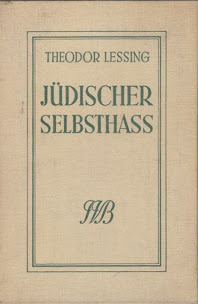
Early claims of self-hate were used to describe Jews who had internalized antisemitic tropes. Recognition of the concept gained widespread currency after German-Jewish philosopher Theodor Lessing published his 1930 book Der jüdische Selbsthass (lit. 'Jewish Self-Hatred'), which sought to explain a perceived inclination among secular Jewish intellectuals towards inciting antisemitism by denouncing Judaism. The term was also used to describe Jewish people whose viewpoints, especially favoring Jewish assimilation, Jewish secularism, limousine liberalism, or anti-Judaism were perceived to reflect self-hatred.


