Modern European ideas, R
- 1ConceptModern European
Ramsey sentence
Ramsey sentences are formal logical reconstructions of theoretical propositions attempting to draw a line between science and metaphysics. A Ramsey sentence aims at rendering propositions containing non-observable theoretical terms (terms employed by a theoretical language) clear by substituting them with observational
Read the full pageRamsey sentences are formal logical reconstructions of theoretical propositions attempting to draw a line between science and metaphysics. A Ramsey sentence aims at rendering propositions containing non-observable theoretical terms (terms employed by a theoretical language) clear by substituting them with observational terms (terms employed by an observation language, also called empirical language).
Ramsey sentences were introduced by the logical empiricist philosopher Rudolf Carnap. However, they should not be confused with Carnap sentences, which are neutral on whether there exists anything to which the term applies.
- 2ConceptModern European
Ramsey theory
Ramsey theory, named after the British mathematician and philosopher Frank P. Ramsey, is a branch of the mathematical field of combinatorics that focuses on the appearance of order in a substructure given a structure of a known size.
Read the full pageRamsey theory, named after the British mathematician and philosopher Frank P. Ramsey, is a branch of the mathematical field of combinatorics that focuses on the appearance of order in a substructure given a structure of a known size. Problems in Ramsey theory typically ask a question of the form: "how big must some structure be to guarantee that a particular property holds?"
A typical result in Ramsey theory starts with some mathematical structure that
- 3ConceptModern European
Ramsey–Lewis method
The Ramsey–Lewis method is a method for defining terms found in theoretical frameworks (such as in scientific theories), credited to mathematician Frank P. Ramsey and philosopher David K.
Read the full pageThe Ramsey–Lewis method is a method for defining terms found in theoretical frameworks (such as in scientific theories), credited to mathematician Frank P. Ramsey and philosopher David K. Lewis. By using this method, a set of theoretical terms appearing in a theory can be defined implicitly by the assertions of the theory itself.
A scientific theory which attempts to describe "electrons" is inherently abstract, as no one has ever observed an electron directly. Thus, the origin and content of the concept of "electron" is questionable. What does the word exactly signify? Ramsey and Lewis proposed that the meaning of the term "electron" is implicitly generated by the scientific theory that describes it, via all its assertions about electrons. Electrons are those things about which all the statements of the theory are true.
- 4ConceptModern European
Rational egoism
Rational egoism (also called rational selfishness) is the principle that an action is rational if and only if it maximizes one's self-interest. As such, it is considered a normative form of egoism, though historically it has been associated with both positive and normative forms.
Read the full pageRational egoism (also called rational selfishness) is the principle that an action is rational if and only if it maximizes one's self-interest. As such, it is considered a normative form of egoism, though historically it has been associated with both positive and normative forms. In its strong form, rational egoism holds that to not pursue one's own interest is unequivocally irrational. Its weaker form, however, holds that while it is rational to pursue self-interest, failing to pursue self-interest is not always irrational.
Originally an element of nihilist philosophy in Russia, it was later popularised in English-speaking countries by Russian-American author Ayn Rand.
- 5ConceptModern European
Rational reconstruction
Rational reconstruction is a philosophical term with several distinct meanings. It is found in the work of Jürgen Habermas and Imre Lakatos.
Read the full pageRational reconstruction is a philosophical term with several distinct meanings. It is found in the work of Jürgen Habermas and Imre Lakatos.
For Habermas, rational reconstruction is a philosophical and linguistic method that systematically translates intuitive knowledge of rules into a logical form. In other words, it is an approach to science and philosophy which attempts to put meanings into language properly. It is a type of formal analysis that makes explicit and systematizes the universal and inescapable conditions for the possibility of certain types of phenomena. Rational reconstruction explicates the deep generative structures that give rise to and allow for particular performances, behaviours, and other symbolically pre-structured realities. It is a procedure that is intimately tied to the interpretation of reality, and can deal with an extremely broad range of questions (but not all).
- 6ConceptModern European
Rationality
Rationality is the quality of being guided by or based on reason. In this regard, a person acts rationally if they have a good reason for what they do, or a belief is rational if it is based on strong evidence.
Read the full pageRationality is the quality of being guided by or based on reason. In this regard, a person acts rationally if they have a good reason for what they do, or a belief is rational if it is based on strong evidence. This quality can apply to an ability, as in a rational animal, to a psychological process, like reasoning, to mental states, such as beliefs and intentions, or to persons who possess these other forms of rationality. A thing that lacks rationality is either arational, if it is outside the domain of rational evaluation, or irrational, if it belongs to this domain but does not fulfill its standards.
There are many discussions about the essential features shared by all forms, or accounts, of rationality. According to reason-responsiveness accounts, to be rational is to be responsive to reasons. For example, dark clouds are a reason for taking an umbrella, which is why it is rational for an agent to do so in response. An important rival to this approach are coherence-based accounts, which define rationality as internal coherence among the agent's mental states. Many rules of coherence have been suggested in this regard, for example, that one should not hold contradictory beliefs or that one should intend to do something if one believes that one should do it.
- 7ConceptModern European
Rationalization (sociology)
In sociology, rationalization (or rationalisation) is the replacement of traditions, values, and emotions as motivators for behavior in society with concepts based on rationality and reason. The term was coined by Max Weber, a German sociologist, jurist, and economist, and it is a central theme in his work.
Read the full pageIn sociology, rationalization (or rationalisation) is the replacement of traditions, values, and emotions as motivators for behavior in society with concepts based on rationality and reason. The term was coined by Max Weber, a German sociologist, jurist, and economist, and it is a central theme in his work.
The term 'rational' is seen in the context of people, their expressions, and or their actions. This term can be applied to people who can perform speech or in general any action, in addition to the views of rationality within people. It can be seen in the perspective of something such as a worldview or perspective (idea). For example, the implementation of bureaucracies in government is a kind of rationalization, as is the construction of high-efficiency living spaces in architecture and urban planning. A potential reason as to why rationalization of a culture may take place in the modern era is the process of globalization. Countries are becoming increasingly interlinked, and with the rise of technology, it is easier for countries to influence each other through social networking, the media and politics. An example of rationalization in place would be the case of witch doctors in certain parts of Africa. Whilst many locals view them as an important part of their culture and traditions, development initiatives and aid workers have tried to rationalize the practice in order to educate the local people in modern medicine and practice.
- 8
 ConceptModern European
Raven paradox
The raven paradox, also known as Hempel's paradox, Hempel's ravens or, rarely, the paradox of indoor ornithology, is a paradox arising from the question of what constitutes evidence for the truth of a statement. Observing objects that are neither black nor ravens may formally increase the likelihood that all ravens are
Read the full pageThe raven paradox, also known as Hempel's paradox, Hempel's ravens or, rarely, the paradox of indoor ornithology, is a paradox arising from the question of what constitutes evidence for the truth of a statement. Observing objects that are neither black nor ravens may formally increase the likelihood that all ravens are black even though, intuitively, these observations are unrelated.
This problem was proposed by the logician Carl Gustav Hempel in the 1940s to illustrate a contradiction between inductive logic and intuition.
- 9ConceptModern European
Reason
Reason is the capacity to consciously apply logic by drawing valid conclusions from new or existing information, with the aim of seeking truth. It is associated with activities considered characteristic of humans, including philosophy, religion, science, language, and mathematics, and is generally considered a distingu
Read the full pageReason is the capacity to consciously apply logic by drawing valid conclusions from new or existing information, with the aim of seeking truth. It is associated with activities considered characteristic of humans, including philosophy, religion, science, language, and mathematics, and is generally considered a distinguishing ability possessed by humans. The term "reason" is sometimes used to refer to rationality, although the latter is more about its application.
Reasoning involves using more-or-less rational processes of thinking and cognition to extrapolate from one's existing knowledge to generate new knowledge, and involves the use of one's intellect. The field of logic is the study of how humans can use formal reasoning to produce logically valid arguments and true conclusions. Reasoning may be subdivided into forms of logical reasoning, such as deductive reasoning, inductive reasoning, and abductive reasoning.
- 10ConceptModern European
Red fascism
Red fascism is a concept equating Stalinism and other variants of Marxism–Leninism or communism in general with fascism. As a term, it dates back to the 1920s and was originally used by left-wing individuals who were critics of Bolshevism; by the 1940s and the Cold War era, particularly in the United States, it was ada
Read the full pageRed fascism is a concept equating Stalinism and other variants of Marxism–Leninism or communism in general with fascism. As a term, it dates back to the 1920s and was originally used by left-wing individuals who were critics of Bolshevism; by the 1940s and the Cold War era, particularly in the United States, it was adapted as an anti-communist slogan within the framework of totalitarianism. Since the 1990s, the concept of red fascism began to overlap with that of red–brownism. Others associated it with red–green–brown alliances, "left-wing fascism" and the regressive left, and Islamofascism.
In the early 20th century, the original Italian fascists initially claimed to be "neither left-wing nor right-wing"; by 1921, they began to identify themselves as the "extreme right", and their founder Benito Mussolini explicitly affirmed that fascism is opposed to socialism and other left-wing ideologies. Accusations that the leaders of the Soviet Union during the Stalin era acted as "red fascists" have come from left-wing figures who identified as anarchists, left communists, left-wing nationalists, social democrats, and other democratic socialists, as well as liberals and among right-wing circles both closer to and further from the political centre. The comparison of Nazism and Stalinism is controversial in academia.
- 11ConceptModern European
Redundancy theory of truth
According to the redundancy theory of truth (also known as the disquotational theory of truth), asserting that a statement is true is completely equivalent to asserting the statement itself. For example, asserting the sentence "'Snow is white' is true" is equivalent to asserting the sentence "Snow is white".
Read the full pageAccording to the redundancy theory of truth (also known as the disquotational theory of truth), asserting that a statement is true is completely equivalent to asserting the statement itself. For example, asserting the sentence "'Snow is white' is true" is equivalent to asserting the sentence "Snow is white". The philosophical redundancy theory of truth is a deflationary theory of truth.
Redundancy theorists infer from this premise that truth is a redundant concept—in other words, that "truth" is merely a word that it is conventional to use in certain contexts but not one that points to anything in reality. The theory is commonly attributed to Frank P. Ramsey, who argued that the use of words like fact and truth was nothing but a roundabout way of asserting a proposition, and that treating these words as separate problems in isolation from judgment was merely a "linguistic muddle", though there remains some debate as to the correct interpretation of his position (Le Morvan 2004).
- 13
 ConceptModern European
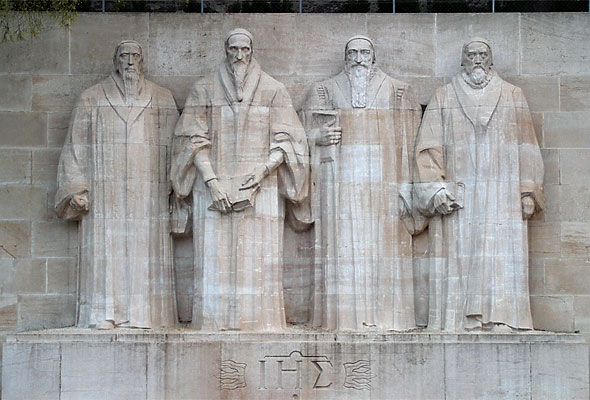
Regulative principle of worship
The regulative principle of worship is a Reformed Christian doctrine held by the Continental Reformed, Anabaptist, Presbyterian, Congregationalist and Baptist traditions that God commands churches to conduct public services of worship using certain distinct elements affirmatively found in the Bible, and conversely, tha
Read the full pageThe regulative principle of worship is a Reformed Christian doctrine held by the Continental Reformed, Anabaptist, Presbyterian, Congregationalist and Baptist traditions that God commands churches to conduct public services of worship using certain distinct elements affirmatively found in the Bible, and conversely, that God prohibits any and all other practices in public worship. The doctrine further determines these affirmed elements to be those set forth in scripture by express commands or examples or, if not expressed, those implied logically by good and necessary consequence. The regulative principle thus provides a governing concept of worship as obedience to God, identifies the set of specific practical elements constituting obedient worship, and identifies and excludes disobedient practices.
The regulative principle of worship is held, practiced, and vigorously maintained by conservative Reformed churches, the Restoration Movement, and other conservative Protestant denominations. Historic confessional standards stating the doctrine include the Westminster Confession of Faith, the Heidelberg Catechism, the Belgic Confession, the Orthodox Creed, and the Second London Baptist Confession of Faith.
- 14ConceptModern European
Reification (Marxism)
In Marxist philosophy, reification (Verdinglichung, "making into a thing") is the process by which human social relations are perceived as inherent attributes of the people involved in them, or attributes of some product of the relation, such as a traded commodity. As a practice of economics, reification transforms obj
Read the full pageIn Marxist philosophy, reification (Verdinglichung, "making into a thing") is the process by which human social relations are perceived as inherent attributes of the people involved in them, or attributes of some product of the relation, such as a traded commodity.
As a practice of economics, reification transforms objects into subjects and subjects into objects, with the result that subjects (people) are rendered passive (of determined identity), whilst objects (commodities) are rendered as the active factor that determines the nature of a social relation. Analogously, the term hypostatization describes an effect of reification that results from presuming the existence of any object that can be named and presuming the existence of an abstractly conceived object, which is a fallacy of reification of ontological and epistemological interpretation.
