Modern European ideas, P
- 1ConceptModern European
Practical philosophy
Practical philosophy concerns itself mainly with subjects that have applications in life, like the study of values, norms, politics, art, etc. The modern division of philosophy into theoretical philosophy and practical philosophy has its origin in Aristotle's categories of natural and moral philosophy.
Read the full pagePractical philosophy concerns itself mainly with subjects that have applications in life, like the study of values, norms, politics, art, etc. The modern division of philosophy into theoretical philosophy and practical philosophy has its origin in Aristotle's categories of natural and moral philosophy. The one has theory for its object, and the other practice.
Examples of practical philosophy subjects are:
- 2ConceptModern European
Practical reason
In philosophy, practical reason is the use of reason to decide how to act. It contrasts with theoretical reason, often called speculative reason, the use of reason to decide what to believe.
Read the full pageIn philosophy, practical reason is the use of reason to decide how to act. It contrasts with theoretical reason, often called speculative reason, the use of reason to decide what to believe. For example, agents use practical reason to decide whether to build a telescope, but theoretical reason to decide which of two theories of light and optics is the best.
Practical reason is understood by most philosophers as determining a plan of action. Thomistic ethics defines the first principle of practical reason as "good is to be done and pursued, and evil is to be avoided." For Kant, practical reason has a law-abiding quality because the categorical imperative is understood to be binding one to one's duty rather than subjective preferences. Utilitarians tend to see reason as an instrument for the satisfactions of wants and needs.
- 3ConceptModern European
Praxis (process)
Praxis is the process by which a theory, lesson, or skill is enacted, embodied, realized, applied, or put into practice. "Praxis" may also refer to the act of engaging, applying, exercising, realizing, or practising ideas. This has been a recurrent topic in the field of philosophy, discussed in the writings of Plato, A
Read the full pagePraxis is the process by which a theory, lesson, or skill is enacted, embodied, realized, applied, or put into practice. "Praxis" may also refer to the act of engaging, applying, exercising, realizing, or practising ideas. This has been a recurrent topic in the field of philosophy, discussed in the writings of Plato, Aristotle, St. Augustine, Francis Bacon, Immanuel Kant, Søren Kierkegaard, Karl Marx, Martin Heidegger, Hannah Arendt, Jean-Paul Sartre, and many others. It has meaning in the political, educational, spiritual and medical realms.
The word praxis is from Ancient Greek: πρᾶξις, romanized: praxis. In Ancient Greek the word praxis referred to activity engaged in by free people. The philosopher Aristotle held that there were three basic activities of humans: theoria (thinking), poiesis (making), and praxis (doing). Corresponding to these activities were three types of knowledge: theoretical, the end goal being truth; poietical, the end goal being production; and practical, the end goal being action. Aristotle further divided the knowledge derived from praxis into ethics, economics, and politics. He also distinguished between eupraxia (εὐπραξία, "good praxis") and dyspraxia (δυσπραξία, "bad praxis, misfortune").
- 4
 ConceptModern European
Predestination in Calvinism
Predestination is a doctrine in Calvinism dealing with the question of the control that God exercises over the world. In the words of the Westminster Confession of Faith, God "freely and unchangeably ordained whatsoever comes to pass." The second use of the word "predestination" applies this to salvation, and refers to
Read the full pagePredestination is a doctrine in Calvinism dealing with the question of the control that God exercises over the world. In the words of the Westminster Confession of Faith, God "freely and unchangeably ordained whatsoever comes to pass." The second use of the word "predestination" applies this to salvation, and refers to the belief that God appointed the eternal destiny of some to salvation by grace, while leaving the remainder to receive eternal damnation for all their sins, even their original sin. The former is called "unconditional election", and the latter "reprobation". In Calvinism, some people are predestined and effectually called in due time (regenerated/born again) to faith by God while all others are reprobated.
Calvinism places more emphasis on election compared to other branches of Christianity.
- 5ConceptModern European
Predicate (logic)
In logic, a predicate is a non-logical symbol that represents a property or a relation, though, formally, does not need to represent anything at all. For instance, in the first-order formula P(a), the symbol P is a predicate that applies to the individual constant a which evaluates to either true or false.
Read the full pageIn logic, a predicate is a non-logical symbol that represents a property or a relation, though, formally, does not need to represent anything at all. For instance, in the first-order formula P(a), the symbol P is a predicate that applies to the individual constant a which evaluates to either true or false. Similarly, in the formula R(a,b), the symbol R is a predicate that applies to the individual constants a and b. Predicates are considered a primitive notion of first-order and higher-order logic, and are therefore not defined in terms of other more basic concepts.
The term derives from the grammatical term "predicate", meaning a word or phrase that represents a property or relation.
- 6
 ConceptModern European
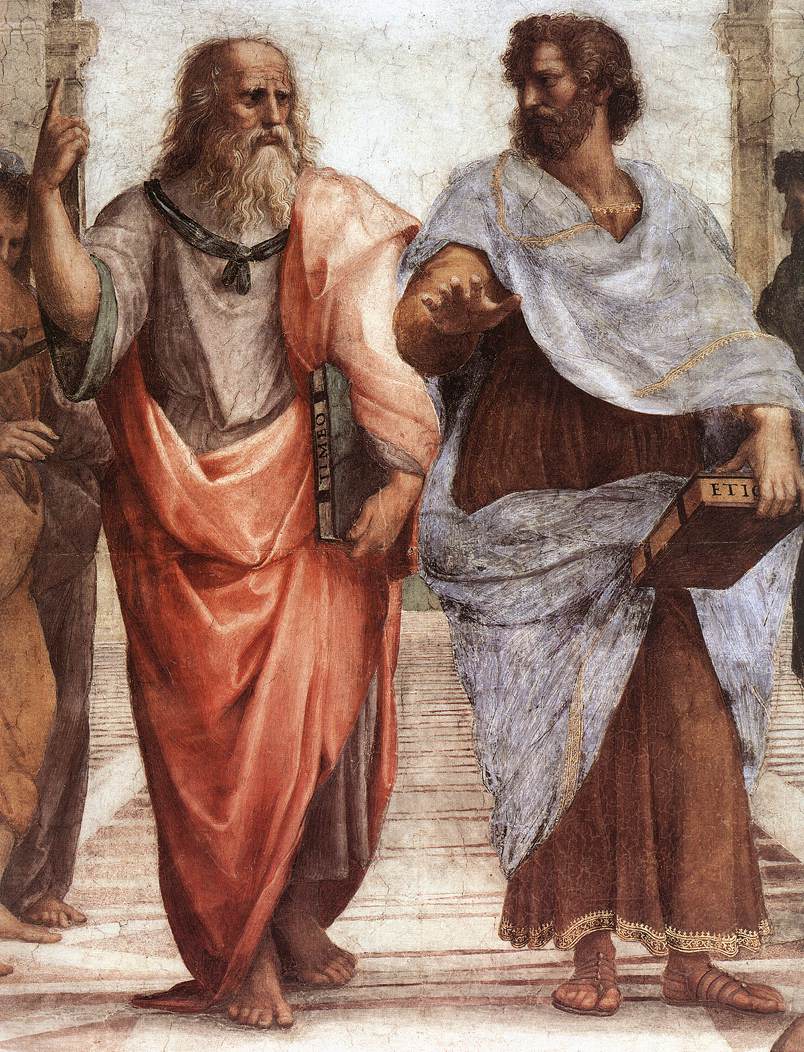
Predication (philosophy)
In philosophy, predication is an act of judgement where one term is subsumed under another. A comprehensive conceptualization describes it as the understanding of the relation expressed by a predicative structure primordially (i.e. both originally and primarily) through the opposition between particular and general or
Read the full pageIn philosophy, predication is an act of judgement where one term is subsumed under another. A comprehensive conceptualization describes it as the understanding of the relation expressed by a predicative structure primordially (i.e. both originally and primarily) through the opposition between particular and general or the one and the many.
Predication is also associated or used interchangeably with the concept of attribution where both terms pertain to the way judgment and ideas acquire a new property in the second operation of the mind (or the mental operation of judging).
- 7ConceptModern European
Preference utilitarianism
Preference utilitarianism (also known as preferentialism) is a form of utilitarianism in contemporary philosophy. Unlike value monist forms of utilitarianism, preferentialism values actions that fulfill the most personal interests for the entire circle of people affected by said action.
Read the full pagePreference utilitarianism (also known as preferentialism) is a form of utilitarianism in contemporary philosophy. Unlike value monist forms of utilitarianism, preferentialism values actions that fulfill the most personal interests for the entire circle of people affected by said action.
Unlike classical utilitarianism, in which right actions are defined as those that maximize pleasure and minimize pain, preference utilitarianism entails promoting actions that fulfil the interests (i.e., preferences) of those beings involved. Here beings might be rational, that is to say, that their interests have been carefully selected and they have not made some kind of error. However, 'beings' can also be extended to all sentient beings, even those who lack the capacity to contemplate long-term interests and consequences. Since what is good and right depends solely on individual preferences, there can be nothing that is in itself good or bad: for preference utilitarians, the source of both morality and ethics in general is subjective preference. Preference utilitarianism therefore can be distinguished by its acknowledgement that every person's experience of satisfaction is unique.
- 8ConceptModern European
Prehension (philosophy)
Prehension is a fundamental concept in Alfred North Whitehead's process philosophy. It establishes the basic experiential relation applying to all entities of reality by which the present is realised out of the past.
Read the full pagePrehension is a fundamental concept in Alfred North Whitehead's process philosophy. It establishes the basic experiential relation applying to all entities of reality by which the present is realised out of the past. Entities selectively incorporate aspects of what they perceive, or prehend, into themselves. It is central to Whitehead's metaphysics and it identifies a mechanism by which both perception and memory are essentially the products of a common metaphysical process.
In his 1925 book Science and the Modern World, Whitehead defined the term prehension as "uncognitive apprehension".
- 9ConceptModern European
Present age
The "present age" is a concept in the philosophy of Søren Kierkegaard. A formulation of the modern age can be found in Kierkegaard's work Two Ages: A Literary Review: Our age is essentially one of understanding and reflection, without passion, momentarily bursting into enthusiasm, and shrewdly relapsing into repose...
Read the full pageThe "present age" is a concept in the philosophy of Søren Kierkegaard. A formulation of the modern age can be found in Kierkegaard's work Two Ages: A Literary Review:
Our age is essentially one of understanding and reflection, without passion, momentarily bursting into enthusiasm, and shrewdly relapsing into repose. ... There is no more action or decision in our day than there is perilous delight in swimming in shallow waters.
- 10ConceptModern European
Principle of compositionality
In semantics, mathematical logic and related disciplines, the principle of compositionality (also known as semantic compositionalism) is the principle that the meaning of a complex expression is determined by the meanings of its constituent expressions and the rules used to combine them. The principle is also called Fr
Read the full pageIn semantics, mathematical logic and related disciplines, the principle of compositionality (also known as semantic compositionalism) is the principle that the meaning of a complex expression is determined by the meanings of its constituent expressions and the rules used to combine them. The principle is also called Frege's principle, because Gottlob Frege is widely credited for the first modern formulation of it. However, the principle has never been explicitly stated by Frege, and arguably it was already assumed by George Boole decades before Frege's work.
While widely adopted in formal semantic theory, the principle of compositionality faces challenges from linguistic phenomena such as contextuality, idiomatic expressions, and quotations, which appear to defy straightforward compositional analysis.
- 11ConceptModern European
Prisca theologia
Prisca theologia ("ancient theology") is the doctrine that asserts that a single, true theology exists which threads through all religions, and which was anciently given by God to humans.
Read the full pagePrisca theologia ("ancient theology") is the doctrine that asserts that a single, true theology exists which threads through all religions, and which was anciently given by God to humans.
The term prisca theologia appears to have been first used by Marsilio Ficino in the 15th century. Ficino and
- 12
 ConceptModern European
Probability theory
Probability theory or probability calculus is the branch of mathematics concerned with probability. Although there are several different probability interpretations, probability theory treats the concept in a rigorous mathematical manner by expressing it through a set of axioms.
Read the full pageProbability theory or probability calculus is the branch of mathematics concerned with probability. Although there are several different probability interpretations, probability theory treats the concept in a rigorous mathematical manner by expressing it through a set of axioms. Typically these axioms formalise probability in terms of a probability space, which assigns a measure taking values between 0 and 1, termed the probability measure, to a set of outcomes called the sample space. Any specified subset of the sample space is called an event.
Central subjects in probability theory include discrete and continuous random variables, probability distributions, and stochastic processes (which provide mathematical abstractions of non-deterministic or uncertain processes or measured quantities that may either be single occurrences or evolve over time in a random fashion).
- 13ConceptModern European
Procedural knowledge
Procedural knowledge, also known as know-how, is the knowledge exercised in the performance of some task. Unlike descriptive knowledge (also known as declarative knowledge, propositional knowledge or "knowing-that"), which involves knowledge of specific propositions (e.g. "I know that snow is white"), that is, facts th
Read the full pageProcedural knowledge, also known as know-how, is the knowledge exercised in the performance of some task. Unlike descriptive knowledge (also known as declarative knowledge, propositional knowledge or "knowing-that"), which involves knowledge of specific propositions (e.g. "I know that snow is white"), that is, facts that can be expressed using declarative sentences, procedural knowledge involves one's ability to do something (e.g. "I know how to change a flat tire"). A person does not need to verbally articulate their procedural knowledge for it to count as knowledge, since procedural knowledge requires only knowing how to correctly perform an action or exercise a skill.
The term procedural knowledge has narrower but related technical uses in both cognitive psychology and intellectual property law.
- 14ConceptModern European
Process theology
Process theology is a type of theology developed from Alfred North Whitehead's process philosophy, but most notably by Charles Hartshorne, John B. Cobb, and Eugene H.
Read the full pageProcess theology is a type of theology developed from Alfred North Whitehead's (1861–1947) process philosophy, but most notably by Charles Hartshorne (1897–2000), John B. Cobb (1925–2024), and Eugene H. Peters (1929–1983). Process theology and process philosophy are collectively referred to as "process thought".
For both Whitehead and Hartshorne, it is an essential attribute of God to affect and be affected by temporal processes, contrary to the forms of theism that hold God to be in all respects non-temporal (eternal), unchanging (immutable), and unaffected by the world (impassible). Process theology does not deny that God is in some respects eternal (will never die), immutable (in the sense that God is unchangingly good), and impassible (in the sense that God's eternal aspect is unaffected by actuality), but it contradicts the classical view by insisting that God is in some respects temporal, mutable, and passible.

