Modern European ideas, I
- 1ConceptModern European
Immanent evaluation
Immanent evaluation is a philosophical concept used by Gilles Deleuze in his essay "Qu'est-ce qu'un dispositif ?", where it is seen as the opposite of transcendent judgment. Deleuze writes about Michel Foucault: "Foucault... makes allusion to 'aesthetic' criteria, which are understood as criteria for life and replace o
Read the full pageImmanent evaluation is a philosophical concept used by Gilles Deleuze in his essay "Qu'est-ce qu'un dispositif ?" (1989), where it is seen as the opposite of transcendent judgment.
Deleuze writes about Michel Foucault: "Foucault ... makes allusion to 'aesthetic' criteria, which are understood as criteria for life and replace on each occasion the claims of transcendental [sic] judgement [jugement transcendant] with an immanent evaluation [évaluation immanente]".
- 2ConceptModern European
Immaterial labor
Immaterial labor is a framework with origins in Marxist-based political economy, particularly Autonomist political philosophy, to describe how value is produced from affective and cognitive activities, which, in various ways, are commodified in capitalist economies. The concept of immaterial labor was coined by Italian
Read the full pageImmaterial labor is a framework with origins in Marxist-based political economy, particularly Autonomist political philosophy, to describe how value is produced from affective and cognitive activities, which, in various ways, are commodified in capitalist economies.
The concept of immaterial labor was coined by Italian sociologist and philosopher Maurizio Lazzarato in his 1996 essay "Immaterial Labor", published as a contribution to Radical Thought in Italy and edited by Virno and Hardt. It was re-published in 1997 as: Lavoro immateriale. Forme di vita e produzione di soggettività. (Ombre corte). Lazzarato was a participant in the Years of Lead (Italy) group as a student in Padua in the 1970s, and is a member of the editorial group of the journal Multitudes. Post-Marxist scholars including Franco Berardi, Antonio Negri, Michael Hardt, Judith Revel, and Paolo Virno, among others have also employed the concept.
- 3
 ConceptModern European
Immortality
Immortality is the concept of eternal life and permanent resistance to death from natural causes. Some species possess "biological immortality" due to an apparent lack of the Hayflick limit.
Read the full pageImmortality is the concept of eternal life and permanent resistance to death from natural causes. Some species possess "biological immortality" due to an apparent lack of the Hayflick limit.
From at least the time of the ancient Mesopotamians, there has been a conviction that gods may be physically immortal, and that this is also a state that the gods at times offer humans. This theory varies wildly in different religions. In Christianity, the conviction that God may offer physical immortality with the resurrection of the flesh at the end of time has traditionally been at the center of its beliefs. What form an unending human life would take, or whether an immaterial soul exists and possesses immortality, has been a major point of focus of religion, as well as the subject of speculation and debate. In religious contexts, immortality is often stated to be one of the promises of divinities to human beings who perform virtue or follow divine law.
- 4
 ConceptModern European
Imputed righteousness
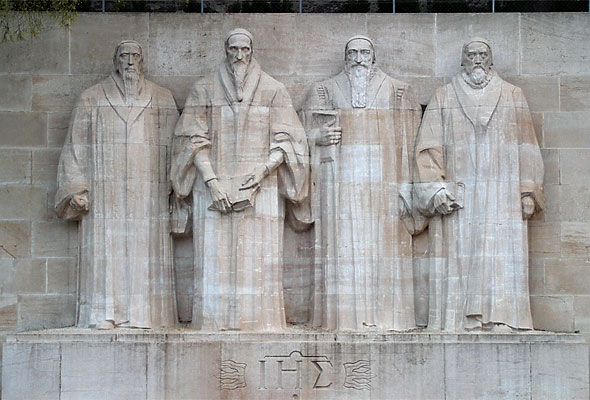
Imputed righteousness is a concept in Christian theology proposing that the "righteousness of Christ... is imputed to [believers]—that is, treated as if it were theirs—through faith." It is on the basis of Jesus' righteousness that God accepts humans. This acceptance is also referred to as justification.
Read the full pageImputed righteousness is a concept in Christian theology proposing that the "righteousness of Christ ... is imputed to [believers]—that is, treated as if it were theirs—through faith." It is on the basis of Jesus' righteousness that God accepts humans. This acceptance is also referred to as justification.
The teaching of imputed righteousness is a signature doctrine of the Lutheran, Reformed and Anglican traditions of Christianity.
- 5ConceptModern European
Independence-friendly logic
Independence-friendly logic is an extension of classical first-order logic (FOL) by means of slashed quantifiers of the form, where V is a finite set of variables. The intended reading of((x=z↔y=w)∧y≠c) which expresses infinity in the empty signature; this cannot be done in FOL.
Read the full pageIndependence-friendly logic (IF logic; proposed by Jaakko Hintikka and Gabriel Sandu in 1989) is an extension of classical first-order logic (FOL) by means of slashed quantifiers of the form, where V is a finite set of variables. The intended reading of (∃v/V) is "there is a v which is functionally independent from the variables in V". IF logic allows one to express more general patterns of dependence between variables than those which are implicit in first-order logic. This greater level of generality leads to an actual increase in expressive power; the set of IF sentences can characterize the same classes of structures as existential second-order logic (Σ11).
For example, it can express branching quantifier sentences, such as the formula ∃c∀x∃y∀z, which expresses that y depends on x, and z depends on y, but z does not depend on x.
- 6ConceptModern European
Individual
An individual is one that exists as a distinct entity. Individuality (or self-hood) is the state or quality of living as an individual; particularly (in the case of humans) as a person unique from other people and possessing one's own needs or goals, rights and responsibilities.
Read the full pageAn individual is one that exists as a distinct entity. Individuality (or self-hood) is the state or quality of living as an individual; particularly (in the case of humans) as a person unique from other people and possessing one's own needs or goals, rights and responsibilities. The concept of an individual features in many fields, including biology, law, and philosophy. Every individual contributes significantly to the growth of a civilization. Society is a multifaceted concept that is shaped and influenced by a wide range of different things, including human behaviors, attitudes, and ideas. The culture, morals, and beliefs of others as well as the general direction and trajectory of the society can all be influenced and shaped by an individual's activities.
From the 15th century and earlier (and also today within the fields of statistics and metaphysics) individual meant "indivisible", typically describing any numerically singular thing, but sometimes meaning "a person". From the 17th century on, an individual has indicated separateness, as in individualism.
- 7ConceptModern European
Individuation
The principle of individuation, or principium individuationis, describes the manner in which a thing is identified as distinct from other things. The concept appears in numerous fields and is encountered in works of Leibniz, Carl Jung, Gunther Anders, Gilbert Simondon, Bernard Stiegler, Friedrich Nietzsche, Arthur Scho
Read the full pageThe principle of individuation, or principium individuationis, describes the manner in which a thing is identified as distinct from other things.
The concept appears in numerous fields and is encountered in works of Leibniz, Carl Jung, Gunther Anders, Gilbert Simondon, Bernard Stiegler, Friedrich Nietzsche, Arthur Schopenhauer, David Bohm, Henri Bergson, Gilles Deleuze, and Manuel DeLanda.
- 8ConceptModern European
Inert knowledge
Inert knowledge is information which one can express but not use. The process of understanding by learners does not happen to that extent where the knowledge can be used for effective problem-solving in realistic situations.
Read the full pageInert knowledge is information which one can express but not use. The process of understanding by learners does not happen to that extent where the knowledge can be used for effective problem-solving in realistic situations.
The phenomenon of inert knowledge was first described in 1929 by Alfred North Whitehead:
- 9ConceptModern European
Infinite qualitative distinction
The infinite qualitative distinction (Danish: den uendelige kvalitative forskel; German: unendliche qualitative Unterschied; Dutch: oneindig kwalitatief onderscheid), sometimes translated as infinite qualitative difference, is a fundamental concept in Christian theology. More colloquially, it is referred to as the Crea
Read the full pageThe infinite qualitative distinction (Danish: den uendelige kvalitative forskel; German: unendliche qualitative Unterschied; Dutch: oneindig kwalitatief onderscheid), sometimes translated as infinite qualitative difference, is a fundamental concept in Christian theology. More colloquially, it is referred to as the Creator/creature distinction or the Categorical Distinction. In its present form, it is usually attributed to Danish philosopher Søren Kierkegaard. The distinction emphasizes the very different attributes of finite and temporal men and the infinite and eternal qualities of a supreme being. This concept can be said to fit into the apophatic theological tradition, although is generally considered a significant feature of classical Christian theology proper cross-traditionally, being found in confessional Lutheran, Reformed, Neo-Orthodox, and Anglican theologies. It is fundamentally at odds with theological theories which posit a supreme being able to be fully understood by man, found in strains of rationalist Enlightenment and post-Enlightenment thought, although such a claim is rare. The theologian Karl Barth made the concept of infinite qualitative distinction a cornerstone of his theology.
The infinite qualitative distinction as measure of conceptual metaphysical distance recedes back at least into Lutheran scholasticism. Robert Preus speaks of "the infinite difference (infinita distantia) between God and man, a doctrine which Lutheranism wished ardently to uphold." The discussion often arose within the context of analogical use of language about God. Preus quotes the German dogmatician David Hollatz:Between God and His creatures there does obtain an infinite positive distance in that God in His absolute perfection and majesty infinitely excels His creatures. But we must not conclude from this that God and His creatures have no attributes in common and that no concept will fit them both. For since God is one who shares His goodness and perfection, He has imparted many streams of His goodness and many rays of His perfection to His creatures, with the result that they possess a certain, though limited, degree of perfection.
- 10ConceptModern European
Information ethics
Information ethics has been defined as "the branch of ethics that focuses on the relationship between the creation, organization, dissemination, and use of information, and the ethical standards and moral codes governing human conduct in society". It examines the morality that comes from information as a resource, a pr
Read the full pageInformation ethics has been defined as "the branch of ethics that focuses on the relationship between the creation, organization, dissemination, and use of information, and the ethical standards and moral codes governing human conduct in society". It examines the morality that comes from information as a resource, a product, or as a target. It provides a critical framework for considering moral issues concerning informational privacy, moral agency (e.g. whether artificial agents may be moral), new environmental issues (especially how agents should behave in the infosphere), problems arising from the life-cycle (creation, collection, recording, distribution, processing, etc.) of information (especially ownership and copyright, digital divide, and digital rights). It is very vital to understand that librarians, archivists, information professionals among others, really understand the importance of knowing how to disseminate proper information as well as being responsible with their actions when addressing information.
Information ethics has evolved to relate to a range of fields such as computer ethics, medical ethics, journalism and the philosophy of information. As the use and creation of information and data form the foundation of machine learning, artificial intelligence and many areas of mathematics, information ethics also plays a central role in the ethics of artificial intelligence, big data ethics and ethics in mathematics.
- 11ConceptModern European
Information hazard
An information hazard or infohazard is "a risk that arises from the dissemination of (true) information that may cause harm or enable some agent to cause harm". It was formalized by philosopher Nick Bostrom in 2011.
Read the full pageAn information hazard or infohazard is "a risk that arises from the dissemination of (true) information that may cause harm or enable some agent to cause harm". It was formalized by philosopher Nick Bostrom in 2011. It challenges the principle of freedom of information, as it states that some types of information are too dangerous, as people could either be harmed by it or use it to harm others.
One example would be the instructions for creating a thermonuclear weapon. Following these instructions could cause massive amounts of harm to others, so limiting who has access to this information is important in preventing harm to others.
- 12ConceptModern European
Infosphere
Infosphere is a metaphysical realm of information, data, knowledge, and communication, populated by informational entities called inforgs (or, informational organisms). Infosphere is portmanteau of information and -sphere.
Read the full pageInfosphere is a metaphysical realm of information, data, knowledge, and communication, populated by informational entities called inforgs (or, informational organisms). Infosphere is portmanteau of information and -sphere.
Though one example is cyberspace, infospheres are not limited to purely online environments; they can include both offline and analogue information.
- 13ConceptModern European
Inner-worldly asceticism
Worldliness (German innerweltliche) was characterized by Max Weber in Economy and Society as the concentration of human behavior upon activities leading to salvation within the context of the everyday world. He saw it as a prime influence in the emergence of modernity and the technological world, a point developed in T
Read the full pageWorldliness (German innerweltliche) was characterized by Max Weber in Economy and Society as the concentration of human behavior upon activities leading to salvation within the context of the everyday world.
He saw it as a prime influence in the emergence of modernity and the technological world, a point developed in The Protestant Ethic and the Spirit of Capitalism.
- 14ConceptModern European
Instant
In physics and the philosophy of science, instant is an infinitesimal interval in time, whose passage is instantaneous. In ordinary speech, an instant has been defined as "a point or very short space of time," a notion deriving from its etymological source, the Latin verb instare, from in- + stare ('to stand'), meaning
Read the full pageIn physics and the philosophy of science, instant is an infinitesimal interval in time, whose passage is instantaneous. In ordinary speech, an instant has been defined as "a point or very short space of time," a notion deriving from its etymological source, the Latin verb instare, from in- + stare ('to stand'), meaning 'to stand upon or near.'
The continuous nature of time and its infinite divisibility was addressed by Aristotle in his Physics, where he wrote on Zeno's paradoxes. The philosopher and mathematician Bertrand Russell was still seeking to define the exact nature of an instant thousands of years later.