Epistemology
The theory of knowledge: what knowledge is, how we get it, and whether we can have any at all.
- 1Branch
Epistemology
The theory of knowledge: what knowledge is, how we get it, and whether we can have any at all.
- ◆Knowledge as justified true belief — and its problems
- ◆Rationalism vs empiricism
- ◆Skepticism
- ◆Sources of knowledge: perception, reason, testimony, memory
Read the full pageEpistemology asks what it is to know something rather than merely believe it, and how far our knowledge reaches. Plato suggested that knowledge is true belief with an account; Indian philosophers catalogued the pramāṇas, the valid sources of knowledge; Descartes sought a foundation no doubt could shake.
Modern epistemology debates the analysis of knowledge (shaken in 1963 by Edmund Gettier's two-page paper), the structure of justification, radical skepticism, the epistemology of testimony and disagreement, and the social dimensions of knowing.
- 2ConceptIndian
Anekāntavāda
Jain doctrine that reality is many-sided, so every claim is true only from some standpoint — like the blind men and the elephant.
Read the full pageAnekāntavāda (Sanskrit: अनेकान्तवाद, "many-sidedness") is the Jain doctrine about metaphysical truths that emerged in ancient India. It states that the ultimate truth and reality is complex and has multiple aspects and viewpoints.
According to Jainism, no single, specific statement can describe the nature of existence and the absolute truth. This knowledge (Kevala Jnana), it adds, is comprehended only by the Arihants. Other beings and their statements about absolute truth are incomplete, and at best a partial truth. All knowledge claims, according to the anekāntavāda doctrine must be qualified in many ways, including being affirmed and denied. Anekāntavāda is a fundamental doctrine of Jainism.
- 3Read the full page
Philosophical skepticism (UK spelling: scepticism; from Greek σκέψις skepsis, "inquiry") is a family of philosophical views that question the possibility of knowledge. It differs from other forms of skepticism in that it even rejects very plausible knowledge claims that belong to basic common sense. Philosophical skeptics are often classified into two general categories: Those who deny all possibility of knowledge, and those who advocate for the suspension of judgment due to the inadequacy of evidence. This distinction is modeled after the differences between the Academic skeptics and the Pyrrhonian skeptics in ancient Greek philosophy. Pyrrhonian skepticism is a practice of suspending judgment, and skepticism in this sense is understood as a way of life that helps the practitioner achieve inner peace. Some types of philosophical skepticism reject all forms of knowledge while others limit this rejection to certain fields, for example, knowledge about moral doctrines or about the external world. Some theorists criticize philosophical skepticism based on the claim that it is a self-refuting idea since its proponents seem to claim to know that there is no knowledge. Other objections focus on its implausibility and distance from regular life.
Philosophical skepticism is a doubtful attitude toward commonly accepted knowledge claims. Skepticism in general is a questioning attitude toward all kinds of knowledge claims. In this wide sense, it is quite common in everyday life: many people are ordinary skeptics about parapsychology or about astrology because they doubt the claims made by proponents of these fields. But the same people are not skeptical about other knowledge claims like the ones found in regular school books. Philosophical skepticism differs from ordinary skepticism in that it even rejects knowledge claims that belong to basic common sense and seem to be very certain. For this reason, it is sometimes referred to as radical doubt. In some cases, it is even proclaimed that one does not know that "I have two hands" or that "the sun will come out tomorrow". In this regard, philosophical skepticism is not a position commonly adopted by regular people in everyday life. This denial of knowledge is usually associated with the demand that one should suspend one's beliefs about the doubted proposition. This means that one should neither believe nor disbelieve it but keep an open mind without committing oneself one way or the other. Philosophical skepticism is often based on the idea that no matter how certain one is about a given belief, one could still be wrong about it. From this observation, it is argued that the belief does not amount to knowledge. Philosophical skepticism follows from the consideration that this might be the case for most or all beliefs. Because of its wide-ranging consequences, it is of central interest to theories of knowledge since it questions their very foundations.
- 4ConceptIndian
Pramāṇa
Valid means of knowledge — perception, inference, comparison, testimony and more.
Read the full pagePramana (Sanskrit: प्रमाणम्; IAST: Pramāṇam) literally means "proof" and "means of knowledge". One of the core concepts in Indian epistemology, pramanas are one or more reliable and valid means by which human beings gain accurate, true knowledge. The focus of pramana is how correct knowledge can be acquired, how one knows, how one does not know, and to what extent knowledge pertinent about someone or something can be acquired.
While the number of pramanas varies widely from system to system, many ancient and medieval Indian texts identify six pramanas as correct means of accurate knowledge and attaining to the truth. Three of these are almost universally accepted: perception (pratyakṣa), inference (anumāna), and "word" (śabda), meaning the testimony of past or present reliable experts. The other three pramanas are more contentious: comparison and analogy (upamāna); postulation or derivation from circumstances (arthāpatti); and non-perception, or proof from absence (anupalabdhi). Each of these are further categorized in terms of conditionality, completeness, confidence, and possibility of error.
- 5
 ConceptModern European
Problem of induction
What justifies inferring the future from the past? Hume argued: nothing but habit.
Read the full pageThe problem of induction is a philosophical problem that questions the rationality of predictions about unobserved things based on previous observations. These inferences from the observed to the unobserved are known as "inductive inferences". David Hume, who first formulated the problem in 1739, argued that there is no non-circular way to justify inductive inferences, while he acknowledged that everyone does and must make such inferences.
The traditional inductivist view is that all claimed empirical laws, either in everyday life or through the scientific method, can be justified through some form of reasoning. The problem is that many philosophers tried to find such a justification but their proposals were not accepted by others. Identifying the inductivist view as the scientific view, C. D. Broad once said that induction is "the glory of science and the scandal of philosophy". In contrast, Karl Popper's critical rationalism claimed that inductive justifications are never used in science and proposed instead that science is based on the procedure of conjecturing hypotheses, deductively calculating consequences, and then empirically attempting to falsify them.
- 6
 ConceptGreek & Roman
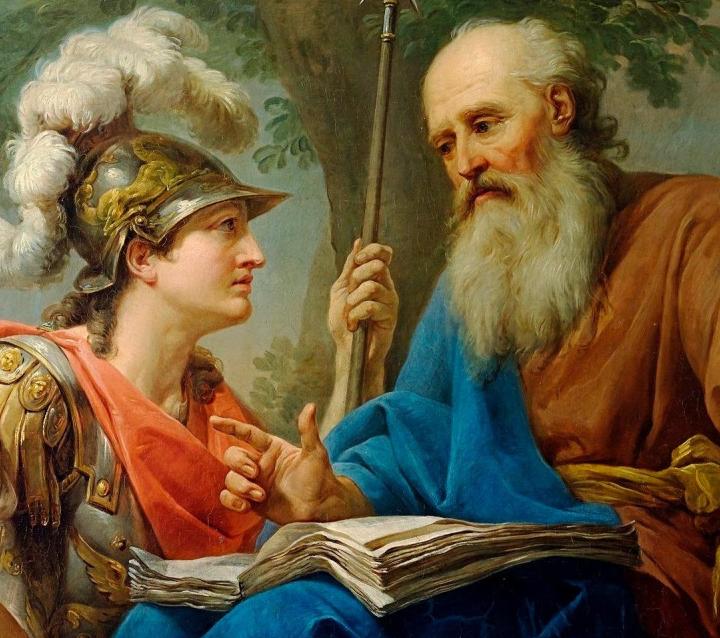
Socratic method
Cooperative questioning that exposes contradictions in our beliefs to reach clearer understanding.
Read the full pageThe Socratic method is a form of argumentative dialogue in which an individual probes a conversation partner on a topic, using questions and clarifications, until the partner is pressed to come to a conclusion on their own, or else their reasoning breaks down and they are forced to admit ignorance. The method is also known as Socratic debate, the maieutic method, or the Socratic dialectic, and sometimes equated with the Greek term elenchus. Socratic dialogues between characters employing this method feature in many of the works of the ancient Greek philosopher Plato, where a fictionalized version of his real-life teacher Socrates debates or expounds upon various philosophical issues with a partner.
In Plato's dialogue Theaetetus, Socrates describes his method as a form of "midwifery" (maieutikós; source of the English adjective maieutic) because it is employed to help his interlocutors develop their understanding and lead it out of them in a way analogous to a child developing in the womb until it is ready for birth. The Socratic method begins with commonly held beliefs and scrutinizes them by way of questioning to determine their internal consistency and their coherence with other beliefs and so to bring everyone closer to the truth.
- 7ConceptModern European
Synthetic a priori
Kant's class of knowledge that is informative yet known independently of experience — like 7+5=12.
Read the full pageThe analytic–synthetic distinction is a semantic distinction used primarily in philosophy to distinguish between propositions (in particular, statements that are affirmative subject–predicate judgments) that are of two types: analytic propositions and synthetic propositions. Analytic propositions are true or not true solely by virtue of their meaning, whereas synthetic propositions' truth, if any, derives from how their meaning relates to the world.
The distinction between analytic and synthetic method in various areas of knowledge, in particular in mathematics, dates to antiquity. However, the distinction between analytic and synthetic propositions was first proposed by Immanuel Kant. It was then revised considerably over time, and different philosophers have used the terms in very different ways. Furthermore, some philosophers (starting with Willard Van Orman Quine) have questioned whether there is even a clear distinction to be made between propositions which are analytically true and propositions which are synthetically true. Debates regarding the nature and usefulness of the distinction continue to this day in contemporary philosophy of language.
- Read the full page
Tabula rasa (; Latin for "blank slate") is the idea of individuals being born empty of any built-in mental content, so that all knowledge comes from later perceptions or sensory experiences. Proponents typically form the extreme "nurture" side of the nature versus nurture debate, arguing that humans are born without any "natural" psychological traits and that all aspects of one's personality, social and emotional behaviour, knowledge, or sapience are later imprinted by one's environment onto the mind as one would onto a wax tablet. This idea is the central view posited in the theory of knowledge known as empiricism. Empiricists disagree with the doctrines of innatism or rationalism, which hold that the mind is born already in the possession of specific knowledge or rational capacity.
Tabula rasa is a Latin phrase often translated as clean slate in English and originates from the Roman tabula, a wax-covered tablet used for notes, which was blanked (rasa) by heating the wax and then smoothing it. This roughly equates to the English term "blank slate" (or, more literally, "erased slate") which refers to the emptiness of a slate prior to it being written on with chalk. Both may be renewed repeatedly, by melting the wax of the tablet or by erasing the chalk on the slate.
- 9Read the full page
Truth is commonly understood as conformity to reality or fact. It contrasts with falsity or misrepresentation that fails to align with the world. Truth is typically treated as a property of sentences, propositions, or beliefs that describe things as they are. It is closely related to truthfulness, a virtue associated with honesty, and to truthlikeness, a characteristic of theories that approximate the truth.
Various theories of the nature of truth have been proposed, but its precise definition remains contested. The correspondence theory holds that a statement is true if it corresponds to facts. According to the coherence theory, a belief is true if it is consistent with other beliefs and supported by them. Pragmatists understand truth based on practical consequences and inquiry, claiming that truth is what works or what would withstand the test of unlimited inquiry. The semantic theory analyzes truth in terms of the conditions under which a sentence would be true. Deflationary theories argue that truth has no significant intrinsic nature, holding that to understand the concept of truth is merely to understand the linguistic role of the word true and similar expressions. Pluralists assert that the definition of truth varies with the domain of analysis, while relativists maintain that the same statement can be true in one perspective and false in another. Theories of truth are challenged by logical paradoxes, such as the liar paradox. There are also discussions about the existence of additional truth values besides true and false and about the possibility of truth value gaps—statements that have no truth value.
- 10ConceptIndian
Two truths doctrine
Conventional truth and ultimate truth — things exist conventionally while empty ultimately.
Read the full pageThe Buddhist doctrine of the two truths (Sanskrit: dvasatya, Wylie: bden pa gnyis) differentiates between two levels of satya (Sanskrit; Pāli: sacca; meaning "truth" or "reality") in the teaching of Śākyamuni Buddha: the "conventional" or "provisional" (saṁvṛti) truth, and the "absolute" or "ultimate" (paramārtha) truth.
The exact meaning varies between the various Buddhist schools and traditions. The best known interpretation is from the Mādhyamaka school of Mahāyāna Buddhism, whose founder was the 3rd-century Indian Buddhist monk and philosopher Nāgārjuna. For Nāgārjuna, the two truths are epistemological truths. The phenomenal world is accorded a provisional existence. The character of the phenomenal world is declared to be neither real nor unreal, but logically indeterminable. Ultimately, all phenomena are empty (śūnyatā) of an inherent self or essence due to the non-existence of the self (anātman), but temporarily exist depending on other phenomena (pratītya-samutpāda).


