
Logos
The rational order or principle running through the cosmos (Heraclitus, the Stoics) — and later, in John's Gospel, the divine Word.
Logos (UK: , US: ; Ancient Greek: λόγος, romanized: lógos, lit. 'word, discourse, or reason') is a term used in Western philosophy, psychology and rhetoric, as well as religion (notably Christianity), that most broadly means reason, logic, order, or understanding. Among its connotations is that of a rational form of discourse that relies on inductive and deductive reasoning.
Aristotle first systematized the usage of the word, making it one of the three principles of rhetoric alongside ethos and pathos. This original use identifies the word closely to the structure and content of language or text. Both Plato and Aristotle used the term logos (along with rhema) to refer to sentences and propositions.
Background
Ancient Greek: λόγος, romanized: lógos, lit. 'word, discourse, or reason' is related to Ancient Greek: λέγω, romanized: légō, lit. 'I say' which is cognate with Latin: lex, lit. 'law'. The word derives from a Proto-Indo-European root, *leǵ-, which can have the meanings "I put in order, arrange, gather, choose, count, reckon, discern, say, speak". In modern usage, it typically connotes the verbs "account", "measure", "reason" or "discourse". It is occasionally used in other contexts, such as for "ratio" in mathematics.
Origins of the term
Logos became a technical term in Western philosophy beginning with Heraclitus (c. 535 – c. 475 BC), who used the term for a principle of order and knowledge. Ancient Greek philosophers used the term in different ways. The sophists used the term to mean "discourse". Aristotle applied the term to refer to "reasoned discourse" or "the argument" in the field of rhetoric, and considered it one of the three modes of persuasion alongside ethos and pathos. Pyrrhonist philosophers used the term to refer to dogmatic accounts of non-evident matters. The Stoics spoke of the logos spermatikos (the generative principle of the Universe) which foreshadows related concepts in Neoplatonism.
Within Hellenistic Judaism, Philo (c. 20 BC – c. 50 AD) integrated the term into Jewish philosophy.
Philo distinguished between logos prophorikos ("the utterer word or speaker"), logos spermatikos ("the speech") and the logos endiathetos ("the word remaining within").
The Gospel of John identifies the Christian Logos, through which all things are made, as divine (theos), and further identifies Jesus Christ as the incarnate Logos. Early translators of the Greek New Testament, such as Jerome (in the 4th century AD), experienced frustration with the inadequacy of any single Latin word to convey the meaning of the word logos as used to describe Jesus Christ in the Gospel of John. The Vulgate Bible usage of in principio erat verbum was thus constrained to use the (perhaps inadequate) noun verbum for "word"; later Romance language translations had the advantage of nouns such as le Verbe in French. Reformation translators took another approach. Martin Luther rejected Zeitwort (verb) in favor of Wort (word), for instance, although later commentators repeatedly turned to a more dynamic use involving the living word as used by Jerome and Augustine. The term is also used in Sufism, and the analytical psychology of Carl Jung.
Despite the conventional translation as "word", logos is not used for a word in the grammatical sense—for that, the term lexis (λέξις, léxis) was used. However, both logos and lexis derive from the same verb légō (λέγω), meaning "(I) count, tell, say, speak".
In the ancient Greek context, the term logos in the sense of "word" or "discourse" also contrasted with mythos (Ancient Greek: μῦθος). Classical Greek usage sees reasoned argument (logos) as distinct from imaginative tales (mythos).
Ancient Greek philosophy
The writing of Heraclitus (c. 535 – c. 475 BC) was the first place where the word logos was given special attention in ancient Greek philosophy, although Heraclitus seems to use the word with a meaning not significantly different from the way in which it was used in ordinary Greek of his time. For Heraclitus, logos provided the link between rational discourse and the world's rational structure.
This logos holds always but humans always prove unable to ever understand it, both before hearing it and when they have first heard it. For though all things come to be in accordance with this logos, humans are like the inexperienced when they experience such words and deeds as I set out, distinguishing each in accordance with its nature and saying how it is. But other people fail to notice what they do when awake, just as they forget what they do while asleep.
For this reason it is necessary to follow what is common. But although the logos is common, most people live as if they had their own private understanding.
Listening not to me but to the logos it is wise to agree that all things are one.
What logos means here is not certain; it may mean "reason" or "explanation" in the sense of an objective cosmic law, or it may signify nothing more than "saying" or "wisdom". Yet, an independent existence of a universal logos was clearly suggested by Heraclitus.
Following one of the other meanings of the word, Aristotle gave logos a different technical definition in the Rhetoric, using it as meaning argument from reason, one of the three modes of persuasion. The other two modes are pathos (πᾰ́θος, páthos), which refers to persuasion by means of emotional appeal, "putting the hearer into a certain frame of mind"; and ethos (ἦθος, êthos), persuasion through convincing listeners of one's "moral character". According to Aristotle, logos relates to "the speech itself, in so far as it proves or seems to prove". In the words of Paul Rahe:
For Aristotle, logos is something more refined than the capacity to make private feelings public: it enables the human being to perform as no other animal can; it makes it possible for him to perceive and make clear to others through reasoned discourse the difference between what is advantageous and what is harmful, between what is just and what is unjust, and between what is good and what is evil.
Logos, pathos, and ethos can all be appropriate at different times. Arguments from reason (logical arguments) have some advantages, namely that data are (ostensibly) difficult to manipulate, so it is harder to argue against such an argument. On the other hand, trust in the speaker—built through ethos—enhances the appeal of arguments from reason.
Robert Wardy suggests that what Aristotle rejects in supporting the use of logos "is not emotional appeal per se, but rather emotional appeals that have no 'bearing on the issue', in that the pathē [πᾰ́θη, páthē] they stimulate lack, or at any rate are not shown to possess, any intrinsic connection with the point at issue—as if an advocate were to try to whip an antisemitic audience into a fury because the accused is Jewish; or as if another in drumming up support for a politician were to exploit his listeners's reverential feelings for the politician's ancestors".
Aristotle comments on the three modes by stating:
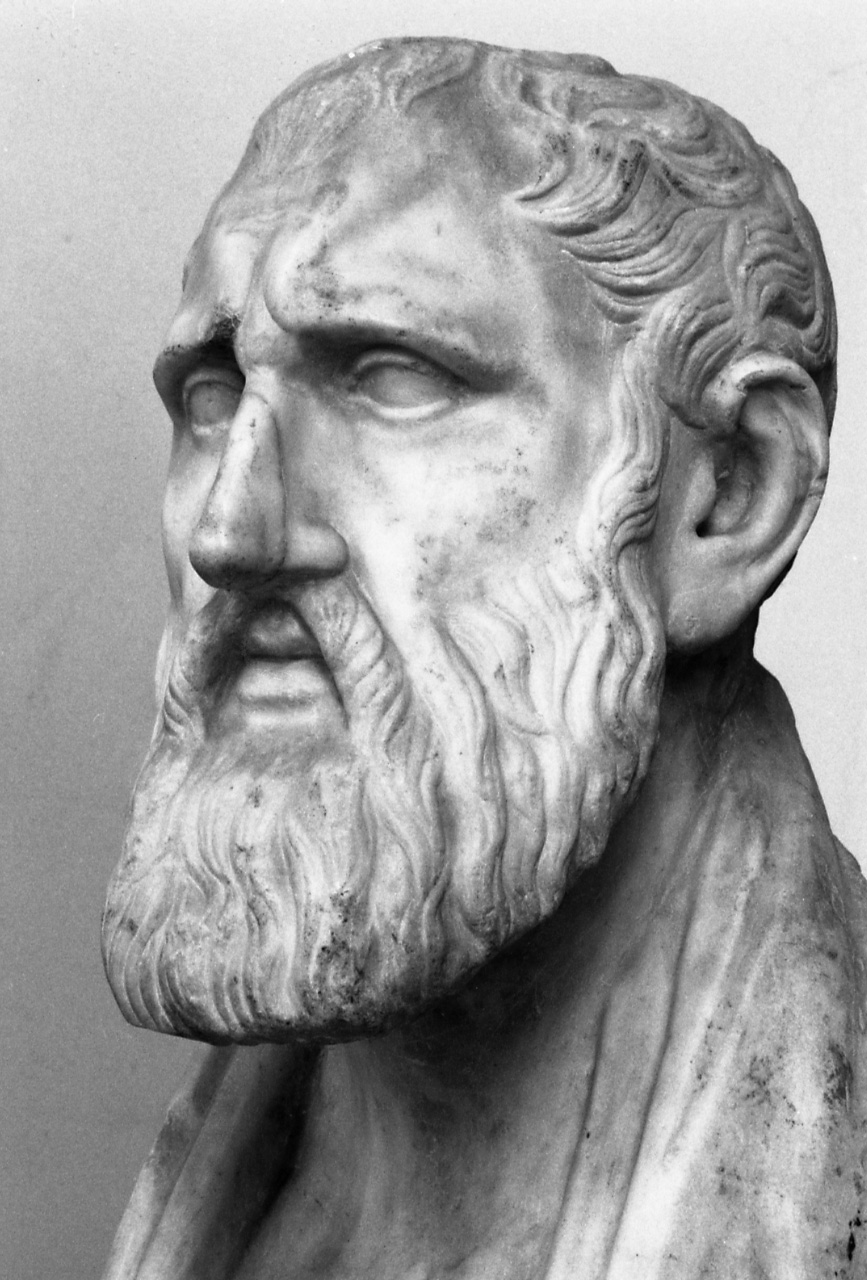
Stoic philosophy began with Zeno of Citium c. 300 BC, in which the logos was the active reason pervading and animating the Universe. It was conceived as material and is usually identified with God or Nature. The Stoics also referred to the seminal logos ("logos spermatikos"), or the law of generation in the Universe, which was the principle of the active reason working in inanimate matter. Humans, too, each possess a portion of the divine logos.
The Stoics took all activity to imply a logos or spiritual principle. As the operative principle of the world, the logos was anima mundi to them, a concept which later influenced Philo of Alexandria, although he derived the contents of the term from Plato. In his Introduction to the 1964 edition of Marcus Aurelius' Meditations, the Anglican priest Maxwell Staniforth wrote that "Logos ... had long been one of the leading terms of Stoicism, chosen originally for the purpose of explaining how deity came into relation with the universe".
Public discourse on ancient Greek rhetoric has historically emphasized Aristotle's appeals to logos, pathos, and ethos, while less attention has been directed to Isocrates' teachings about philosophy and logos, and their partnership in generating an ethical, mindful polis. Isocrates does not provide a single definition of logos in his work, but Isocratean logos characteristically focuses on speech, reason, and civic discourse. He was concerned with establishing the "common good" of Athenian citizens, which he believed could be achieved through the pursuit of philosophy and the application of logos.
Neoplatonism
Adapted from the Wikipedia article Logos, available under CC BY-SA 4.0.
Connections

Part of
1
You might also explore
 ImpermanenceIndianAll conditioned things arise and pass away; nothing lasts.
 Free will★Are our choices genuinely up to us, or determined by prior causes?Materialism★Everything that exists is matter or depends on it.Dialectic★Reasoning through opposition: from Socratic dialogue to Hegel's movement of contradiction and resolution.IdealismReality is fundamentally mental or mind-dependent.
 Yin and yangChineseComplementary opposites — dark/light, receptive/active — whose interplay makes up the world.