Lingayats
The Lingayats are a monotheistic religious denomination of Hinduism. Lingayats are known for their unique practice of Ishtalinga worship, where adherents carry a personal linga symbolizing a constant, intimate relationship with Parashiva.
The Lingayats are a monotheistic religious denomination of Hinduism. Lingayats are known for their unique practice of Ishtalinga worship, where adherents carry a personal linga symbolizing a constant, intimate relationship with Parashiva. A radical feature of Lingayats is their staunch opposition to the caste system and advocacy for social equality, challenging societal norms of the time. Its philosophical tenets are encapsulated in Vachanas, a form of devotional poetry. The tradition also emphasizes Kayaka (work) and Dasoha (service) as forms of worship, underscoring the sanctity of labor and service to others. Unlike mainstream Hinduism, Lingayats reject the scriptural authority of the Vedas and Puranas, superstition, astrology, vedic priesthood ritualistic practices, promoting a direct, personal experience of the divine.
Lingayats are considered a Shaiva tradition or Sampradaya (sect). Lingayatism is generally considered a Hindu sect because their beliefs include many Hindu elements. Worship is centered on Shiva as the universal god in the iconographic form of Ishtalinga. Lingayats emphasize qualified monism, with philosophical foundations similar to those of Ramanuja.
Contemporary Lingayats are influential in South India, especially in the state of Karnataka. Lingayats celebrate anniversaries (jayanti) of major religious leaders of their sect, as well as Hindu festivals such as Shivaratri and Ganesh Chaturthi. Lingayats have their own pilgrimage places, temples, shrines and religious poetry based on Shiva. Today, Lingayats, along with Shaiva Siddhanta followers, Naths, Pashupatas, Kapalikas and others constitute the Shaivite population.
Etymology
The word 'Lingayat' is derived from the Sanskrit root lingam "mark, symbol" and the suffix ayta. The adherents of ishtalinga are known as "Lingayats". In historical literature, they are sometimes referred to as Lingawants, Lingangis, Lingadharis, Sivabhaktas, Virasaivas or Veerashaivas. The term Lingayat is based on the practice of both genders of Lingayats wearing an iṣṭaliṅga contained inside a silver box with a necklace all the time. The istalinga is an oval-shaped emblem symbolising Parashiva, the absolute reality and icon of their spirituality.
Historically, Lingayats were known as "Virashaivas" or "ardent, heroic worshippers of Shiva." According to Blake Michael, Virashaivism refers both to a "philosophical or theological system as well as to the historical, social and religious movement which originated from that system." Lingayats refer to the modern adherents of this religion. The term Lingayats came to be commonly used during the British colonial period.
The terms Lingayat and Virashaiva have been used synonymously. Virashaivism refers to the broader Virashaiva philosophy and theology as well as the movement, states Blake Michael, while Lingayata refers to the modern community, sect or caste that adheres to this philosophy. In the contemporary era, some state that Veerashaiva is a (sub)tradition within Lingayats with Vedic influences, and these sources have been seeking a political recognition of Lingayats to be separate from Veerashaivas, and Lingayats to be a separate religious community. In contrast, Veerashaivas consider the two contemporary (sub)traditions to be "one and the same community" belonging to Hinduism. The present-day dispute involves two opposing groups, one seeking separate status for the Lingayat community and the other wanting to keep the Virashaiva-Lingayat community united.
Origin
The origins of Lingayats are traced to the 11th- and 12th-century CE in a region that includes northern Karnataka and nearby districts of South India. This region was a stronghold of Jainism and Shaivism. According to Iyer and other scholars, the Lingayat theology emerged as a definitive egalitarian movement in this theological milieu, growing rapidly beyond north Karnataka. The Lingayats, states Burjor Avari quoting Jha, were "extremely anti-Jain". The Veerashaiva philosophy enabled Lingayats to "win over the Jains to Shiva worship". The Lingayats were also anti-Brahmin as evidenced by the polemics against the Brahmins in early Veerashaiva literature.
According to a tradition which developed after Basava's time, Veerashaivism was transmitted by five Panchacharyas, namely Renukacharya, Darukacharya, Ekorama, Panditharadhya, and Vishweswara, and first taught by Renukacharya to sage Agasthya, a Vedic seer. A central text in this tradition is Siddhanta Shikhamani, which was written in Sanskrit, and gives an elaboration of "the primitive traits of Veerashaivism [found] in the Vedas and the Upanishads" and "the concrete features given to it in the latter parts (Uttarabhaga) of the Saivagamas." While Veerashaivas regard the Siddhanta Shikhamani to predate Basava, it may actually have been composed in the 13th or 14th century, post-dating Basava.
Basava (12th century)
The Sharana-movement, which started in the 11th century, is regarded by some as the start of Veerashaivism. It started in a time when Kalamukha Shaivism, which was supported by the ruling classes, was dominant, and in control of the monasteries. The Sharana-movement was inspired by the Nayanars, and emphasised personal religious experience over text-based dogmatism.
The traditional legends and hagiographic texts state that Basava was the founder of the Lingayats and its secular practices. Basava was a 12th-century Hindu philosopher, statesman, Kannada poet in the Shiva-focused Bhakti movement and a social reformer during the reign of the Kalachuri king Bijjala II (reigned 1157–1167) in Karnataka, India.
Basava grew up in a Brahmin family with a tradition of Shaivism. As a leader, he developed and inspired a new devotional movement named Virashaivas, or "ardent, heroic worshippers of Shiva". This movement shared its roots in the ongoing Bhakti movement, particularly the Shaiva Nayanars traditions, over the 7th- to 11th-century. However, Basava championed devotional worship that rejected temple worship with rituals led by Brahmins, and emphasized personalised direct worship of Shiva through practices such as individually worn icons and symbols like a small linga.
Basavanna spread social awareness through his poetry, popularly known as Vachanas. Basavanna rejected gender and social discrimination, and caste distinctions, as well as some extant practices such as the wearing of sacred thread, and replaced this with the ritual of wearing Ishtalinga necklace, with an image of the Shiva Liṅga, by every person regardless of his or her birth, to be a constant reminder of one's bhakti (loving devotion) to god Shiva. As the chief minister of his kingdom, he introduced new public institutions such as the Anubhava Mantapa (or, the "hall of spiritual experience"), which welcomed men and women from all socio-economic backgrounds to discuss spiritual and mundane questions of life, in the open.
After initially supporting Basava, king Bijjala II disagreed with Basava's rejection of caste distinctions. In 1167 the Veerashaivas were repressed, and most of them left Kalyāna, Bijjala's new capital, spreading Basava's teachings into a wider area in southern India. The king was assassinated by the Veerashaivas in 1168.
Consolidation (12th–14th century)
After Basava's death, Shaivism consolidated its influence in southern India, meanwhile adjusting to Hindu orthodoxy. Basava's nephew Channabasava organised the community and systematised Virasaiva theology, moving the Virashaiva community toward the mainstream Hindu culture. Basava's role in the origins of Shaivism was downplayed, and a mythology developed in which the origins of Veerashaivism were attributed to the five Panchacharyas, descending to earth in the different world-ages to teach Shaivism. In this narrative, Basava was regarded as a reviver of this ancient teaching.
Monasteries of the older Saiva schools, "such as the Kalamukha," were taken over by the Virasaivas. Two kinds of monastic orders developed. Due to their roots in the traditional schools, the gurusthalada monasteries were more conservative, while the viraktas "constituted the true Virasaiva monastic organisation, shaped by the ideals of Basava and his contemporaries."
Vijayanagara Empire (15th–17th century)
In the 14th-15th century, a Lingayat revival took place in northern Karnataka in the Vijayanagara Empire. The Lingayats likely were a part of the reason why Vijayanagara succeeded in territorial expansion and in withstanding the Deccan Sultanate wars. The Lingayat text Sunyasampadane grew out of the scholarly discussions in an Anubhava Mantapa, and according to Bill Aitken, these were "compiled at the Vijayanagara court during the reign of Praudha Deva Raya". Similarly, the hagiographical epic poem Basava Purana, detailing the life of Basava, was expanded and translated into Kannada in 1369 during the reign of Vijayanagara ruler Bukka Raya I.
Adapted from the Wikipedia article Lingayats, available under CC BY-SA 4.0.
Connections
Proposed by
1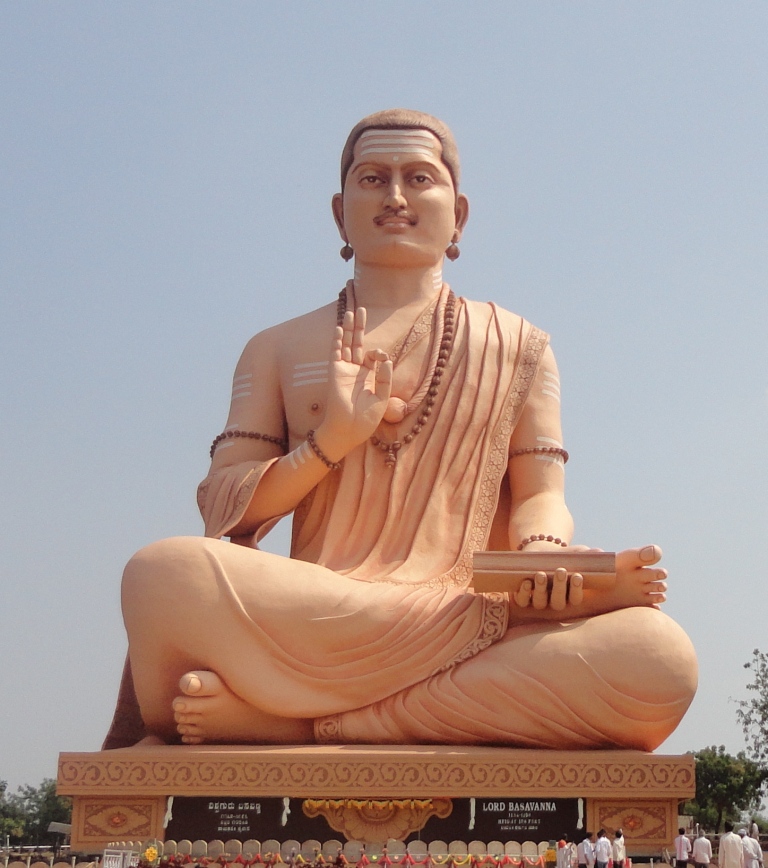
You might also explore
 AhiṃsāIndianNon-violence toward all living beings.
 Anandpur SahibIndianSri Anandpur Sahib, also referred simply as Anandpur (lit. 'city of bliss'), is a city in Rupnagar district (Ropar), on…AnekāntavādaIndianJain doctrine that reality is many-sided, so every claim is true only from some standpoint — like the blind men and the…ĀtmanIndianThe innermost self or soul — in Advaita, identical with Brahman.
 Bairagi Brahmin (caste)IndianBairagi Brahmin or Vaishnav Bairagi or Vaishnav Brahmin is a Hindu caste. They are Hindu priests.