
Krishna
Krishna (; Sanskrit: कृष्ण, lit. 'Black', IAST: Kṛṣṇa Sanskrit: [ˈkr̩ʂɳɐ] ) also known as Govinda, Madhava, Gopala, and other names and titles is a major deity in Hinduism. He is worshipped as the eighth avatar of Vishnu and as the Supreme God in his own right.
Krishna (; Sanskrit: कृष्ण, lit. 'Black', IAST: Kṛṣṇa Sanskrit: [ˈkr̩ʂɳɐ] ) also known as Govinda, Madhava, Gopala, and other names and titles is a major deity in Hinduism. He is worshipped as the eighth avatar of Vishnu and as the Supreme God in his own right. He is widely revered for his divine qualities of love, compassion, protection, and tenderness. Krishna's birthday is celebrated every year by Hindus on Krishna Janmashtami, according to the lunisolar Hindu calendar, which falls in late August or early September of the Gregorian calendar.
Krishna is often depicted in dark skin in accordance with meaning of his name, "black" or "dark". The anecdotes and narratives of Krishna's life are known as Krishna Lila. He is a central figure in the Mahabharata, the Bhagavata Purana, the Brahma Vaivarta Purana, and the Bhagavad Gita, and is mentioned in many Hindu philosophical, theological, and mythological texts. These texts describes him as a divine statesman, teacher, savior of dharma, charioteer, and sometimes a cowherd. They portray him in various perspectives: as a god-child, a prankster, a model lover, a divine hero, and the universal supreme being. His iconography reflects these legends and shows him in different stages of his life, such as an infant eating butter, a young boy playing a flute, a handsome youth with Radha or surrounded by female devotees, or a friendly charioteer giving counsel to Arjuna.
Krishna was born in Mathura to Devaki and Vasudeva, but was raised by Nanda and Yashoda in Gokul to escape his maternal uncle, the tyrant king Kamsa. His life, as given in texts, incorporates highly symbolic miraculous elements: he enchanted the gopis with his divine flute playing, performed the celestial Rasa Lila, and lifted Govardhan Hill to protect his community from devastating rains. He later defeated Kamsa and restored order in Mathura. He went on to establish the city of Dvaraka and played a central role in the Kurukshetra War, serving as Arjuna’s charioteer and delivering the philosophical teachings of the Bhagavad Gita.
The name and synonyms of Krishna have been traced to 1st millennium BCE literature and cults. In some sub-traditions within Hinduism, such as Krishnaism, Krishna is worshipped as the Supreme God and Svayam Bhagavan (God Himself) as he was master in all 64 forms of Art and 14 Vidya. These sub-traditions arose in the context of the medieval-era Bhakti movement. Krishna-related literature has inspired numerous performance arts such as Bharatanatyam, Kathakali, Kuchipudi, Odissi, and Manipuri dance. He is a pan-India god, but is particularly revered in some locations, such as Vrindavan in Uttar Pradesh, Dwarka and Junagadh in Gujarat, the Jagannatha aspect in Odisha, Mayapur in West Bengal, and other places. He is also worshipped in different regional forms across India.
Since the 1960s, the worship of Krishna has also spread to the Western world, largely due to the work of the Bhaktivedanta Swami and his organisation, ISKCON.
Names and epithets
The name "Krishna" originates from the Sanskrit word kṛṣṇa, which means "black", "dark" or "dark blue". The term is also associated with the Krishna Paksha, waning phase of the moon carrying its adjective meaning "darkening". In accordance with the meaning of the name, Krishna murtis are often depicted with black or blue skin.
As a name of Vishnu, Krishna it appears as the 57th name in the Vishnu Sahasranama.
Krishna is also known by various other names, epithets, and titles that reflecting his diverse associations and attributes. Among the most common names are:
Achyuta (Sanskrit: अच्युत): The infallible one; one who never falls from his divine nature
Ananta (Sanskrit: अनन्त): The endless or infinite one
Bāl Gopāl (Sanskrit: बाल गोपाल): The child Krishna; protector of cows
Bānke Bihārī (Sanskrit: बाँके बिहारी): The charming, graceful one who enjoys divine play
Chakrapāṇi (Sanskrit: चक्रपाणि): One who holds the Sudarshana Chakra (disc or wheel)
Dāmodara (Sanskrit: दामोदर): One who was tied around the waist with a rope
Devakīnandana (Sanskrit: देवकीनन्दन): Son of Devaki
Dvārakādhīśa (Sanskrit: द्वारकाधीश): Lord of Dwarka
Ghanashyām (Sanskrit: घनश्याम): Dark like a rain-filled cloud
Giridhārī (Sanskrit: गिरिधारी): Lifter of the (Govardhan) mountain
Gopāla (Sanskrit: गोपाल): Protector of cows
Gopīnātha (Sanskrit: गोपीनाथ): Lord of the Gopis
Govinda (Sanskrit: गोविन्द): One who gives joy to the cows
Hari (Sanskrit: हरि): The remover of sins and suffering
Jagannātha (Sanskrit: जगन्नाथ): Lord of the universe
Janārdana (Sanskrit: जनार्दन): One who protects people; one worshipped by devotees
Kanhaiyā (Sanskrit: कन्हैया): Beloved young Krishna
Kānha (Sanskrit: कान्हा): The dark-complexioned beloved one
Keśava (Sanskrit: केशव): One with beautiful hair; also, slayer of the demon Keshi
Keev (Sanskrit: कीव): Prankster
Krishna (Sanskrit: कृष्ण): The dark-complexioned one; the all-attractive one
Mādhava (Sanskrit: माधव): Consort of Lakshmi; sweet and spring-like one
Madhusūdana (Sanskrit: मधुसूदन): Slayer of the demon Madhu
Manmohana (Sanskrit: मनमोहन): One who enchants the mind
Mohan (Sanskrit: मोहन): The charming or enchanting one
Murlīdhara (Sanskrit: मुरलीधर): Holder of the flute (Murlī)
Nandakumāra (Sanskrit: नन्दकुमार): Son of Nanda
Navanīta Chora (Sanskrit: नवनीत चोर): Stealer of butter
Parthasārathi (Sanskrit: पार्थसारथि): Charioteer of Arjuna
Purushottama (Sanskrit: पुरुषोत्तम): The supreme being; highest among all beings
Rādhāramaṇa (Sanskrit: राधारमण): Beloved of Radha
Rādhāvallabha (Sanskrit: राधावल्लभ): Dear or beloved of Radha
Ranchhod (Sanskrit: रणछोड़): One who left the battlefield as part of divine strategy
Shyām (Sanskrit: श्याम): The dark or dusky one
Shyāmsundara (Sanskrit: श्यामसुन्दर): The beautiful dark-complexioned one
Vāsudeva (Sanskrit: वासुदेव): Son of Vasudeva (Sanskrit: वसुदेव) also the indwelling divine presence
Venugopāla (Sanskrit: वेणुगोपाल): Krishna as the flute-playing cowherd
Viṣṇu (Sanskrit: विष्णु): The all-pervading one
Yādava (Sanskrit: यादव): Descendant of the Yadu dynasty
Yogeśvara (Sanskrit: योगेश्वर): Lord of yoga; master of divine wisdom
Certain names of Krishna also hold regional importance, such as Jagannatha, associated with the Jagannath Temple, Puri, is a popular manifestation of Krishna in Odisha state and nearby regions of eastern India.
In Hindu tradition, Krishna’s names and epithets signify his qualities, relationships, divine functions, and mythological deeds. The Mahābhārata explains names such as Vāsudeva, Viṣṇu, Madhusūdana, Janārdana, and Puruṣottama by linking them to Krishna’s all-pervading nature, lineage, and slaying of demons, while the Bhāgavata Purāṇa connects names such as Dāmodara and Giridhārī to specific episodes in Krishna’s childhood and Vṛndāvana līlās.
Role and significance in religion
Krishna is the eighth avatar of Vishnu and a major deity in Hinduism. He is worshipped as a full incarnation of Vishnu and Supreme God in his own right. He is also referred to as Swayam Bhagavan (God Himself) particularly in the Krishnaism and Vaishnavism traditions.
He is the God of protection, compassion, tenderness, and love, and is widely revered among Hindu divinities. He struck down his maternal uncle Kamsa, established the ancient city of Dwarka, and played a pivotal role in the Mahabharata epic by fighting for the Pandavas and concluding the war.
Krishna appears as a central figure in several Hindu texts, including the Mahabharata and the Bhagavata Puran, where he expounds many of his philosophical ideas. The Bhagavad Gita, part of the Mahabharata, is widely read as an independent spiritual text in its own right. It allegorically describes the ethical and moral dilemmas of human life through the conversation of Krishna and Arjuna during the Kurukshetra War. The text presents answers to questions of human freedoms, choices, and responsibilities (dharma) towards oneself and others. These teachings later became a central influence on the Bhakti movement in medieval India.
Origins and early sources
The tradition of Krishna appears to have developed through the amalgamation of several independent deities of ancient India, the earliest attested being Vāsudeva. Vāsudeva was a hero-god of the tribe of the Vrishnis, belonging to the Vrishni heroes, whose worship is attested from the 5th–6th centuries BCE in the writings of Pāṇini, and from the 2nd century BCE in epigraphic evidences such as the Heliodorus pillar. The Vrishnis were thought to have later merged with the tribe of the Yadavas, whose hero-god was Krishna. Vāsudeva and Krishna subsequently merged into a single deity, who appears in the Mahabharata, and started to be identified with Vishnu in the Mahabharata and the Bhagavad Gita. By the 4th century CE, the Gopala-Krishna tradition of the Abhiras centred on the Krishna's role as protector of cattle, which has also been incorporated into the broader Krishna tradition.
Depiction in coinage (2nd century BCE)
Around 180 BCE, the Indo-Greek king Agathocles issued coinage (discovered in Ai-Khanoum, Afghanistan) bearing images of deities that are now interpreted as being related to Vaisnava imagery in India. The deities displayed on the coins appear to be Saṃkarṣaṇa-Balarama with attributes of the gada (mace) and the plow, and Vāsudeva-Krishna with attributes of the shankha (conch) and the sudarshana chakra (wheel).
Inscriptions
The Heliodorus Pillar is a stone pillar with a Brahmi inscription that was discovered by colonial-era archaeologists in Besnagar (Vidisha, in the central Indian state of Madhya Pradesh). Based on the internal evidence of the inscription, it has been dated to between 125 and 100 BCE and is named after Heliodorus, an Indo-Greek who served as an ambassador of the Greek king Antialcidas to a regional Indian king, Kasiputra Bhagabhadra. The Heliodorus pillar inscription is a private religious dedication of Heliodorus to Vāsudeva, an early deity and another name for Krishna in the Indian tradition. The inscription states that the column was constructed by "the Bhagavata Heliodorus" and that it is a "Garuda pillar" (both Vishnu-Krishna-related terms). Additionally, the inscription includes a Krishna-related verse, from chapter 11.7 of the Mahabharata, that states that the path to immortality and heaven is to correctly live a life of three virtues: self-temperance (damah), generosity (cagah or tyaga), and vigilance (apramadah). The Heliodorus pillar site was fully excavated by archaeologists in the 1960s. The effort revealed the brick foundations of a much larger ancient elliptical temple complex with a sanctum, mandapas, and seven additional pillars. The Heliodorus Pillar inscription and the temple are among the earliest known evidence of Krishna-Vasudeva devotion and Vaishnavism in ancient India.
The Heliodorus inscription is not isolated evidence. The Hathibada Ghosundi Inscriptions, all located in the state of Rajasthan and dated by modern methodology to the 1st century BCE, mention Saṃkarṣaṇa and Vāsudeva, and state that the structure was built for their worship in association with the supreme deity Narayana. These four inscriptions are known for being some of the oldest-known Sanskrit inscriptions. However, historians argue that the Hathibada-Ghosundi inscription is associated with Jainism, as it explicitly mentions the Jina.
A Mora stone slab found at the Mathura-Vrindavan archaeological site in Uttar Pradesh, now held in the Mathura Museum, has a Brahmi inscription. It is dated to the 1st century CE and mentions the five Vrishni heroes, otherwise known as Saṃkarṣaṇa, Vāsudeva, Pradyumna, Aniruddha, and Samba.
The inscriptional record for Vāsudeva starts in the 2nd century BCE with the coinage of Agathocles and the Heliodorus Pillar, but the name of Krishna appears rather later in epigraphy. At the Chilas II archaeological site dated to the first half of the 1st century CE in northwest Pakistan, near the Afghanistan border, two male figures are engraved, along with many Buddhist images nearby. The larger of the two male figures holds a plough and a club in his two hands. The artwork also has a Kharosthi inscription, which has been deciphered by scholars as Rama-Krsna, and interpreted as an ancient depiction of the two brothers, Balarama and Krishna.
The first known depiction of the life of Krishna himself comes relatively late, with a relief found in Mathura dated to the 1st–2nd century CE. This fragment seems to show Vasudeva, Krishna's father, carrying baby Krishna in a basket across the Yamuna. At one end, the relief shows a seven-hooded Naga crossing a river, where a makara crocodile is thrashing around, and, at the other end, a person seemingly holding a basket over his head.
Mahabharata
The earliest text to contain detailed descriptions of Krishna as a personality is the epic Mahabharata, which depicts Krishna as an incarnation of Vishnu. Krishna is central to many of the main stories of the epic. The eighteen chapters of the sixth book (Bhishma Parva) of the epic, which constitute the Bhagavad Gita, contain the advice Krishna gives to Arjuna on the battlefield.
At the time the Bhagavad Gita was composed, Krishna was widely seen as an avatar of Vishnu rather than an individual deity, yet he was immensely powerful and almost everything in the universe other than Vishnu was "somehow present in the body of Krishna". Krishna had "no beginning or end", "fill[ed] space", and every god but Vishnu was seen as ultimately him, including Brahma, "storm gods, sun gods, bright gods, light gods, and gods of ritual". Other forces also existed in his body, such as "hordes of varied creatures" that included "celestial serpents". He is also "the essence of humanity".
The Harivamsa, a later appendix to the Mahabharata, contains a detailed version of Krishna's childhood and youth.
Other sources
The Chandogya Upanishad (Verse III.xvii.6) describes Krishna, in Krishnaya Devakiputraya, as a student of the sage Ghora of the Angirasa family. Ghora is identified with Neminatha, the twenty-second tirthankara in Jainism, by some scholars. Krishnaya Devakiputraya, which means "To Krishna the son of Devaki", has been mentioned by scholars such as Max Müller as a potential source of fables and Vedic lore about Krishna in the Mahabharata and other ancient literature – only potentially because this verse could have been interpolated into the text, or the Krishna Devakiputra could be different from the deity Krishna. These doubts are supported by the fact that the much later Sandilya Bhakti Sutras, a treatise on Krishna, cites later age compilations such as the Narayana Upanishad but never cites this verse of the Chandogya Upanishad. Other scholars disagree that the Krishna mentioned along with Devaki in the ancient Upanishad is unrelated to the later Hindu god of Bhagavad Gita fame. For example, Archer states that the coincidence of the two names appearing together in the same Upanishad verse cannot be dismissed easily.
Yāska's Nirukta, an etymological treatise published around the 6th century BCE, contains a reference to the Shyamantaka jewel in the possession of Akrura, a motif from the well-known Puranic story about Krishna. Shatapatha Brahmana and Aitareya-Aranyaka associate Krishna with his Vrishni origins.
In Ashṭādhyāyī, authored by the ancient grammarian Pāṇini (probably belonging to the 5th or 6th century BCE), Vāsudeva and Arjuna, as recipients of worship, are referred to together in the same sutra.
Megasthenes, a Greek ethnographer and an ambassador of Seleucus I to the court of Chandragupta Maurya towards the end of 4th century BCE, made reference to Herakles in his famous work Indica. This text is now lost to history, but was quoted in secondary literature by later Greeks such as Arrian, Diodorus, and Strabo. According to these later texts, Megasthenes mentioned that the Sourasenoi tribe of India, who worshipped Herakles, had two major cities named Methora and Kleisobora, and a navigable river named the Jobares. According to Edwin Bryant, "there is little doubt that the Sourasenoi refers to the Shurasenas, a branch of the Yadu dynasty to which Krishna belonged". The word Herakles, states Bryant, is likely a Greek phonetic equivalent of Hari-Krishna, as is Methora of Mathura, Kleisobora of Krishnapura, and the Jobares of Jamuna. Later, when Alexander the Great launched his campaign in the northwest Indian subcontinent, his associates recalled that the soldiers of Porus were carrying an image of Herakles.
The Buddhist Pali canon and the Ghata-Jâtaka (No. 454) polemically mention the devotees of Vâsudeva and Baladeva. These texts have many peculiarities and may be a garbled and confused version of the Krishna legends. Jain texts also mention Krishna themes, especially in works dedicated to Neminath, the twenty-second Tirthankara, traditionally regarded as Krishna's cousin. This inclusion of Krishna-related legends in ancient Buddhist and Jaina literature suggests that Krishna theology was important to the religious of ancient India.
The ancient Sanskrit grammarian Patanjali, in his Mahabhashya, makes several references to Krishna and his associates found in Indian texts. In his commentary on Pāṇini's verse 3.1.26, he uses the word Kamsavadha or the "killing of Kamsa", an important part of the legends surrounding Krishna.
Puranas
Many Puranas tell Krishna's life story or some highlights from it. Two Puranas, the Bhagavata Purana and the Vishnu Purana, contain the most elaborate telling of Krishna's story, but the life stories of Krishna in these and other texts vary, and contain significant inconsistencies. The Bhagavata Purana consists of twelve books subdivided into 332 chapters, with a cumulative total of between 16,000 and 18,000 verses, depending on the version. The tenth book of the text, which contains about 4,000 verses (approximately 25% of total verses) is dedicated to legends about Krishna, has been the most popular and widely studied part of this text.
Proposed dating and historicity
According to Guy Beck, most scholars of Hinduism and Indian history accept the historicity of Krishna, that Krishna was a historical figure, whether human or divine, who likely lived on Indian soil at least prior to 1000 BCE and interacted with many other historical persons included in the epic and puranic histories. Beck further notes that, however, there is enormous number of contradictions and discrepancies surrounding the chronology of Krishna's life as depicted in the Sanskrit canon.
Some scholars believe that, among others, the detailed description of Krishna's peace mission in the 5th book of the Mahabharata, ("Udyoga Parvan"), is likely based on real events. The epic's translator J.A.B. van Buitenen in this context assumes that there was some degree of verisimilitude in the Mahabharata's depictions of life.
Iconography
Indian traditions represent Krishna in many ways, but with some common features. His iconography typically depicts him with black, dark, or blue skin, like that of Vishnu. However, ancient and medieval reliefs and stone-based arts depict him in the natural color of the material out of which he is formed, both in India and in southeast Asia. In some texts, his skin is poetically described as the color of Jambul (Jamun, a black-colored fruit).
Krishna is often depicted wearing a peacock-feather wreath or crown, and playing the bansuri (Indian flute). In this form, he is usually shown standing with one leg bent in front of the other in the tribhanga posture. He is sometimes accompanied by cows or a calf, which symbolise the divine herdsman Govinda. Alternatively, he is shown as a romantic young boy with the gopi s (milkmaids), often playing music or playing pranks.
Adapted from the Wikipedia article Krishna, available under CC BY-SA 4.0.
Connections
Proposed by
1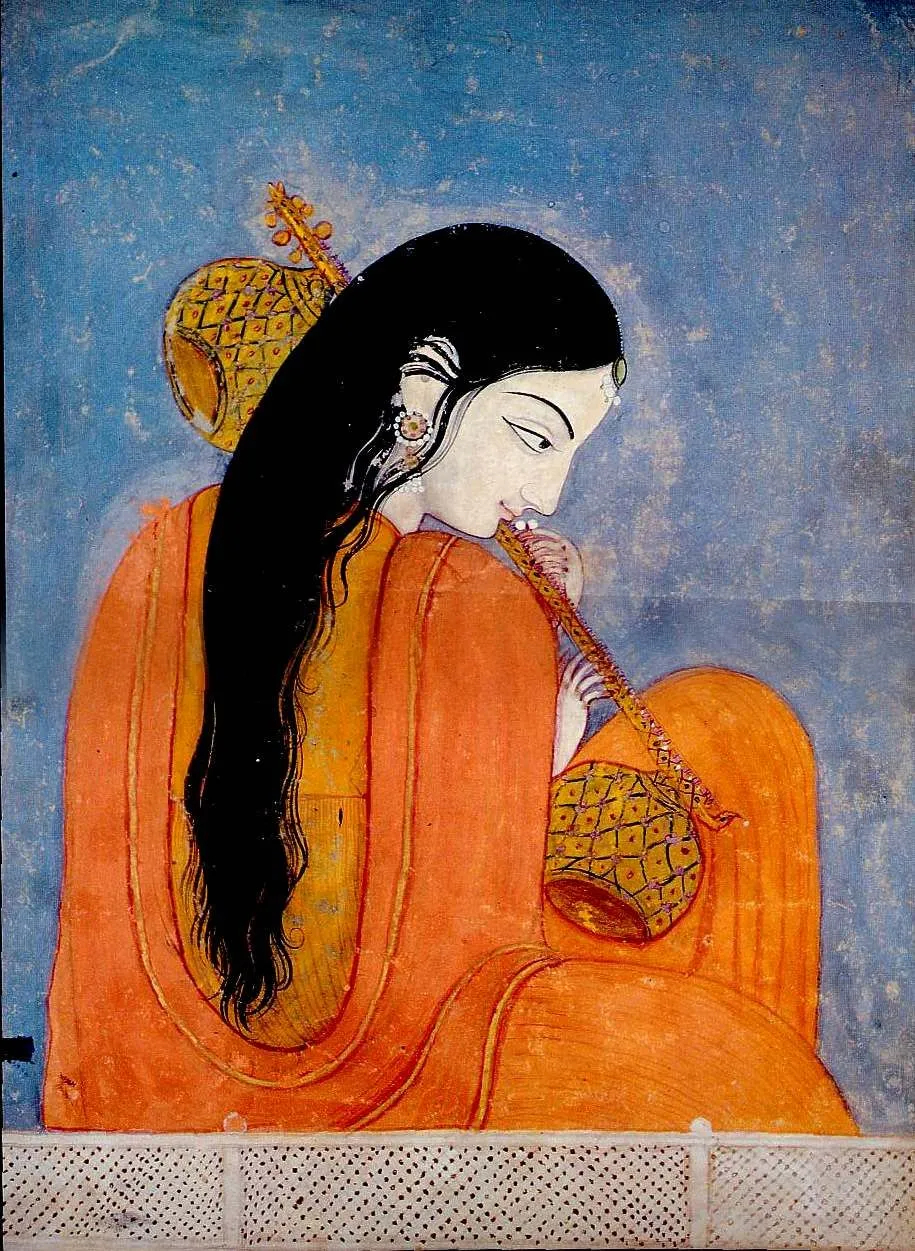
You might also explore
 AhiṃsāIndianNon-violence toward all living beings.
 Anandpur SahibIndianSri Anandpur Sahib, also referred simply as Anandpur (lit. 'city of bliss'), is a city in Rupnagar district (Ropar), on…AnekāntavādaIndianJain doctrine that reality is many-sided, so every claim is true only from some standpoint — like the blind men and the…Anubhava MantapaIndianAnubhava Mantapa, established by Basavanna in the 12th century C.E., is a religious complex located in Tipranth…ĀtmanIndianThe innermost self or soul — in Advaita, identical with Brahman.