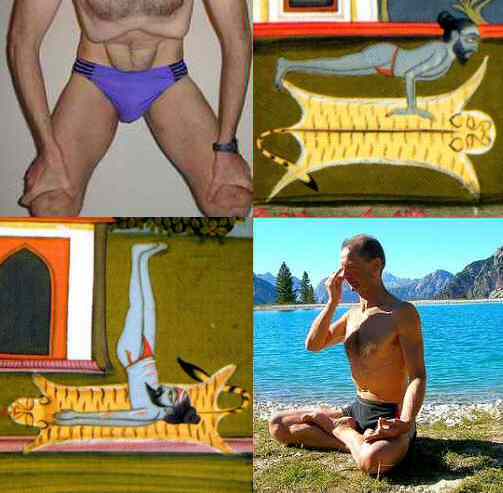
Hatha yoga
Hatha yoga (; Sanskrit: हठयोग, romanized: haṭhayoga) is a Medieval branch of yoga that uses physical techniques to try to preserve and channel vital force or energy. The Sanskrit word हठ (haṭha) literally means "force", alluding to a system of physical techniques.
Hatha yoga (; Sanskrit: हठयोग, romanized: haṭhayoga) is a Medieval branch of yoga that uses physical techniques to try to preserve and channel vital force or energy. The Sanskrit word हठ (haṭha) literally means "force", alluding to a system of physical techniques. Some hatha yoga style techniques can be traced back at least to the 1st century CE, in texts such as the Hindu Sanskrit epics and Buddhism's Pali canon. The oldest dated text so far found to describe hatha yoga, the 11th-century Amṛtasiddhi, comes from a tantric Buddhist milieu. The oldest texts to use the terminology of hatha are also Vajrayana Buddhist. Hindu hatha yoga texts appear from the 11th century onward.
Some of the early hatha yoga texts (11th–13th centuries) describe methods to raise and conserve bindu (vital force; that is, semen, and, in women, rajas, or menstrual fluid). This was seen as the physical essence of life that was constantly dripping down from the head and being lost. Two early hatha yoga techniques sought to either physically reverse this process of dripping by using gravity to trap the bindhu in inverted postures like viparītakaraṇī, or force bindu upwards through the central channel by directing the breath flow into the centre channel using mudras (yogic seals, not to be confused with hand mudras, which are gestures).
Almost all hathayogic texts belong to the Nath siddhas, and the important early ones (11th–13th centuries) are credited to Matsyendranatha and his disciple, Gorakhnath or Gorakshanath (11th century). Early Nāth works teach a yoga based on raising kuṇḍalinī through energy channels and energy centers, called Layayoga ("the yoga of dissolution"). However, other early Nāth texts, like the Vivekamārtaṇḍa, can be seen as co-opting the hatha yoga mudrās. Later Nāth as well as Śākta texts adopt the practices of hatha yoga mudras into a Saiva system, melding them with Layayoga methods, without mentioning bindu. These later texts promote a universalist yoga, available to all, "without the need for priestly intermediaries, ritual paraphernalia or sectarian initiations."
In the 20th century, a development of hatha yoga focusing particularly on asanas (the physical postures) with goals of fitness and wellbeing, rather than liberation or magical powers, became popular as a form of physical exercise. This modern form of yoga is now widely known simply as "yoga".
Earliest textual references
According to the Indologist James Mallinson, some haṭha yoga style techniques practised only by ascetics can be traced back at least to the 1st-century CE, in texts such as the Sanskrit epics (Hinduism) and the Pali canon (Buddhism). The Pali canon contains three passages in which the Buddha describes pressing the tongue against the palate for the purposes of controlling hunger or the mind, depending on the passage. However, there is no mention of the tongue being inserted further back into the nasopharynx as in true khecarī mudrā. The Buddha also used a posture where pressure is put on the perineum with the heel, similar to modern postures used to stimulate Kundalini. In the Mahāsaccaka sutta (MN 36), the Buddha mentions how physical practices such as various meditations on holding one's breath did not help him "attain to greater excellence in noble knowledge and insight which transcends the human condition." After trying these, he then sought another path to enlightenment. The term haṭha yoga was first used in the c. 3rd century Bodhisattvabhūmi, the phrase na haṭhayogena, seemingly meaning only that the bodhisattva would get his qualities "not by force".
Tantric Buddhism
The earliest mentions of haṭha yoga as a specific set of techniques are from some seventeen Vajrayana Buddhist texts, mainly tantric works from the 8th century onwards. In Puṇḍarīka's c. 1030 Vimalaprabhā commentary on the Kālacakratantra, haṭha yoga is for the first time defined within the context of tantric sexual ritual:
when the undying moment does not arise because the breath is unrestrained [even] when the image is seen by means of withdrawal (pratyahara) and the other (auxiliaries of yoga, i.e. dhyana, pranayama, dharana, anusmrti and samadhi), then, having forcefully (hathena) made the breath flow in the central channel through the practice of nada, which is about to be explained, [the yogi] should attain the undying moment by restraining the bindu [i.e. semen] of the bodhicitta in the vajra [penis] when it is in the lotus of wisdom [vagina].
While the actual means of practice are not specified, the forcing of the breath into the central channel and the restraining of ejaculation are central features of later haṭha yoga practice texts.
The c. 11th century Amṛtasiddhi is the earliest substantial text describing Haṭha yoga, though it does not use the term; it is a tantric Buddhist work, and makes use of metaphors from alchemy. A manuscript states its date as 1160. The text teaches mahābandha, mahāmudrā, and mahāvedha which involve bodily postures and breath control, as a means to preserve amrta or bindu (vital energy) in the head (the "moon") from dripping down the central channel and being burned by the fire (the "sun") at the perineum. The text also attacks Vajrayana deity yoga as ineffective. According to Mallinson, later manuscripts and editions of this text have obscured or omitted the Buddhist elements (such as the deity Chinnamasta which appears in the earliest manuscripts and was originally a Buddhist deity, only appearing in Hindu works after the 16th century). However, the earliest manuscript makes it clear that this text originated in a Vajrayana Buddhist milieu. The inscription at the end of one Amṛtasiddhi manuscript ascribes the text to Mādhavacandra or Avadhūtacandra and is "said to represent the teachings of Virūpākṣa". According to Mallinson, this figure is most likely the Buddhist mahasiddha Virupa.
Another 11th century text, Dispelling the Hindrances of Immortality, is a Tibetan ancillary to the Amṛtasiddhi. Attributed to an Indian, Yogeśvara Amoghavajra, who was living in Tibet, the text describes 108 āsana-like physical movements intended to overcome obstacles to tantric practice.
Early Hindu texts
The c. 10th century Kubjikāmatatantra anticipates haṭha yoga with its description of the raising of Kundalini, and a 6-chakra system.
Around the 11th century, techniques associated with Haṭha yoga also begin to be outlined in a series of early Hindu texts. The aims of these practices were siddhis (supranormal powers such as levitation) and mukti (liberation).
In India, haṭha yoga is associated in popular tradition with the Yogis of the Natha Sampradaya. Almost all hathayogic texts belong to the Nath siddhas, and the important ones are credited to Gorakhnath or Gorakshanath (c. early 11th century), the founder of the Nath Hindu monastic movement in India, though those texts post-date him. Goraknath is regarded by the contemporary Nath-tradition as the disciple of Matsyendranath (early 10th century), who is celebrated as a saint in both Hindu and Buddhist tantric and haṭha yoga schools, and regarded by tradition as the founder of the Natha Sampradaya. Early haṭha yoga works include:
The Amaraugha (12th century, attributed to Goraknath) describes three bandhas to lock the vital energy into the body, as in the Amṛtasiddhi, but adding the raising of Kundalinī.
The Dattātreyayogaśāstra, a Vaisnava text probably composed in the 13th century, is the earliest text which provides a systematized form of Haṭha yoga, and the earliest to place its yoga techniques under the name Haṭha. It teaches an eightfold yoga identical with Patañjali's 8 limbs that it attributes to Yajnavalkya and others as well as eight mudras that it says were undertaken by the rishi Kapila and other ṛishis. The Dattātreyayogaśāstra teaches mahāmudrā, mahābandha, khecarīmudrā, jālandharabandha, uḍḍiyāṇabandha, mūlabandha, viparītakaraṇī, vajrolī, amarolī, and sahajolī.
The Vivekamārtaṇḍa, an early Nāth text (13th century) attributed to Goraknath, contemporaneous with the Dattātreyayogaśāstra, teaches nabhomudrā (i.e. khecarīmudrā), mahāmudrā, viparītakaraṇī and the three bandhas. It also teaches six chakras and the raising of Kundalinī by means of "fire yoga" (vahniyogena).
The Gorakṣaśataka, a Nāth text of the same period (13th century), teaches śakticālanīmudrā ("stimulating Sarasvatī") along with the three bandhas. "Stimulating Sarasvat" is done by wrapping the tongue in a cloth and pulling on it, stimulating the goddess Kundalinī who is said to dwell at the other end of the central channel. This text does not mention the preservation of bindu, but merely says that liberation is achieved by controlling the mind through controlling the breath.
The ̣Śārṅgadharapaddhati, an anthology of verses on a wide range of subjects compiled by Sharngadharain 1363, describes Haṭha yoga including ̣the Dattātreyayogaśāstra's teachings on five mudrās.
Adapted from the Wikipedia article Hatha yoga, available under CC BY-SA 4.0.
Connections
Proposed by
1
You might also explore
 Beauty★Is beauty in the object or the eye of the beholder?
 Consciousness★Subjective experience — the felt "what-it-is-like" of being a mind.DeterminismEvery event is necessitated by prior events and the laws of nature.Dialectic★Reasoning through opposition: from Socratic dialogue to Hegel's movement of contradiction and resolution.
 Free will★Are our choices genuinely up to us, or determined by prior causes?IdealismReality is fundamentally mental or mind-dependent.