Gödel logic
In mathematical logic, Gödel logics, sometimes referred to as Dummett logics or Gödel–Dummett logics, is a family of finite- or infinite-valued logics in which the sets of truth values V are closed subsets of the unit interval [0,1] containing both 0 and 1. Different such sets V in general determine different Gödel log
In mathematical logic, Gödel logics, sometimes referred to as Dummett logics or Gödel–Dummett logics, is a family of finite- or infinite-valued logics in which the sets of truth values V are closed subsets of the unit interval [0,1] containing both 0 and 1. Different such sets V in general determine different Gödel logics.
Gödel logics have several alternative definitions. Specifically, Gödel logics are:
logics of linearly-ordered Heyting algebras
logics of (classes of) linearly ordered and countable intuitionistic Kripke structures with constant domains
logics of relative comparison, in contrast to Łukasiewicz logic, which is a logic of absolute comparison or metric comparison
The concept is named after Kurt Gödel and Michael Dummett.
Propositional
Given a propositional Gödel logic, an interpretation of it is defined as follows:
Each propositional variable p is assigned a truth value I[p]∈V.
I[A∨B]=max(I[A],I[B]).
I[A∧B]=min(I[A],I[B]).
I[A→B]={1 if I[A]≤I[B],I[B] if I[A]>I[B]
I[⊥]=0
I[¬A]:=I[A→⊥]={1 if I[A]=0,0 else.
I[⊤]:=I[¬⊥]:=I[⊥→⊥]=1
For this logic, there is usually also another unary logical connective Δ, such that a model of it must satisfyI(ΔA)={1 if I[A]=1,0 else.and a binary logical connective ≺ defined by A≺B:=(B→A)→B, which impliesI[A≺B]={1 if I[A]<I[B],I[B] if I[A]≥I[B]Note that for this, we do not need V to be a closed set, only that V contain 0,1.
First-order
Given a first-order logic, it corresponds to a first-order Gödel logic. An interpretation of it is defined essentially the same as the first-order logic:
There is a nonempty set M, the universe of the interpretation.
For each variable symbol v, there is an element vI∈M.
For each k-ary function symbol f, there is a function fI:Mk→M.
For each k-ary relation symbol R, there is a function RI:Mk→V.
For each term f(t1,…,tk), its interpretation is f(t1,…,tk)I:=fI(t1I,…,tkI).
For each atomic formula R(t1,…,tk), its interpreted truth value is I(R(t1,…,tk)):=RI(t1I,…,tkI).
The propositional logic connectives works the same as before.
For each ∀x,A, its interpreted truth value is I(∀x,A):=infm∈MIm/x, where I[m/x] is defined as the interpretation generated by setting xI to m instead.
For each ∃x,A, its interpreted truth value is I(∃x,A):=supm∈MIm/x,
Note that for this, we do need V to be a closed set, since otherwise the quantified formulas is not guaranteed to have a truth value.
Entailment
For any set Γ of formulas, and any interpretation I, define I(Γ):=infA∈ΓI(A), with the special case that I(∅︀)=1.
We say that Γ⊨VA iff for any interpretation I into V, I(Γ)≤I(A). In particular, ⊨VA iff for any interpretation I into V, I(A)=1.
Syntax
In 1959, Michael Dummett showed that infinite-valued propositional Gödel logic can be axiomatised by adding the axiom schema
(A→B)∨(B→A)
to intuitionistic propositional logic.
Adapted from the Wikipedia article Gödel logic, available under CC BY-SA 4.0.
Connections
Proposed by
2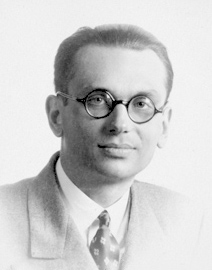

You might also explore
 Gödel's loopholeAmericasGödel's loophole is a supposed "inner contradiction" in the Constitution of the United States postulated in 1947 by the…Logical harmonyModern EuropeanLogical harmony, a name coined by Michael Dummett, is a property on the rules of inference that a given logical system…