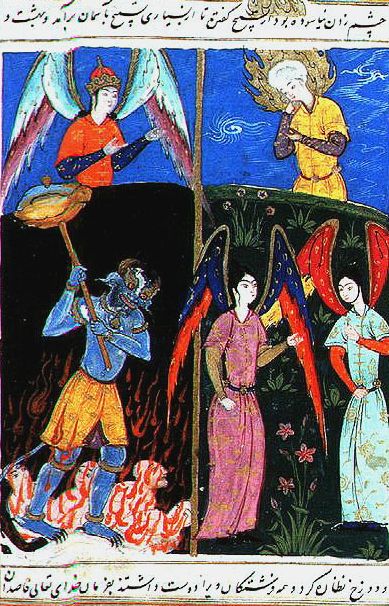
Afterlife
The afterlife or life after death is a speculation concerning existence after death, in which the essential part of an individual's stream of consciousness or identity continues to exist after the death of their physical body. The surviving essential aspect varies between belief systems; it may be some partial element,
The afterlife or life after death is a speculation concerning existence after death, in which the essential part of an individual's stream of consciousness or identity continues to exist after the death of their physical body. The surviving essential aspect varies between belief systems; it may be some partial element, or the entire soul or spirit, which carries with it one's personal identity.
In some views, this continued existence takes place in a supernatural realm, while in others, the individual may be reborn into this world and begin the life cycle over again in a process referred to as reincarnation, likely with no memory of what they have done in the past. In this latter view, such rebirths and deaths may take place over and over again continuously until the individual gains entry to a spiritual realm or otherworld. Major views on the afterlife derive from religion, esotericism, and metaphysics.
Some belief systems, such as many pagan ones, hold that the dead go to a specific place (e.g., paradise or the underworld) after death, as determined by their god or gods, based on their actions and beliefs during life. In contrast, in systems of reincarnation, such as those of the Indian religions, the nature of the continued existence is determined directly by the actions of the individual in their ended life.
Different metaphysical models
Theist immortalists generally believe some afterlife awaits people when they die. Members of some generally non-theistic religions believe in an afterlife without reference to a deity.
Religions, such as many various pagan belief systems, and some versions of Abrahamic religions, believe in the soul's existence in another world, while others, like many forms of Hinduism and Buddhism, believe in reincarnation. In both cases, these religions hold that one's status in the afterlife is determined by their conduct during life.
Reincarnation
Reincarnation is the philosophical or religious conjecture that an aspect of a living being starts a new life in a different physical body or form after each death. This concept is also known as rebirth or transmigration and is part of the Saṃsāra/karma doctrine of cyclic existence. Saṃsāra refers to the process in which souls (jivass) go through a sequence of human and animal forms. Traditional Hinduism teaches that each life helps the soul (jivas) learn until the soul becomes purified to the point of liberation. All major Indian religions—namely Buddhism, Hinduism, Jainism, and Sikhism—have their own interpretations of the idea of reincarnation. The human idea of reincarnation is found in many diverse ancient cultures, and a belief in rebirth/metempsychosis was held by historic Greek figures, such as Pythagoras and Plato. It is a common belief of various ancient and modern religions, such as Spiritism, theosophy, and Eckankar. It is found as well in many tribal societies around the world, in places such as Australia, East Asia, Siberia, and South America.
Although the majority of denominations within the Abrahamic religions do not believe that individuals reincarnate, particular groups within these religions do refer to reincarnation; these groups include the mainstream historical and contemporary followers of Kabbalah, the Cathars, Alawites, the Druze, and the Rosicrucians. The historical relations between these sects and the beliefs about reincarnation that were characteristic of Neoplatonism, Orphism, Hermeticism, Manicheanism, and Gnosticism of the Roman era, as well as the Indian religions have been the subject of scholarly research. Unity Church and its founder Charles Fillmore teach reincarnation.
Rosicrucians speak of a life review period occurring immediately after death and before entering the afterlife's planes of existence (before the silver cord is broken), followed by a judgment, more akin to a final review or end report over one's life.
Heaven and hell
Heaven, the heavens, Seven Heavens, pure lands, Tian, Jannah, Valhalla, or the Summerland, is a common religious, cosmological, or transcendent place where beings such as gods, angels, jinn, saints, or venerated ancestors are said to originate, be enthroned, or live. According to the beliefs of some religions, heavenly beings can descend to earth or incarnate, and earthly beings can ascend to heaven in the afterlife, or in exceptional cases, enter heaven alive.
Heaven is often described as a "higher place", the holiest place, a paradise, in contrast to hell or the underworld or the "low places", and universally or conditionally accessible by earthly beings according to various standards of divinity, goodness, piety, faith or other virtues or right beliefs or the will of God. Some believe in the possibility of a heaven on Earth in a world to come.
In Hinduism, heaven is termed Svarga loka. There are seven positive regions and seven negative regions to which the soul can go after death. After completing its stay in the respective region, the soul is subjected to rebirth in different living forms according to its karma. This cycle can be broken after a soul achieves Moksha or Nirvana. Any place of existence, either of humans, souls or deities, outside the tangible world (heaven, hell, or other) is referred to as otherworld.
Hell, in many religious and folkloric traditions, is a place or state of punishment for souls after death. Religions with a linear divine history sometimes depict hell as eternal, while religions with a cyclic history usually depict a hell as an intermediary period between incarnations. Typically, these traditions locate hell in another dimension or under the Earth's surface and often include entrances to hell from the land of the living. Traditions that do not conceive of the afterlife as a place of punishment or reward merely describe hell as an abode of the dead, the grave, or a neutral place or state (for example, Sheol or Hades).
Ancient Egyptian religion
The afterlife played an important role in Ancient Egyptian religion, and its belief system is one of the earliest known in recorded history. When the body died, parts of its soul known as ka (body double) and the ba (personality) would go to the afterlife, which is known to Egyptians as the "Kingdom of the Dead". To sustain the ka, the living provided offerings of food and drink, which were believed to nourish the ka's spiritual needs.
The ka would reunite with the deceased's spirit and enjoy eternal life in the Fields of Aaru, a paradise reserved for the righteous. However, Osiris demands work as restitution for the protection he provides. Statues were placed in the tombs to serve as substitutes for the deceased.
Arriving at one's reward in afterlife was a demanding ordeal, requiring a sin-free heart and the ability to recite the spells, passwords, and formulae of the Book of the Dead. In the Hall of Two Truths, the deceased's heart was weighed against the Shu feather of truth and justice taken from the headdress of the goddess Maʽat. If the heart was lighter than the feather, they could pass on, but if it were heavier, they would be devoured by the demon Ammit.
Egyptians also believed that being mummified and put in a sarcophagus (an ancient Egyptian "coffin" carved with complex symbols and designs, as well as pictures and hieroglyphs) was the only way to have an afterlife. What are referred to as the Coffin Texts are inscribed on a coffin and serve as a guide for the challenges in the afterlife. The Coffin Texts are more or less a duplication of the Pyramid Texts, which would serve as a guide for Egyptian pharaohs or queens in the afterlife. Only if the corpse had been properly embalmed and entombed in a mastaba could the dead live again in the Fields of Yalu and accompany the Sun on its daily ride. Due to the dangers the afterlife posed, the Book of the Dead was placed in the tomb with the body as well as food, jewelry, and 'curses'. They also used the "opening of the mouth".
Ancient Egyptian civilization was based on religion. The belief in the rebirth after death became the driving force behind funeral practices; for them, death was a temporary interruption rather than complete cessation of life. Eternal life could be ensured by means like piety to the gods, preservation of the physical form through mummification, and the provision of statuary and other funerary equipment. Each human consisted of the physical body, the ka, the ba, and the akh. The Name and Shadow were also living entities. To enjoy the afterlife, all these elements had to be sustained and protected from harm.
On 30 March 2010, a spokesman for the Egyptian Culture Ministry claimed it had unearthed a large red granite door in Luxor with inscriptions by User, a powerful adviser to the 18th Dynasty Queen Hatshepsut who ruled between 1479 BC and 1458 BC, the longest of any woman. It believes the false door is a 'door to the Afterlife'. According to the archaeologists, the door was reused in a structure in Roman Egypt.
Ancient Greek and Roman religions
The Greek god Hades is known in Greek mythology as the king of the underworld, a place where souls live after death. The Greek god Hermes, the messenger of the gods, would take the dead soul of a person to the underworld (sometimes called Hades or the House of Hades). Hermes would leave the soul on the banks of the River Styx, the river between life and death.
Charon, also known as the ferryman, would take the soul across the river to Hades, if the soul had gold: upon burial, the family of the dead soul would put coins under the deceased's tongue. Once crossed, the soul would be judged by Aeacus, Rhadamanthus and King Minos. The soul would be sent to Elysium, Tartarus, or Asphodel Fields. The Elysian Fields were for the ones that lived pure lives. It consisted of green fields, valleys and mountains, everyone there was peaceful and contented, and the Sun always shone there. Tartarus was for the people that blasphemed against the gods or were rebellious and consciously evil. In Tartarus, the soul would be punished by being burned in lava or stretched on racks. The Asphodel Fields were for a varied selection of human souls including those whose sins equaled their goodness, those who were indecisive in their lives, and those who were not judged.
Some heroes of Greek legend are allowed to visit the underworld. The Romans had a similar belief system about the afterlife, with Hades becoming known as Pluto. In the Ancient Greek myth about the Labours of Heracles, the hero Heracles had to travel to the underworld to capture Cerberus, the three-headed guard dog, as one of his tasks.
In Dream of Scipio, Cicero describes what seems to be an out-of-body experience of the soul traveling high above the Earth, looking down at the small planet from far away.
In Book VI of Virgil's Aeneid, the hero, Aeneas, travels to the underworld to see his father. By the River Styx, he sees the souls of those not given a proper burial, forced to wait by the river until someone buries them. While down there, along with the dead, he is shown the place where the wrongly convicted reside, the fields of sorrow where those who committed suicide and now regret it reside, including Aeneas' former lover, the warriors and shades, Tartarus (where the Titans and powerful non-mortal enemies of the Olympians reside) where he can hear the groans of the imprisoned, the palace of Pluto, and the fields of Elysium where the descendants of the divine and bravest heroes reside. He sees the river of forgetfulness, Lethe, which the dead must drink to forget their life and begin anew. Lastly, his father shows him all of the future heroes of Rome who will live if Aeneas fulfills his destiny in founding the city.
Other eschatological views populate the Ancient Greek worldview; for instance, Plato argued for reincarnation in several dialogues, including the Timaeus.
Norse religion
The Poetic and Prose Eddass, the oldest sources for information on the Norse concept of the afterlife, vary in their description of the several realms that are described as falling under this topic. The most well-known are:
Valhalla: (lit. "Hall of the Slain" i.e. "the Chosen Ones") Half the warriors who die in battle join the god Odin who rules over a majestic hall called Valhalla in Asgard.
Fólkvangr: (lit. 'Field of the Host') The other half join the goddess Freyja in a great meadow known as Fólkvangr.
Niflhel: (lit. "The Dark" or "Misty Hel"). Niflhel is believed to be a place of punishment, where the oathbreakers and other wicked people go.
Hel: (lit. 'The Covered Hall'). Hel was the daughter of god Loki and her kingdom was located in downward and northward. Snorri Sturluson's Gylfaginning tells of evil men going to Niflhel via Hel.
Celtic religion
In Celtic mythology, the Otherworld is the realm of the deities and possibly also the dead. It is described either as a parallel world that exists alongside our own, or as a heavenly land beyond the sea or under the earth. In Gaelic and Brittonic myth, it is usually a supernatural realm of everlasting youth, beauty, health, abundance and joy.
Judaism
Sheol
Sheol, in the Hebrew Bible, is a place of darkness (Job 10:21–22) to which all the dead go—both the righteous and the unrighteous—regardless of the moral choices made in life (Book of Ezekiel 32; Isaiah 16; Job 30:23), a place of stillness (Psalm 88:13, 94:17; Ecclesiastes 9:10), at the longest possible distance from Heaven (Job 11:8; Amos 9:2; Psalm 139:8).
The inhabitants of Sheol were the "shades" (rephaim), entities without personality or strength. Under some circumstances, they were thought to be able to be contacted by the living (as the Witch of Endor contacts the shade of Samuel for Saul), but such practices were forbidden (Deuteronomy 18:10).
Whereas the Hebrew Bible appears to describe Sheol as the permanent place of the dead, in the Second Temple period (roughly 500 BC – 70 AD), a more diverse set of ideas developed. In some texts, Sheol is considered to be the home of both the righteous and the wicked, separated into respective compartments; in others, it was considered a place of punishment, meant for the wicked dead alone. When the Hebrew scriptures were translated into Greek in ancient Alexandria around 200 BC, the word "Hades" (the Greek underworld) was substituted for Sheol. This is reflected in the New Testament where Hades is both the underworld of the dead and the personification of the evil it represents.
World to Come
The Talmud offers several thoughts relating to the afterlife. After death, the soul is brought for judgment. Those who have led pristine lives immediately enter the Olam Haba, or world to come. Most do not enter the world to come immediately but experience a period of reflection on their earthly actions and are made aware of what they have done wrong. Some view this period as "reschooling", with the soul gaining wisdom as one's errors are reviewed. Others view this period as spiritual discomfort caused by past wrongs. At the end of this period, not longer than one year, the soul then takes its place in the world to come. Although discomforts are made part of certain Jewish conceptions of the afterlife, the concept of eternal damnation is not a tenet of the Jewish afterlife. According to the Talmud, extinction of the soul is reserved for a far smaller group of malicious and evil leaders whose very evil deeds go way beyond norms or who lead large groups of people to utmost evil. This is also part of Maimonides' 13 principles of faith.
Maimonides describes the Olam Haba in spiritual terms, relegating the prophesied physical resurrection to the status of a future miracle unrelated to the afterlife or the Messianic era. According to Maimonides, an afterlife continues for the soul of every human being: soul now separated from the body in which it was "housed" during its earthly existence.
The Zohar describes Gehenna not as a place of punishment for the wicked but as a place of spiritual purification for souls.
Reincarnation in Jewish tradition
Although there is no reference to reincarnation in the Talmud or any prior writings, according to rabbis such as Avraham Arieh Trugman, reincarnation is recognized as being part and parcel of Jewish tradition. Trugman explains that it is through oral tradition that the meanings of the Torah, its commandments, and stories are known and understood. The classic work of Jewish mysticism, the Zohar, is quoted liberally in all Jewish learning; in the Zohar, the idea of reincarnation is mentioned repeatedly. Trugman states that in the last five centuries, the concept of reincarnation, which until then had been a much-hidden tradition within Judaism, was given open exposure.
Shraga Simmons commented that within the Bible itself, the idea [of reincarnation] is intimated in Deut. 25:5–10, Deut. 33:6 and Isaiah 22:14, 65:6.
Yirmiyahu Ullman wrote that reincarnation is an "ancient, mainstream belief in Judaism". The Zohar makes frequent and lengthy references to reincarnation. Onkelos, a righteous convert and authoritative commentator of the same period, explained the verse, "Let Reuben live and not die ..." (Deuteronomy 33:6) to mean that Reuben should merit the world to come directly and not have to die again as a result of being reincarnated. Torah scholar, commentator and kabbalist, Nachmanides (Ramban 1195–1270), attributed Job's suffering to reincarnation, as hinted in Job's saying "God does all these things twice or three times with a man, to bring back his soul from the pit to... the light of the living' (Job 33:29–30)."
Reincarnation, called gilgul, became popular in folk belief and is found in much Yiddish literature among Ashkenazi Jews. Among a few kabbalists, it was posited that some human souls could end up being reincarnated into non-human bodies. These ideas were found in several kabbalistic works from the 13th century and among many mystics in the late 16th century. Martin Buber's early collection of stories of the Baal Shem Tov's life includes several that refer to people reincarnating in successive lives.
Among well-known (generally non-kabbalist or anti-kabbalist) rabbis who rejected the idea of reincarnation are Saadia Gaon, David Kimhi, Hasdai Crescas, Yedayah Bedershi (early 14th century), Joseph Albo, Abraham ibn Daud, the Rosh and Leon de Modena. Saadia Gaon, in Emunoth ve-Deoth (Hebrew: "beliefs and opinions"), concludes Section VI with a refutation of the doctrine of metempsychosis (reincarnation). While rebutting reincarnation, Saadia Gaon further states that Jews who hold to reincarnation have adopted non-Jewish beliefs. By no means do all Jews today believe in reincarnation, but belief in reincarnation is not uncommon among many Jews, including Orthodox.
Other well-known rabbis who are reincarnationists include Yonassan Gershom, Abraham Isaac Kook, Talmud scholar Adin Steinsaltz, DovBer Pinson, David M. Wexelman, Zalman Schachter, and many others. Reincarnation is cited by authoritative biblical commentators, including Ramban (Nachmanides), Menachem Recanti, and Rabbenu Bachya.
Among the many volumes of Yitzchak Luria, most of which come down from the pen of his primary disciple, Chaim Vital, are insights explaining issues related to reincarnation. His Shaar HaGilgulim ("The Gates of Reincarnation") is a book devoted exclusively to the subject of reincarnation in Judaism.
Rabbi Naftali Silberberg of The Rohr Jewish Learning Institute notes that "Many ideas that originate in other religions and belief systems have been popularized in the media and are taken for granted by unassuming Jews."
Christianity
Mainstream Christianity professes belief in the Nicene Creed, and English versions of the Nicene Creed in current use include the phrase: "We look for the resurrection of the dead, and the life of the world to come."
Adapted from the Wikipedia article Afterlife, available under CC BY-SA 4.0.
Connections
Proposed by
1You might also explore
 NominalismModern EuropeanIn metaphysics, nominalism is the view that universals and abstract objects do not actually exist other than being…PhenomenalismModern EuropeanIn metaphysics, phenomenalism is the view that physical objects cannot justifiably be said to exist as…
 Philosophy of perceptionModern EuropeanThe philosophy of perception is concerned with the nature of perceptual experience and the status of perceptual data…Sense dataModern EuropeanThe theory of sense data is a view in the philosophy of perception, popularly held in the early 20th century by…A Critique of Pure ToleranceModern EuropeanA Critique of Pure Tolerance is a 1965 book by the philosopher Robert Paul Wolff, the sociologist Barrington Moore Jr.…A History of Philosophy (Copleston)Modern EuropeanA History of Philosophy is a history of Western philosophy written by the English Jesuit priest Frederick Charles…